
Do I Have Royal Blood in Me Quiz
How the Scales are Structured
Who Usually Takes This Test?
See How You Compare
Below is a preview of how scores are typically distributed across each scale.
Example Questions From the Test
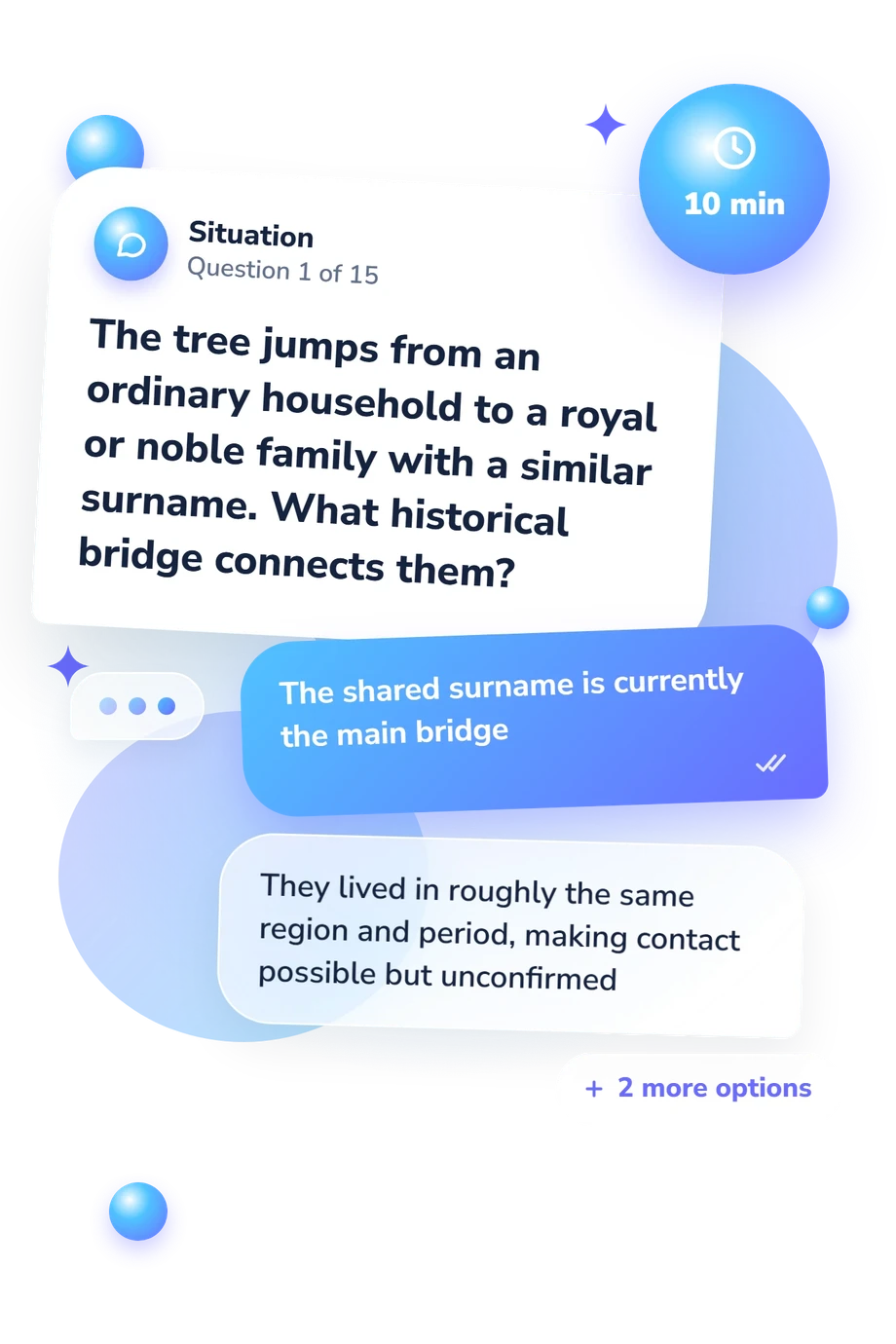
- The shared surname is currently the main bridge
- They lived in roughly the same region and period, making contact possible but unconfirmed
- A documented marriage, parent-child relationship, or equivalent record connects the two households
- Property, service, occupation, associates, or local records create a specific plausible connection that still needs proof
- I compare its claims with records and have independently verified the most important links
- I add the person when several public trees repeat the same relationship
- I treat it as a lead only and independently verify each relationship before relying on it
- I check whether the dates and places look reasonable, even if I do not obtain the cited records
- The version that preserves the royal connection is currently used
- Both versions are noted, and some additional sources have been checked, but the conflict remains
- The more detailed or more frequently copied version is preferred
- The records' origins, dates, informants, and other evidence have been compared, with the conclusion and uncertainty documented
Do I Have Royal Blood in Me Quiz - Description and methodology of the test
People investigating a family story about royal or noble descent can use this assessment to distinguish a promising lead from a traceable genealogical route. The Do I Have Royal Blood in Me Quiz gives a structured picture of historical fit, the documented line, and the dependability of its supporting sources. The result points toward the next evidence to examine. As a royal ancestry quiz, it supports focused family-history research.
What This Assessment Explores
This assessment tests whether a royal-family claim forms a traceable route rather than resting on a surname, crest, copied tree, or family story. Items address parent-child links, identity changes, migration, dates, royal records, DNA matches, and descent versus inherited status. This Do I Have Royal Blood Quiz helps family historians check a tradition.
The result dimensions are:
- Historical Consistency (0-15) measures fit among dates, places, identities, relationships, and historical context: Major questions (0-5), Plausible framework (6-10), Coherent context (11-15).
- Lineage Documentation (0-15) measures how fully each generational link is documented: Early trail (0-5), Partial chain (6-10), Strong paper trail (11-15).
- Source Reliability (0-15) measures the quality and independence of support: Unverified leads (0-5), Mixed support (6-10), Carefully corroborated (11-15).
Together, the profile shows whether the story is a lead, partly supported route, or documented case, and points to the next gap.
Methodology and Evidence Base
Each item presents a genealogy situation with four choices. Options distinguish assumption-based claims from documented or partly supported research, asking you to rate current evidence rather than recall facts.
The result provides one score per dimension, but the questionnaire is not presented as standardized: no validated answer-to-point formula, norms, or clinical cutoffs are published. The bands organize evidence feedback, not probabilities of royal descent; a result can set priorities without proving a relationship.
The questionnaire is conceptually consistent with Gateway Ancestors (Taylor and Murphy, n.d.), which treats a traceable route as requiring evidence rather than a surname association. The Board for Certification of Genealogists' standards support citations, source analysis, conflict resolution, and reasoned conclusions. The College of Arms separates inherited arms from surname claims, while Kluge's 2023 analysis emphasizes comparing relationships. It is an online self-reflection tool, not an adaptation of those sources.
Its value as a royal lineage test grows after original-record research and corroboration. Family lore, copied trees, ethnicity estimates, incomplete records, mistaken identities, and confirmation bias shape self-reports; treat the profile as a research map, not documentary proof.
- Taylor, Nathaniel Lane, and Nathan W. Murphy. "Gateway Ancestors." The Hereditary Society Community, accessed September 21, 2026.
- Board for Certification of Genealogists. Genealogy Standards, Second Edition Revised. Nashville, TN: Ancestry, 2021. ISBN 9781684423521.
- College of Arms. "Proving a Right to Arms." College of Arms, accessed September 21, 2026.
- Kluge, Arnold G. "Genealogical Systematics." Genealogy 7, no. 1 (2023): 11. 10.3390/genealogy7010011.
Updated: