
Dirty Would You Rather Quiz
How the Scales are Structured
Who Usually Takes This Test?
See How You Compare
Below is a preview of how scores are typically distributed across each scale.
Example Questions From the Test
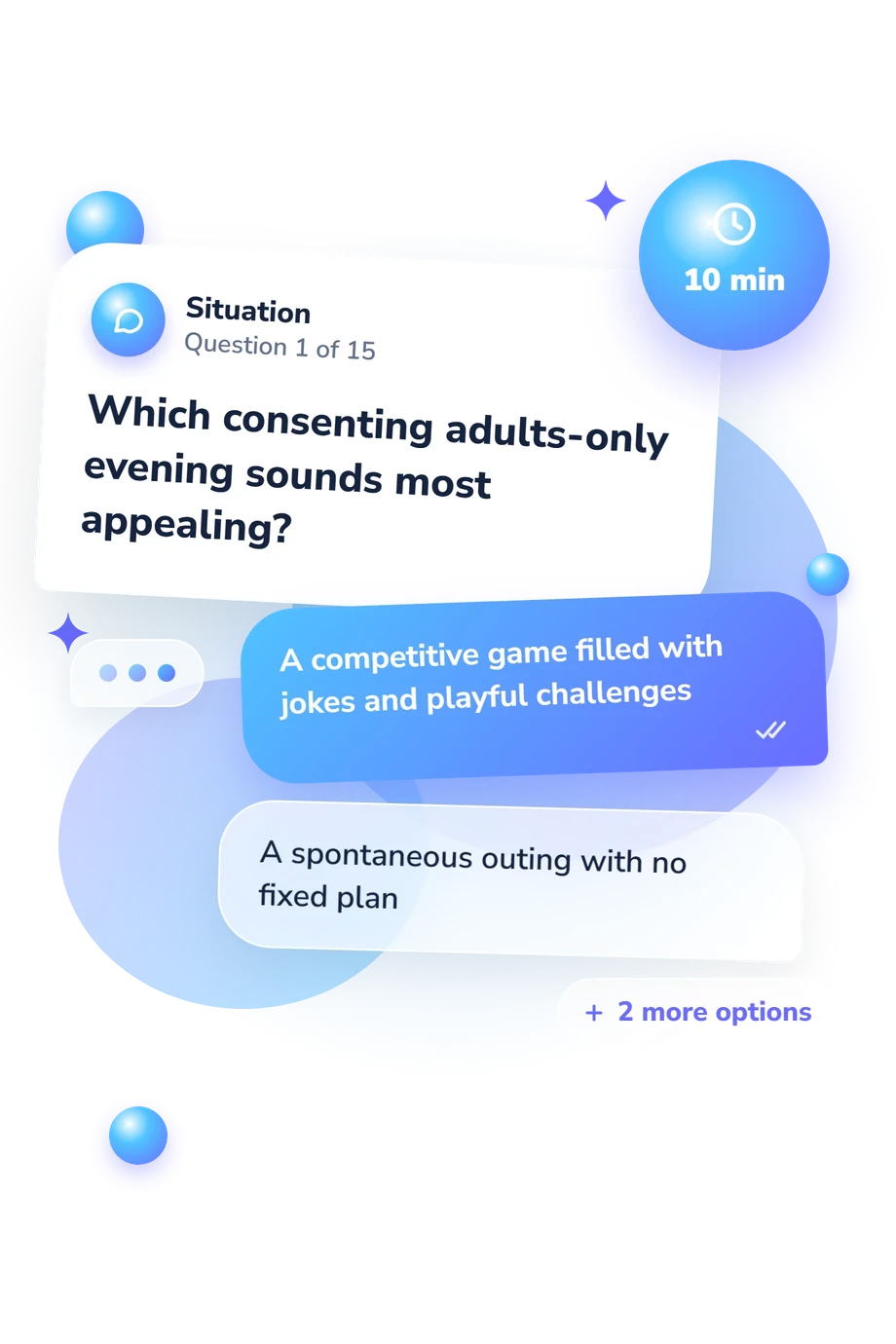
- A competitive game filled with jokes and playful challenges
- A spontaneous outing with no fixed plan
- A dramatic conversation about bold fantasies
- A candlelit talk that gradually turns into lingering affection
- Choosing between two familiar favorites
- Choosing between two affectionate confessions
- Choosing between two competitive teasing games
- Choosing between two new fantasies or imagined roles
- An unplanned moment where spontaneity does the work
- A bright, playful setting that keeps things light
- A dramatic setup that makes mutual desire obvious
- Soft music, focused attention, and plenty of anticipation
Dirty Would You Rather Quiz - Description and methodology of the test
Consenting adults can use this questionnaire to explore what makes flirtation feel exciting. Wanting to discuss intimate preferences without judging experience, you can use the Dirty Would You Rather Questions Quiz for structured reflection. It reveals preference patterns rather than judging experience or relationship quality. As a quiz about dirty Would You Rather choices, it supports conversations about chemistry, boundaries, and comfort.
What This Assessment Explores
Rather than measuring sexual behavior or relationship quality, the questionnaire explores consensual chemistry that feels engaging. Its choices contrast familiarity with novelty, teasing with direct desire, and affection with anticipation. The test gives adults language for discussing preferences through a quiz built around sexually themed Would You Rather questions, without ranking one style above another.
The result has three preference dimensions:
- Bold Adventure (0-15) reflects novelty and spontaneity: Light Affinity (0-5) favors familiarity, Selective Explorer (6-10) welcomes novelty with trust, and Adventurous Charge (11-15) seeks imaginative possibilities.
- Playful Tease (0-15) reflects cheeky banter: Light Affinity (0-5) favors sincerity, Flexible Flirt (6-10) enjoys playful tension, and Teasing Spark (11-15) centers clever dares.
- Romantic Heat (0-15) reflects affection-led desire: Light Affinity (0-5) prefers less buildup, Warm Connection (6-10) values affection, and Intimate Glow (11-15) emphasizes closeness and anticipation.
Methodology and Scientific Basis
Each item presents four adults-only, consensual alternatives. Choose the option that best matches your preference; there is no correct answer. The result compares scores generated by your selections across the three dimensions: the highest indicates your strongest affinity, while scores within one point are read as a blended profile. As a sexually themed would-you-rather quiz, the format turns abstract preferences into concrete romantic scenarios.
Methodologically, the questionnaire is conceptually consistent with Baxter (1992), whose work links intimate play with closeness, risk management, and interactional functions. It is also conceptually consistent with Hall and colleagues’ Flirting Styles Inventory, Kalichman and colleagues’ work on sexual sensation seeking, and the Sexual Desire Inventory developed by Spector, Carey, and Steinberg. These sources provide conceptual context and related evidence, but this online questionnaire is neither an adaptation nor a validated form of those instruments.
Treat the result as a self-report snapshot: mood, relationship context, self-awareness, or candor may affect scores, so they describe responses rather than establish a fixed trait or predict behavior. Read the profile alongside your comfort, boundaries, and communication with a partner.
- Baxter, Leslie A. (1992). Forms and Functions of Intimate Play in Personal Relationships. Human Communication Research, 18(3), 336-363. 10.1111/j.1468-2958.1992.tb00556.x
- Kalichman, S. C., Johnson, J. R., Adair, V., Rompa, D., Multhauf, M., & Kelly, J. A. (1994). Sexual sensation seeking: scale development and predicting AIDS-risk behavior among homosexually active men. Journal of Personality Assessment, 62(3), 385-397. 10.1207/s15327752jpa6203_1
- Hall, Jeffrey A., Carter, Steve, Cody, Michael J., & Albright, Julie M. (2010). Individual Differences in the Communication of Romantic Interest: Development of the Flirting Styles Inventory. Communication Quarterly, 58(4), 365-393. 10.1080/01463373.2010.524874
- Spector, I. P., Carey, M. P., & Steinberg, L. (1996). The sexual desire inventory: development, factor structure, and evidence of reliability. Journal of Sex & Marital Therapy, 22(3), 175-190. 10.1080/00926239608414655
Updated: