
Diploids Quiz
How the Scales are Structured
Who Usually Takes This Test?
See How You Compare
Below is a preview of how scores are typically distributed across each scale.
Example Questions From the Test
- The sporophyte, which develops from the zygote
- The gametophyte, which produces gametes by meiosis
- The gamete generation, which begins before fertilization
- The spore, which contains two homologous chromosome sets
- They contain chromosomes without any DNA.
- They contain one complete chromosome set rather than two.
- Their chromosomes cannot replicate.
- They carry only sex chromosomes.
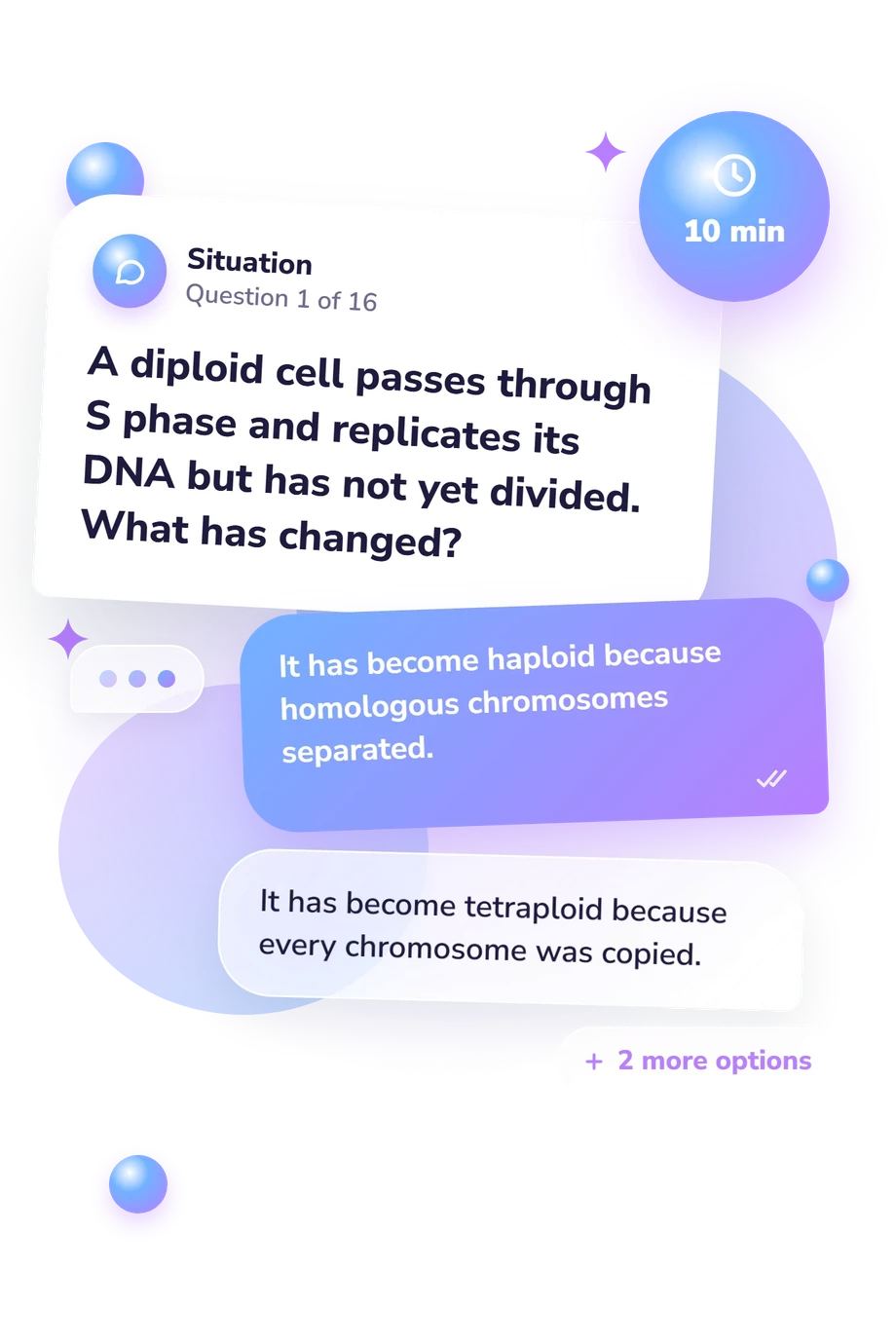
- It has 20 unduplicated chromosomes and remains diploid.
- It has 10 duplicated chromosomes and is haploid.
- It has 10 unduplicated chromosomes and is diploid.
- It has 20 duplicated chromosomes and is tetraploid.
Diploids Quiz - Description and methodology of the test
Students who want to check whether chromosome-set concepts are secure can use this diploid knowledge quiz as a focused biology review. The Diploids Quiz is suited to learners preparing for coursework, revision, or independent study, and its result shows how well they understand and apply core diploid concepts. It turns common areas of confusion about chromosome sets into a clear starting point for further practice.
What This Assessment Explores
The assessment separates chromosome-set number from DNA amount when replication or division changes one without changing the other. It applies those ideas to meiosis, mitosis, fertilization, gametes, homologous pairs, aneuploidy, and plant life cycles. A diploid cell quiz can expose gaps that term memorization misses.
The result is reported as Diploids Knowledge (0-16), with one point for each correct answer. Foundations to build covers 0-6, Developing knowledge covers 7-12, and Strong knowledge covers 13-16.
These themes explain the score:
- Chromosome sets show whether you identify haploid and diploid complements.
- Replication and division show whether you separate DNA content from chromosome number.
- Meiosis and fertilization show whether you apply ploidy concepts to reproduction.
- Variation shows whether you recognize homologous pairs and aneuploidy.
Methodology and Scientific Basis
Each item gives a biology situation or definition with four answer choices. The format checks recognition and application rather than open-ended explanation, covering chromosome notation, cell-cycle changes, reproductive cells, and organismal examples. One point is added for each correct response, so the result reflects demonstrated knowledge on these items.
The conceptual approach is closest to the Meiosis Concept Inventory, which addresses misconceptions about meiotic processes, and it aligns with the genetics concept-assessment tradition of Smith, Wood, and Knight. The open biology textbook by Fowler, Roush, and Wise supports the terminology and examples. The questionnaire is a separate item set, so validation evidence for those published instruments does not transfer to its score.
For study planning, this chromosome number quiz can show whether missed answers point to ploidy, replication, meiosis, or chromosome structure. The bands are performance guides for this questionnaire, not population norms or a measure of overall biological ability. Because the concept sample is limited, attention, prior instruction, and guessing can influence results, and the score cannot represent all genetics knowledge.
- Kalas, Pamela, Angie O'Neill, Carol Pollock, and Gülnur Birol. "Development of a Meiosis Concept Inventory." CBE-Life Sciences Education, 12(4), 655-664, 2013. 10.1187/cbe.12-10-0174.
- Smith, Michelle K., William B. Wood, and Jennifer K. Knight. "The Genetics Concept Assessment: A New Concept Inventory for Gauging Student Understanding of Genetics." CBE-Life Sciences Education, 7(4), 422-430, 2008. 10.1187/cbe.08-08-0045.
- Fowler, Samantha, Rebecca Roush, and James Wise. Concepts of Biology. OpenStax, 2013.
Updated: