
Dimensional Analysis Quiz
How the Scales are Structured
Who Usually Takes This Test?
See How You Compare
Below is a preview of how scores are typically distributed across each scale.
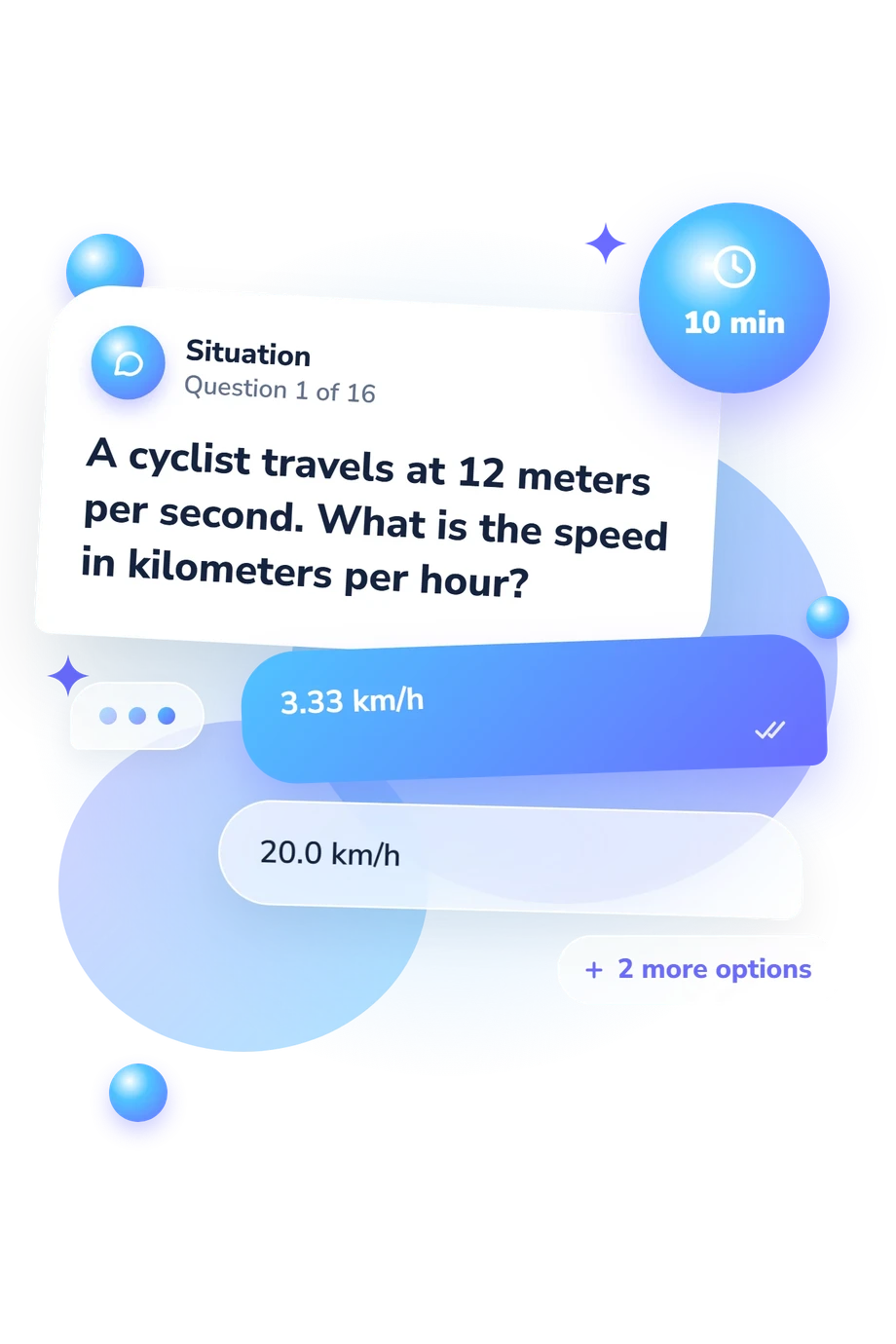
Example Questions From the Test
- 33 km/h
- 0 km/h
- 120 km/h
- 2 km/h
- 1 m / 100 cm
- 1 m / 1,000 cm
- 1 kg / 100 g
- 1 min / 100 s
- 12 L/h
- 2 L/h
- 72 L/h
- 0 L/h
Dimensional Analysis Quiz - Description and methodology of the test
Students reviewing science, engineering, or technical coursework can use this dimensional analysis quiz to check whether they preserve a quantity’s meaning while converting or combining measurements. To guide study planning, this dimensional analysis test gives a focused snapshot of unit reasoning, helping learners decide which relationships deserve more practice before laboratory work, homework, or further problem solving.
What This Assessment Measures
Rather than testing memorized definitions, the questionnaire examines whether learners preserve a physical quantity while converting or combining measurements. Its tasks include ordinary conversions, rates, density, area and volume, significant figures, and equations whose dimensions must be compatible.
Learners can use it as a dimensional analysis practice quiz when reviewing the following four skill groups:
- Conversion factors show whether ratios are oriented so unwanted units cancel.
- Compound units show whether rates and density are converted coherently.
- Squared and cubed units show whether powers are carried through a conversion.
- Dimensional consistency shows whether equations combine compatible quantities.
The Dimensional Analysis Knowledge scale runs from 0-16: Foundations to strengthen (0-6) signals skills needing reinforcement; Developing command (7-12) reflects success on many standard conversions with some room to improve; Strong command (13-16) indicates consistent reasoning across straightforward and multistep problems.
Methodology and Evidence Base
Each item presents a numerical or conceptual problem with four answer choices. Respondents select a conversion factor, complete a factor-label setup, convert a quantity, calculate a derived value, or judge dimensional consistency. This unit conversion quiz uses applied problems rather than vocabulary recall.
The result summarizes performance across the tested skills. Displayed bands describe performance on these questions, not population norms or clinical categories. A higher result suggests more dependable handling of sampled relationships; a lower result points to review of conversion factors, unit cancellation, and multistep setups.
The method is conceptually consistent with Petersson et al. (2026), which connects measurement-unit reasoning to problem-solving competency. Ambler Thompson and Barry N. Taylor (2008) supply SI conventions behind the conversions, and Pryor (2018) explains factor-label procedures. These sources support the educational approach; this questionnaire is neither an adaptation nor a validation of them.
Arithmetic accuracy, attention, SI familiarity, and study context can affect performance. Use the result as a learning profile, alongside worked problems or broader assessment, rather than as a complete measure of mathematical competence.
- Petersson, Jöran, Maria Antonietta Lepellere, and Rosie Lopez-Conde. “Dimensional analysis: reasoning with units of measurement as a tool for improved problem-solving competency.” International Journal of Mathematical Education in Science and Technology 57 (2026): 1-25. 10.1080/0020739X.2025.2590521
- Thompson, Ambler, and Barry N. Taylor. Guide for the Use of the International System of Units (SI). NIST Special Publication 811. National Institute of Standards and Technology, Gaithersburg, MD, 2008. 10.6028/NIST.SP.811e2008
- Pryor, Roger W. Dimensional Analysis for Unit Conversions Using MATLAB. Mercury Learning and Information, 2018. 10.1515/9781683923299
Updated: