
Diet Quiz
How the Scales are Structured
Who Usually Takes This Test?
See How You Compare
Below is a preview of how scores are typically distributed across each scale.
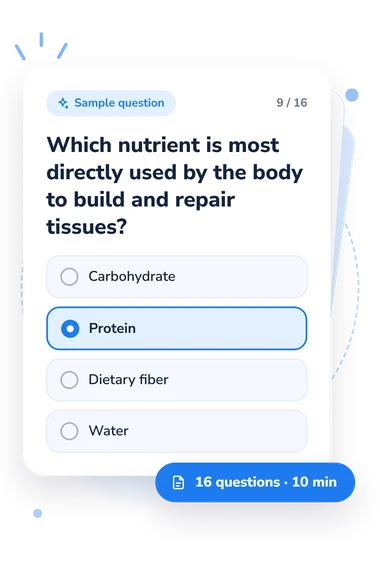
Example Questions From the Test
- Place it in warm water until the center softens
- Leave it on the kitchen counter for the day
- Thaw it in the refrigerator
- Set it outdoors in direct sunlight
- Total carbohydrate
- Includes added sugars
- Dietary fiber
- Total sugars
- Olive oil, nuts, and seeds
- Butter, cream, and shortening
- Candy, soft drinks, and syrup
- Skinless chicken, egg whites, and white fish
Diet Quiz - Description and methodology of the test
People reviewing their nutrition understanding can use this self-check to see which principles they recognize and where study could help. In that role, the diet quiz examines practical decisions rather than judging a person's meals. Its result maps tested knowledge, not an eating pattern or health status. The result of this nutrition knowledge quiz shows which nutrition concepts you recognize and does not assess the overall quality of your diet.
What This Assessment Explores
The questions assess practical nutrition knowledge, not the quality of a person's overall diet. They ask whether respondents recognize guidance involving labels, portions, nutrients, meals, hydration, and food safety. For learners reviewing fundamentals or people refreshing familiar knowledge, this nutrition literacy test focuses on usable understanding.
The questions group into four areas:
- Labels and portions show whether serving sizes, ingredients, added sugars, and sodium are read correctly.
- Nutrients and balance show whether protein, fiber, fats, iron, and variety connect with sensible meals.
- Hydration shows whether suitable fluid guidance is recognized during moderate activity.
- Food safety shows whether thawing and leftover-storage decisions follow basic principles.
The result uses Diet Knowledge, 0-16, with Foundations to build (0-6), Developing knowledge (7-12), and Strong knowledge (13-16). These bands describe performance on tested material, not the quality of a diet.
Methodology and Evidence Base
Each item uses a best-answer multiple-choice format. Plausible alternatives test whether the respondent recognizes the principle that fits the situation rather than selecting a preferred lifestyle. The educational score describes performance on the tested material; it does not estimate calories, nutrient intake, or adherence.
The questionnaire is useful as a healthy eating knowledge check; its content is conceptually consistent with the Nutrition Knowledge Questionnaire, but it is a separate online questionnaire, not an adaptation of that instrument. Kliemann and colleagues and Parmenter and Wardle provide related models for organizing general nutrition knowledge across practical domains.
The score is an unvalidated educational measure whose bands describe tested nutrition knowledge rather than medical status. It is most useful for choosing topics to study, such as label reading, meal balance, and food safety.
Attention, wording, prior exposure to nutrition advice, and uncertainty between options can affect answers. Read the result as a snapshot of tested knowledge, since a broader evaluation would require actual intake, individual needs, and health context.
- Jones, Anna Marie; Lamp, Cathi; Neelon, Marisa; Nicholson, Yvonne; Schneider, Connie; Wooten Swanson, Patti; Zidenberg-Cherr, Sheri. "Reliability and Validity of Nutrition Knowledge Questionnaire for Adults." Journal of Nutrition Education and Behavior, 2015, 47(1), 69-74. 10.1016/j.jneb.2014.08.003
- Kliemann, N.; Wardle, J.; Johnson, F.; Croker, H. "Reliability and validity of a revised version of the General Nutrition Knowledge Questionnaire." European Journal of Clinical Nutrition, 2016, 70(10), 1174-1180. 10.1038/ejcn.2016.87
- Parmenter, K.; Wardle, J. "Development of a general nutrition knowledge questionnaire for adults." European Journal of Clinical Nutrition, 1999, 53(4), 298-308. 10.1038/sj.ejcn.1600726