
Data Structure Quiz
How the Scales are Structured
Who Usually Takes This Test?
See How You Compare
Below is a preview of how scores are typically distributed across each scale.
Example Questions From the Test
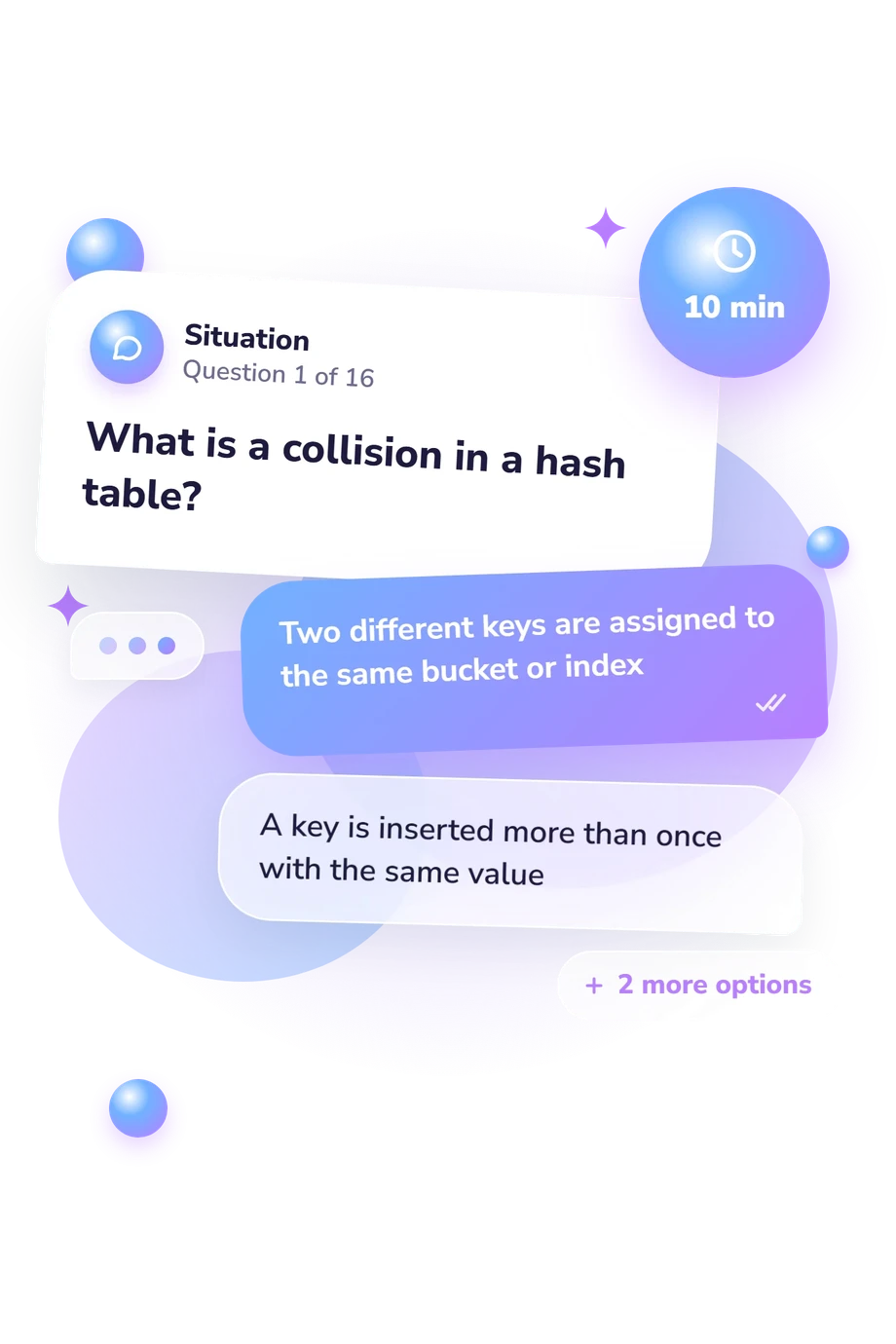
- Two different keys are assigned to the same bucket or index
- A key is inserted more than once with the same value
- The table's keys are stored in sorted order
- A lookup examines every bucket before returning
- Every left child is smaller than its right sibling
- Nodes are ordered by their insertion time
- All keys in the left subtree are smaller than the root key
- Every parent has a key no greater than the keys of its children
- Pop
- Dequeue
- Peek
- Enqueue
Data Structure Quiz - Description and methodology of the test
Students, junior developers, and interview candidates can use this assessment to check whether they can choose and reason about common data structures without writing a complete program. Across its data structure quiz questions, it tests transferable concepts, so the overall result can show where review is most useful. For coursework, coding practice, and technical discussions, this data structure assessment indicates which fundamentals deserve closer attention.
What This Assessment Explores
The questionnaire checks whether learners can connect structures with the behaviors they support. Items cover operations such as pop and enqueue, plus ordering, memory use, traversal, and efficiency. The result can turn review into a data structure practice session focused on concepts needing examples or implementation work.
It examines four connected areas:
- Core operations show how stacks, queues, linked lists, and arrays behave.
- Ordering and priority show whether heaps, binary search trees, hashing, and sorted-search requirements are recognized.
- Graph, string, and set structures show whether adjacency lists, tries, disjoint sets, and hash-based sets fit tasks.
- Algorithmic reasoning shows whether breadth-first search, cycle detection, amortized analysis, and constant-space constraints are understood.
The scale is Data Structure Knowledge (0-16), with 0-6 Foundation to Build, 7-12 Developing Knowledge, and 13-16 Strong Knowledge. It summarizes correct-answer performance as an educational snapshot, not formal certification.
Methodology and Evidence Base
Each item presents a short programming scenario or definition followed by four answer choices, making the questionnaire a fixed-answer knowledge assessment. The respondent selects the best answer, and one point is assigned for each correct response, producing the total score for this quiz on data structure.
Its content is conceptually consistent with the study by Tenenberg and Murphy on undergraduate knowledge and self-knowledge in data structures, and with the BDSI concept inventory described by Porter and colleagues. It is not presented as an adaptation of either published instrument. Related research on differentiated assessment, including work by Begum and colleagues, offers context for data-structure learning; this questionnaire, however, reports one overall score rather than separate prerequisite and advanced dimensions.
The displayed result is an educational snapshot of performance on these questions rather than a formal certification. Guessing, test familiarity, and uneven experience with programming contexts can affect performance. A lower band suggests revisiting fundamentals, while a higher band indicates stronger performance on the sampled concepts. It does not establish mastery of implementation, debugging, or workplace-level problem solving.
- Tenenberg, J., & Murphy, L. (2005). Knowing What I Know: An investigation of undergraduate knowledge and self-knowledge of data structures. Computer Science Education, 15(4), 297-315. 10.1080/08993400500307677
- Porter, L., Zingaro, D., Liao, S. N., Taylor, C., Webb, K. C., Lee, C., & Clancy, M. (2019). BDSI: A Validated Concept Inventory for Basic Data Structures. In Proceedings of the 2019 ACM Conference on International Computing Education Research (ICER ’19), 111-119. 10.1145/3291279.3339404
- Begum, M., Haglund, P., Korhonen, A., Lonati, V., Monga, M., Strömbäck, F., & Tilanterä, A. (2024). Empirical Evaluation of a Differentiated Assessment of Data Structures: The Role of Prerequisite Skills. Informatics in Education, 23(1), 57-99. 10.15388/infedu.2024.05
Updated: