
Cupcake Quiz
How the Scales are Structured
Who Usually Takes This Test?
See How You Compare
Below is a preview of how scores are typically distributed across each scale.
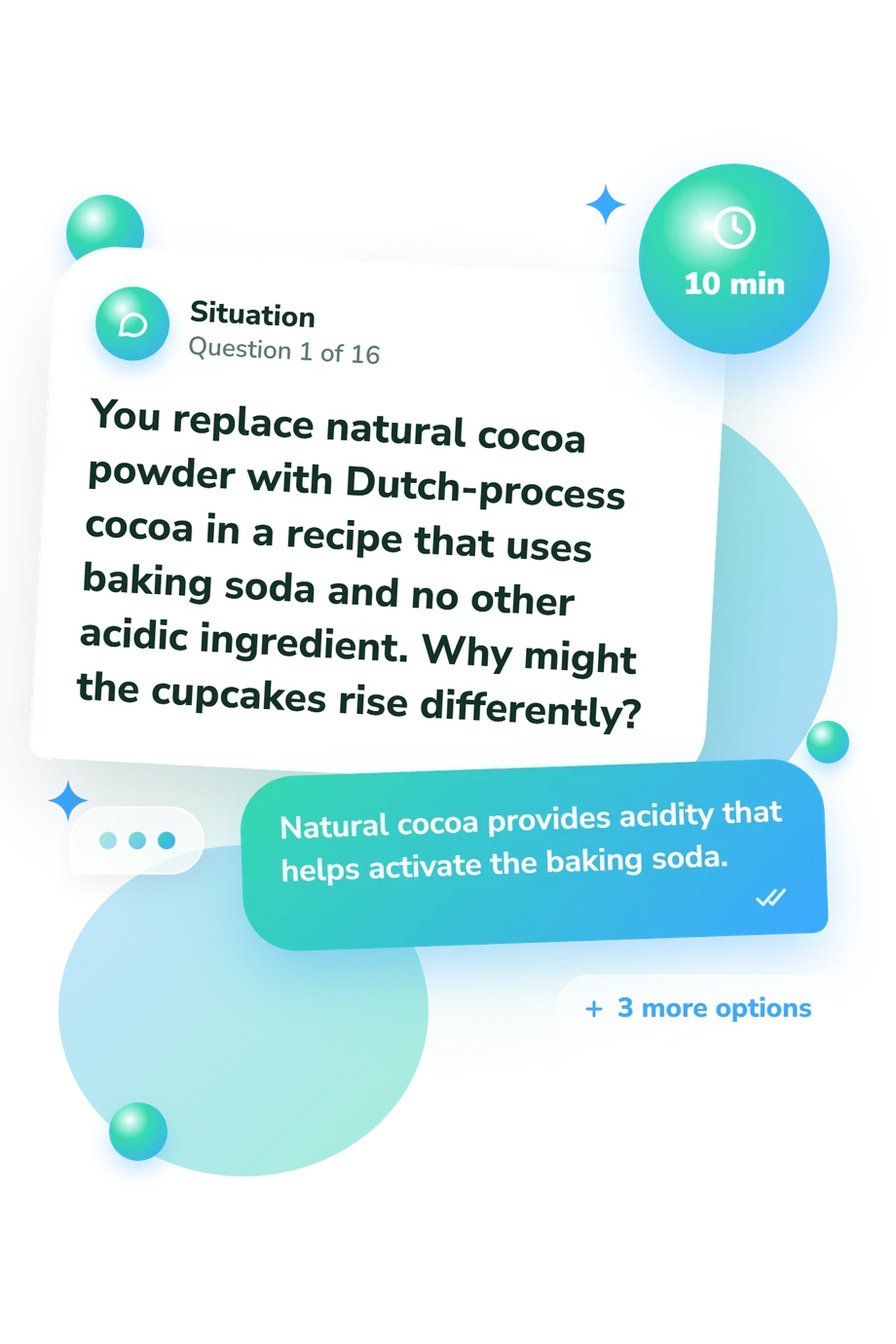
Example Questions From the Test
- To prevent the eggs from contributing moisture
- To dissolve every sugar crystal before flour is added
- To trap small air pockets that help create a lighter texture
- To stop gluten from forming later in the batter
- The dry ingredients were whisked together before use.
- The sugar was added gradually instead of all at once.
- The eggs were lightly beaten before being incorporated.
- The batter was mixed too long after the flour was added.
- It remains completely firm when pressed.
- It feels cold but can be cut into small cubes.
- It has become glossy and partly liquid around the edges.
- It yields slightly to pressure but still holds its shape.
Cupcake Quiz - Description and methodology of the test
Designed for home bakers and curious learners, this assessment turns everyday cupcake decisions into a focused knowledge check. The Cupcake Quiz helps you judge which baking action is most appropriate when a recipe, oven, or finished cake presents a problem. The result of this cupcake baking quiz can point to topics that deserve review, from diagnosing a baking issue to choosing a better next step.
What This Assessment Explores
The scenarios test applied knowledge, not flavor preference. They cover ingredients, leavening, mixing, doneness, frosting, storage, and transport, so the assessment suits occasional bakers and people refining dependable routines. The result from this cupcake knowledge test shows how well you connect a technique with its likely result and recognize an effective baking choice. Key areas include:
- Ingredient choices show how acids, cocoa, and binders affect structure.
- Mixing decisions reveal understanding of creaming, gluten development, portioning, and crumb.
- Oven judgment covers temperature errors, sinking, browning, and wet centers.
- Frosting and storage choices reflect control of consistency, cooling, freshness, and heat.
Cupcake Knowledge runs 0-16: 0-6 Cosmic Beginner, 7-12 Rising Baker, and 13-16 Stellar Cupcake Expert; these bands describe quiz performance, not professional certification.
Methodology and Scientific Basis
Each item presents a baking problem with four answer choices. Selecting the best explanation or action tests applied reasoning, not isolated recall. The result reports one score and band; because no separate weighting rule is stated, the questionnaire does not support assumptions about points per answer. The online questionnaire has no published norms or psychometric validation, so its score is descriptive, not standardized.
The content is conceptually consistent with Baik et al. (1999), which examined cupcake temperature during baking. Christaki et al. (2017) match its focus on batter rheology, leavening acid, and mixing time, while Karaoğlu and Kotancılar (2009) support storage and texture over time. These studies support scenario relevance but do not make this questionnaire an adaptation of their instruments.
Interpret the band as a snapshot of practical knowledge. Guessing, reading precision, prior recipe exposure, and familiarity with baking terminology can affect performance. The single score summarizes performance on these items rather than guaranteeing consistent results across kitchens. This online cupcake test can guide learning, while hands-on results still depend on equipment, ingredients, and execution.
- Baik, O. D., Sablani, S. S., Marcotte, M., & Castaigne, F. (1999). Modeling the Thermal Properties of a Cup Cake During Baking. Journal of Food Science, 64(2), 295-299. 10.1111/j.1365-2621.1999.tb15886.x
- Christaki, M., Verboven, P., Van Dyck, T., Nicolai, B., Goos, P., & Claes, J. (2017). The Predictive Power of Batter Rheological Properties on Cake Quality - The Effect of Pregelatinized Flour, Leavening Acid Type and Mixing Time. Journal of Cereal Science, 77, 219-227. 10.1016/j.jcs.2017.07.001
- Karaoğlu, M. M., & Kotancılar, H. G. (2009). Quality and Textural Behaviour of Par-Baked and Rebaked Cake During Prolonged Storage. International Journal of Food Science and Technology, 44(1), 93-99. 10.1111/j.1365-2621.2007.01650.x
Updated: