
Crypto Quiz
How the Scales are Structured
Who Usually Takes This Test?
See How You Compare
Below is a preview of how scores are typically distributed across each scale.
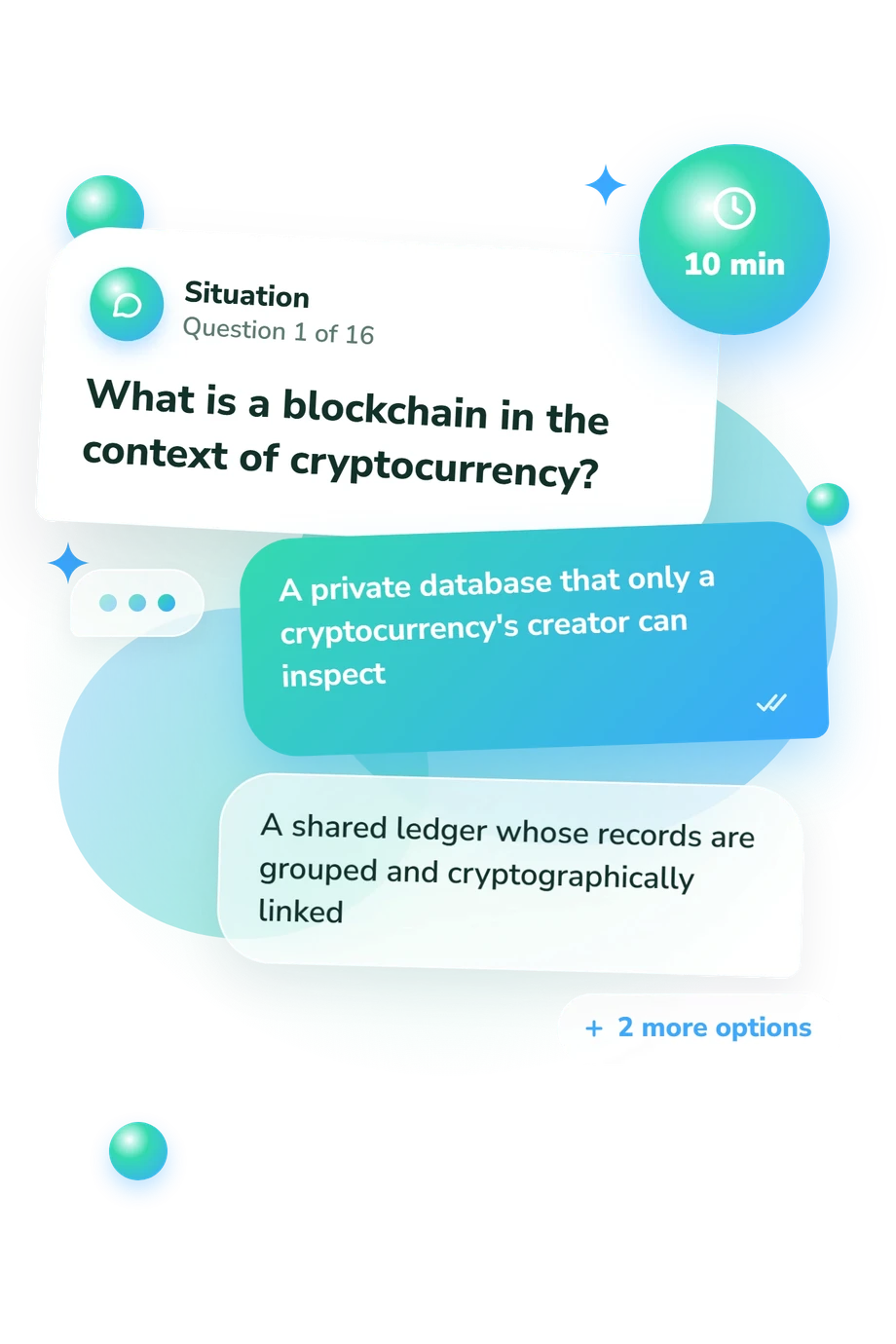
Example Questions From the Test
- Choose which users are allowed to create wallet addresses
- Set a guaranteed market price for the cryptocurrency
- Solve a computational challenge to propose and secure blocks
- Convert every transaction into government-issued currency
- Change the maximum supply rules without network agreement
- Hide every transaction associated with the corresponding address
- Recover any transaction sent to an incorrect address
- Authorize transactions involving the associated crypto assets
- The wallet's recovery phrase
- The private key used to authorize spending
- A compatible public receiving address
- The wallet application's backup password
Crypto Quiz - Description and methodology of the test
People who are new to digital assets, preparing to use a wallet, or trying to make sense of crypto discussions may find this assessment useful before making practical decisions. The crypto quiz offers a structured way to test readiness for conversations about transactions, custody, and common risks without requiring market experience. A cryptocurrency quiz format turns broad interest in digital assets into a focused self-check.
What This Assessment Explores
The questions examine practical literacy rather than market prediction. As a crypto currency quiz, this assessment covers how distributed ledgers record activity, how proof-of-work and confirmations affect transactions, and what users can and cannot do with private keys and recovery phrases. Other items address coins, tokens, stablecoins, smart contracts, market capitalization, diversification, and phishing.
The result uses one Crypto Knowledge scale from 0-16. Its three displayed bands are:
- Foundation to build (0-6) shows that the respondent recognizes some core ideas but may need review of wallets, records, transaction handling, and security basics.
- Developing understanding (7-12) indicates a useful grasp of central concepts with room to strengthen practical application.
- Strong understanding (13-16) reflects broad command of fundamental concepts and common operational risks.
Methodology and Evidence Base
Each item presents four alternatives and asks the respondent to select the best answer. One point is assigned for each correct response, so the total reflects knowledge recognition rather than an essay or personality profile. An answer-keyed crypto knowledge test makes each decision explicit, while the displayed result consolidates performance into a knowledge level.
The methodology is conceptually consistent with the Cryptocurrency Literacy Scale, but this online questionnaire is not presented as an adaptation of that instrument. Nakamoto's work supports shared ledgers, proof of work, confirmations, and transaction history. Buterin's framework supports smart contracts, while the study by Conti and colleagues supplies security context for phishing, key custody, double-spending, and privacy risks.
The displayed bands describe performance on these 16 items rather than a population-normed standing. It is an educational score, not financial or security advice; guessing, prior study, wording, and current attention can affect performance. The result is best used to choose learning priorities.
- Jones, Michael, Truong (Jack) Luu, and Binny M. Samuel. 2025. "Measuring Crypto Literacy." Journal of Consumer Affairs 59, no. 4: e70029. 10.1111/joca.70029
- Nakamoto, Satoshi. 2008. "Bitcoin: A Peer-to-Peer Electronic Cash System."
- Buterin, Vitalik. 2014. "Ethereum: A Next-Generation Smart Contract and Decentralized Application Platform." Ethereum.
- Conti, Mauro, Sandeep Kumar E., Chhagan Lal, and Sushmita Ruj. 2018. "A Survey on Security and Privacy Issues of Bitcoin." IEEE Communications Surveys and Tutorials 20, no. 4: 3416-3452. 10.1109/COMST.2018.2842460
Updated: