
Cow Breed Quiz
How the Scales are Structured
Who Usually Takes This Test?
See How You Compare
Below is a preview of how scores are typically distributed across each scale.
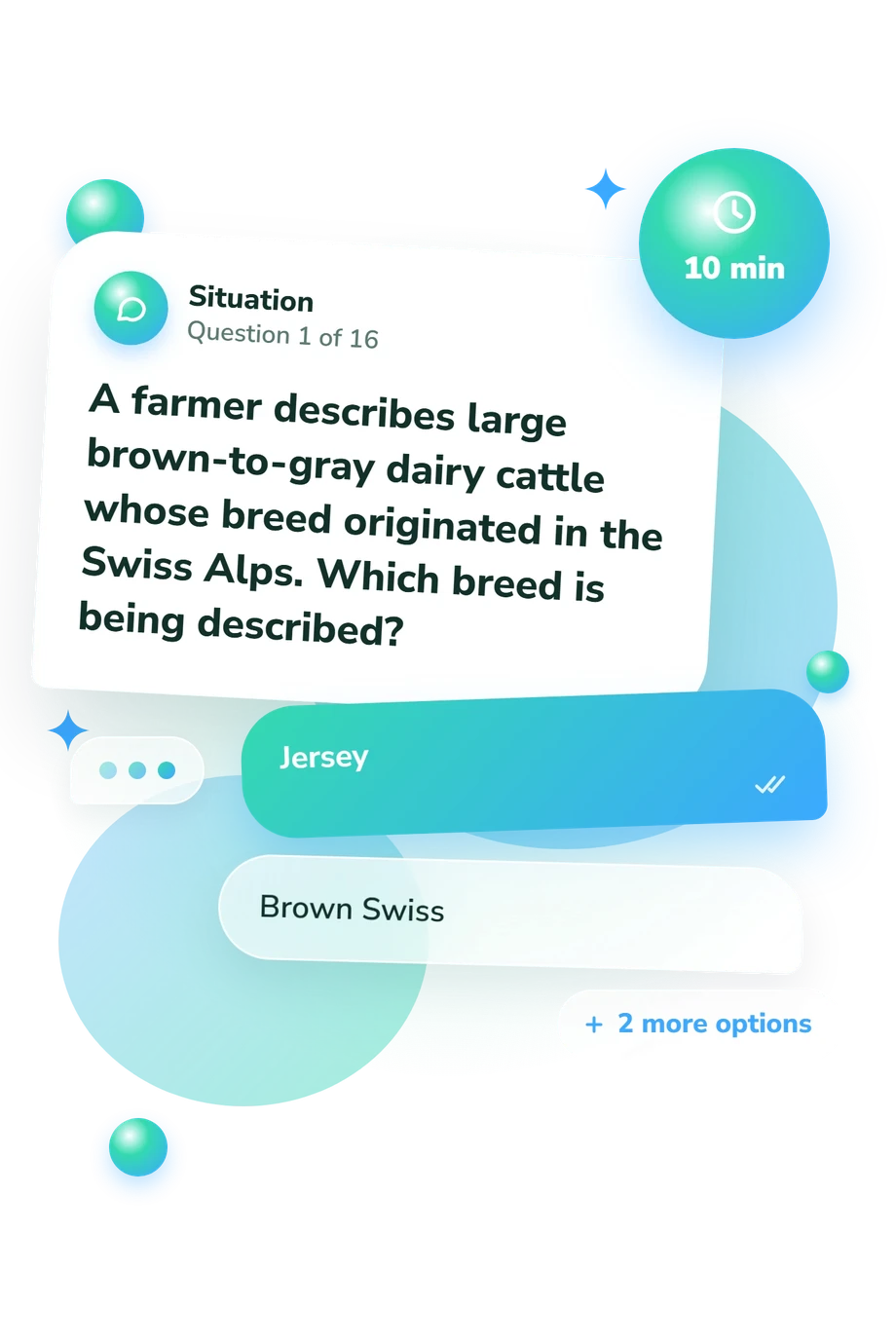
Example Questions From the Test
- Jersey
- Brown Swiss
- Guernsey
- Ayrshire
- Charbray
- Braford
- Beefmaster
- Brangus
- Ayrshire
- Guernsey
- Jersey
- Brown Swiss
Cow Breed Quiz - Description and methodology of the test
People who want a more accurate working knowledge of cattle breeds can use this Cow Breed Quiz to test practical recall. For learners, livestock enthusiasts, farmers, and anyone building a practical reference, the cattle breed quiz’s identification task turns breed study into a focused practical exercise. The result can clarify which areas deserve further study and where existing knowledge is strongest.
What This Assessment Explores
This cow breed test examines breed recognition rather than general farming knowledge. The items cover dairy, beef, composite, and heritage cattle, asking you to connect a breed with its origin, coat pattern, body type, horn development, production purpose, or climate adaptation.
The questions fall into four practical groups:
- Dairy breeds test recognition of milk-focused cattle through origins and distinctive production clues.
- Beef breeds show whether build, coat color, facial markings, and production context guide your identification.
- Composite breeds require recognition of cattle developed from specified ancestry.
- Heritage and regional breeds draw on distinctive history, geography, appearance, and adaptation.
The result is summarized by Cow Breed Knowledge, scored from 0-16 with one point for each correct answer. Foundation covers 0-6, Developing covers 7-12, and Strong covers 13-16. These bands describe the breadth of recognition demonstrated by the answers.
Methodology and Scientific Basis
The format uses a cattle breed identification quiz structure: short farm, herd, or breed-description scenarios followed by four answer choices. Select the breed that best fits the stated clues. One point is awarded for each correct response, so the total reflects accumulated identifications rather than a clinical trait score.
Breed histories, relationships, and contextual clues in the questions are conceptually consistent with Felius and colleagues’ cattle-breed literature; Felius’s later work and Mason’s encyclopedia add context on origins, appearance, production roles, and composite development. The one-point total belongs to this online questionnaire, not those sources, and the questionnaire is not an adaptation of a published standardized instrument.
Score bands are descriptive categories for this online knowledge assessment, not population norms. Performance can be affected by prior exposure to breed names, regional knowledge, attention to wording, and familiarity with visual or historical clues. A result indicates current accuracy on these identifications; practical experience, breed verification, and broader assessment are needed to judge expertise beyond this quiz.
- Felius, Marleen, Peter A. Koolmees, Bert Theunissen, and Johannes A. Lenstra. "On the Breeds of Cattle-Historic and Current Classifications." Diversity 3, no. 4 (2011): 660-692. 10.3390/d3040660.
- Felius, Marleen. Cattle Breeds of the World. Brill, 2025.
- Porter, Valerie, Lawrence Alderson, Stephen J.G. Hall, and D. Phillip Sponenberg. Mason's World Encyclopedia of Livestock Breeds and Breeding, 2 Volume Pack. CABI, 2016.
Updated: