
Cosplay Quiz
How the Scales are Structured
Who Usually Takes This Test?
See How You Compare
Below is a preview of how scores are typically distributed across each scale.
Example Questions From the Test
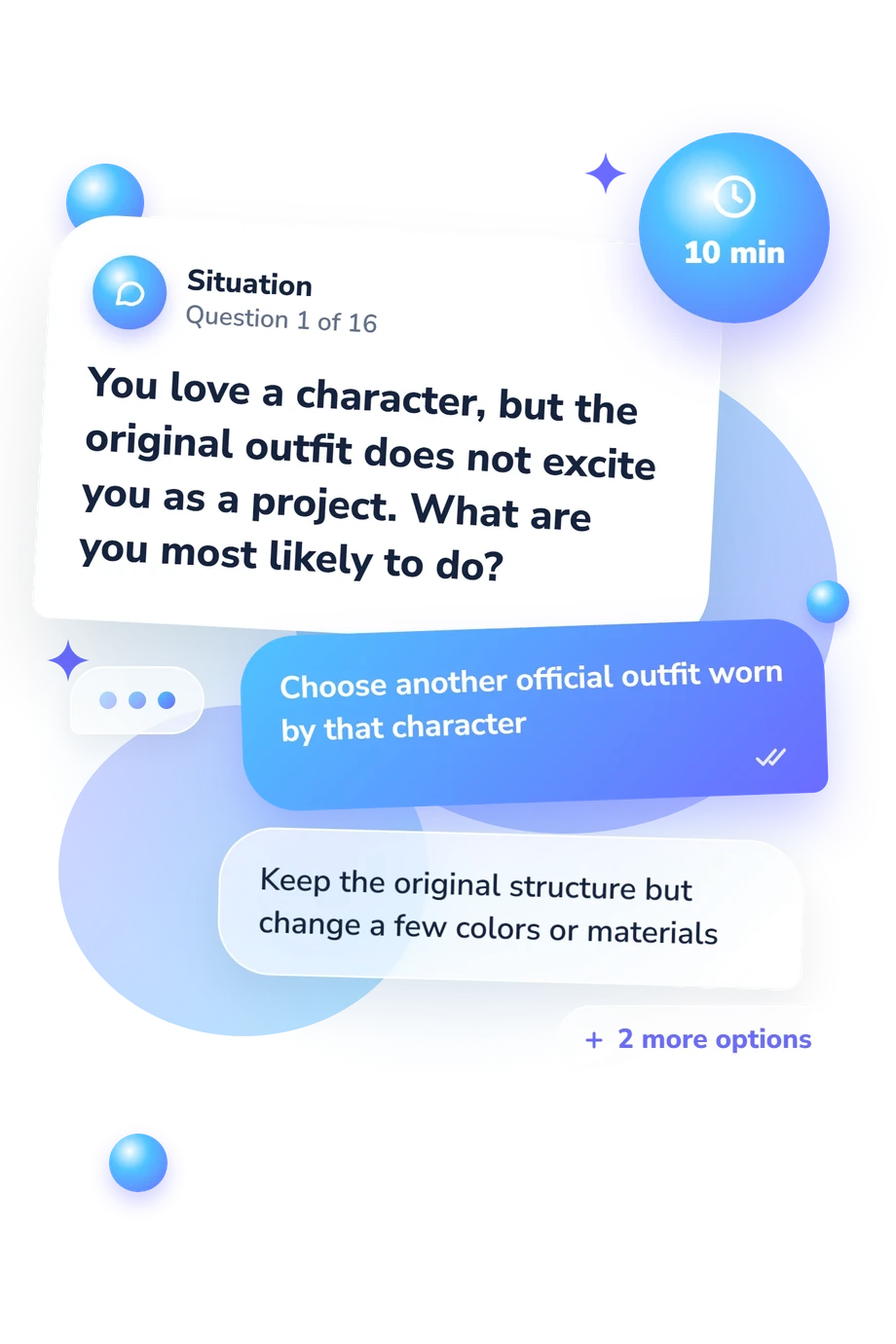
- Choose another official outfit worn by that character
- Keep the original structure but change a few colors or materials
- Adapt the character into a different era, genre, or fashion style
- Redesign selected pieces around a personal visual theme
- I mainly check that the costume and props are camera-ready
- I save a few poses that clearly fit the character
- I practice expressions, gestures, and poses for different scenes
- I think about the character's mood so I can improvise during the shoot
- Use it if it creates a strong image, even if it is not character-specific
- Try it once, then return to poses I recognize from the character
- Adjust the pose so the emotion and body language fit the character
- Keep the dramatic shape but add a familiar gesture or expression
Cosplay Quiz - Description and methodology of the test
People selecting a character, planning a build, or wondering why one costume feels more rewarding than another can use this cosplay quiz to reflect on motivations rather than appearance alone. It suits newcomers and experienced cosplayers asking who should I cosplay, with this quiz clarifying why. The profile connects character choice with the way each person enjoys making and wearing a costume.
What This Assessment Explores
Four themes organize the result: source fidelity, embodied performance, participation with fans, and imaginative redesign. Situations involving outfit versions, photoshoots, convention interactions, materials, and group plans connect these themes with practical decisions. When choosing a project, the quiz helps answer who to cosplay by showing whether accuracy, performance, community, or redesign matters most.
The outcomes are:
- Canon-Accurate Crafter (0-12) measures how strongly reference accuracy and construction details matter: Flexible Interpreter 0-4; Selective Detailer 5-8; Canon-Accurate Crafter 9-12.
- Character Performer (0-12) measures enjoyment of posture, movement, voice, and in-character interaction: Costume-Centered 0-4; Expressive Poser 5-8; Character Performer 9-12.
- Community Connector (0-12) measures motivation from collaboration, encouragement, shared events, and groups: Independent Participant 0-4; Social Collaborator 5-8; Community Connector 9-12.
- Creative Remixer (0-12) measures attraction to changing genres, aesthetics, materials, or ideas: Source-Led Designer 0-4; Adaptive Remixer 5-8; Creative Remixer 9-12.
Methodology and Evidence Base
Each item presents a cosplay situation with four response options. The responses form a self-report profile of priorities, not a judgment of sewing skill or costume quality. When considering a character, use this quiz to answer what anime character I should cosplay as, then compare the project's demands with your preferred way of engaging with cosplay.
Scoring compares the four outcome scores rather than treating one answer as a verdict. The highest score marks the strongest affinity, and any other outcome within one point joins it as a blend.
A 2013 survey by Rosenberg and Letamendi provides the closest context for varied cosplay motivations. Rahman, Liu, and Cheung discuss identity and performance; Rosenberg and Letamendi examine social heterogeneity; Reysen and colleagues address anime-fandom participation. The questionnaire is conceptually consistent with these works, not an adaptation of them.
The online questionnaire uses descriptive outcome bands and has no established norms for these exact items. Current interests, self-awareness, and response honesty can shift the result, so treat it as a reflective snapshot rather than a diagnosis.
- Rosenberg, Robin S., and Andrea M. Letamendi. 2013. "Expressions of Fandom: Findings from a Psychological Survey of Cosplay and Costume Wear." Intensities: The Journal of Cult Media, 5, 9-18.
- Rahman, Osmud, Liu Wing-sun, and Brittany Hei-man Cheung. 2012. "Cosplay": Imaginative Self and Performing Identity. Fashion Theory, 16(3), 317-342. DOI 10.2752/175174112X13340749707204
- Rosenberg, Robin S., and Andrea M. Letamendi. 2018. "Personality, Behavioral, and Social Heterogeneity within the Cosplay Community." Transformative Works and Cultures, 28. DOI 10.3983/twc.2018.1535
- Reysen, Stephen, Courtney N. Plante, Sharon E. Roberts, and Kathleen C. Gerbasi. 2018. "Motivations of Cosplayers to Participate in the Anime Fandom." The Phoenix Papers, 4(1), 29-40. DOI 10.17605/OSF.IO/UT4FB
Updated: