
Correct Logo Quiz
How the Scales are Structured
Who Usually Takes This Test?
See How You Compare
Below is a preview of how scores are typically distributed across each scale.
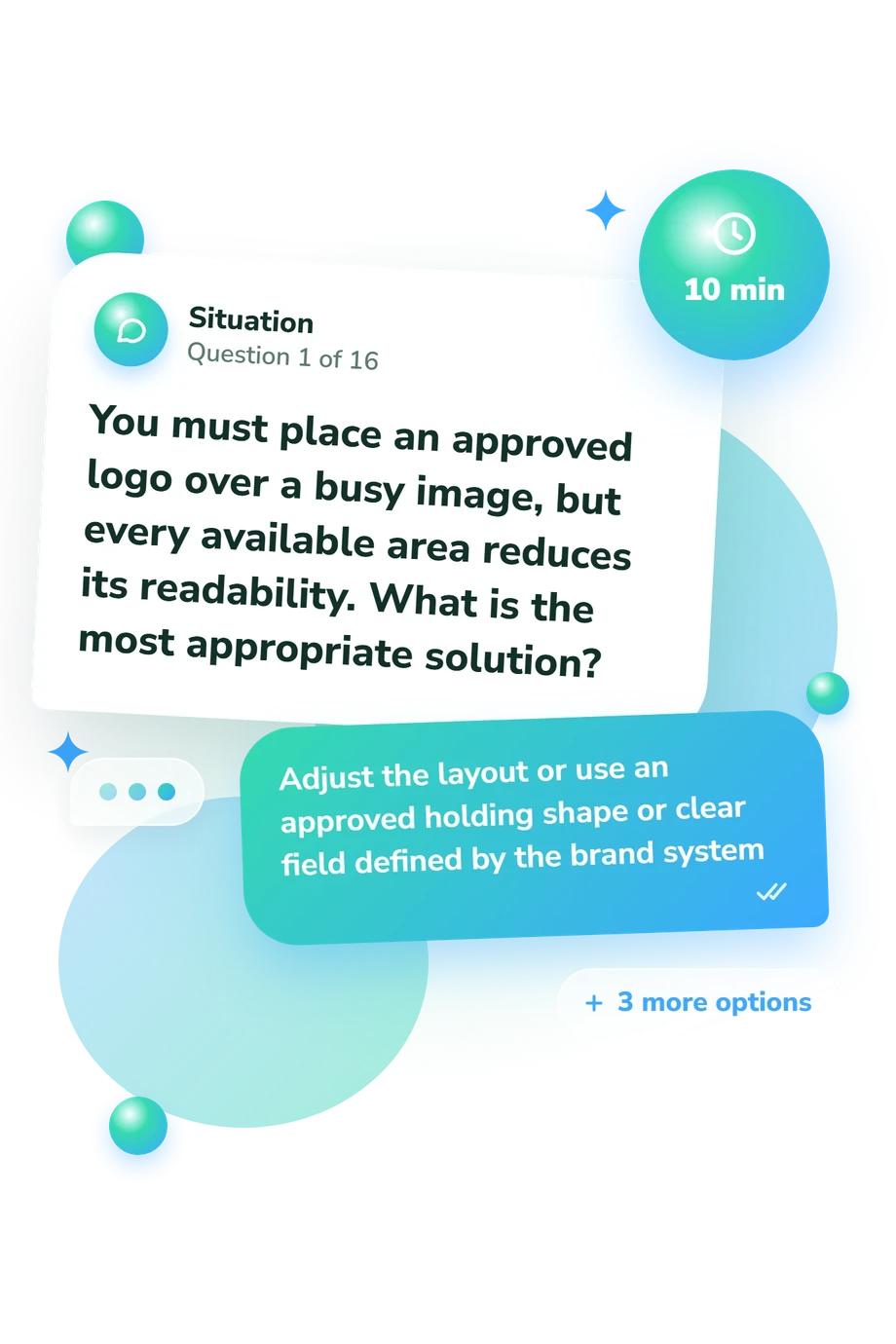
Example Questions From the Test
- A high-quality JPEG saved at its original dimensions
- A vector file containing scalable paths
- A screenshot placed inside a PDF
- A small transparent PNG enlarged as needed
- The amount of blank canvas included inside the logo file
- The distance between letters within the brand name
- The minimum unobstructed area surrounding the logo
- The maximum distance between the logo and a page edge
- Scaling the entire lockup uniformly as one unit
- Moving the symbol closer whenever the logo is reduced
- Enlarging the wordmark separately to balance the layout
- Adjusting the gap according to the surrounding text size
Correct Logo Quiz - Description and methodology of the test
People who choose, prepare, or review brand assets can use this assessment to check practical decisions before a logo reaches a layout, website, package, or printed piece. The Correct Logo Quiz focuses on distinguishing approved use from convenient but risky alteration. It presents practical logo-use scenarios and reports a single general-knowledge score and band.
What This Assessment Explores
When conditions change, this logo application quiz checks whether you preserve a mark’s identity. Scenarios cover approved assets, clear space, contrast, lockups, co-branding, responsive versions, production quality, and accessible labeling.
It suits designers, marketers, reviewers, and learners handling brand materials. The result reflects logo selection and application in digital and print contexts, not compliance with one organization’s rulebook.
These question themes are knowledge domains contributing to the single displayed score:
- Approved assets show whether you follow current guidelines and authorized libraries.
- Legibility and spacing show how you protect recognition in difficult layouts.
- File choices show whether you match vector, raster, and print assets to tasks.
- Responsive and accessible use shows whether you recognize approved small-format alternatives and name linked logo images.
Correct Logo Knowledge: 0-16. Foundational 0-6, Developing 7-12, Strong 13-16. It measures general principles, not a brand’s official standards.
Methodology and Evidence Base
Best-answer multiple choice structures this logo knowledge test: each item presents a situation and four alternatives, requiring the response most consistent with approved practice. The result condenses performance into one displayed score and its descriptive band, rather than a separate profile. The questionnaire does not state a separate weighting rule.
Its conceptual framework is consistent with Brand Identity Essentials (Budelmann and Kim, 2019), emphasizing consistency, asset control, spacing, proportion, and context in brand identity management. NASA’s 1976 graphics standards manual provides a historical example of formal rules for logo construction and use. Ward and colleagues’ 2020 study supports treating identity elements as sources of distinctiveness, while WCAG 2.2 supports the accessibility requirement for appropriately named linked logo images.
These sources support the subject matter, but this questionnaire is not presented as an adaptation or standardized administration of any one of them. The bands are interpretive descriptions for this online assessment, not population norms or universal cutoffs. Results may reflect prior exposure, attention, and familiarity with brand systems, so work should be checked against applicable guidelines.
- Budelmann, Kevin, and Yang Kim. Brand Identity Essentials, Revised and Expanded: 100 Principles for Building Brands. Beverly, MA: Rockport Publishers, 2019. ISBN 978-1-63159-708-4.
- National Aeronautics and Space Administration. NASA Graphics Standards Manual (NHB 1430.2). Washington, DC: NASA, 1976.
- Ward, Ella, Song Yang, Jenni Romaniuk, and Virginia Beal. “Building a unique brand identity: measuring the relative ownership potential of brand identity element types.” Journal of Brand Management 27 (2020): 393-407. 10.1057/s41262-020-00187-6.
- World Wide Web Consortium. Web Content Accessibility Guidelines (WCAG) 2.2. W3C Recommendation, 12 December 2024.
Updated: