
Commercial Jingle Quiz
How the Scales are Structured
Who Usually Takes This Test?
See How You Compare
Below is a preview of how scores are typically distributed across each scale.
Example Questions From the Test
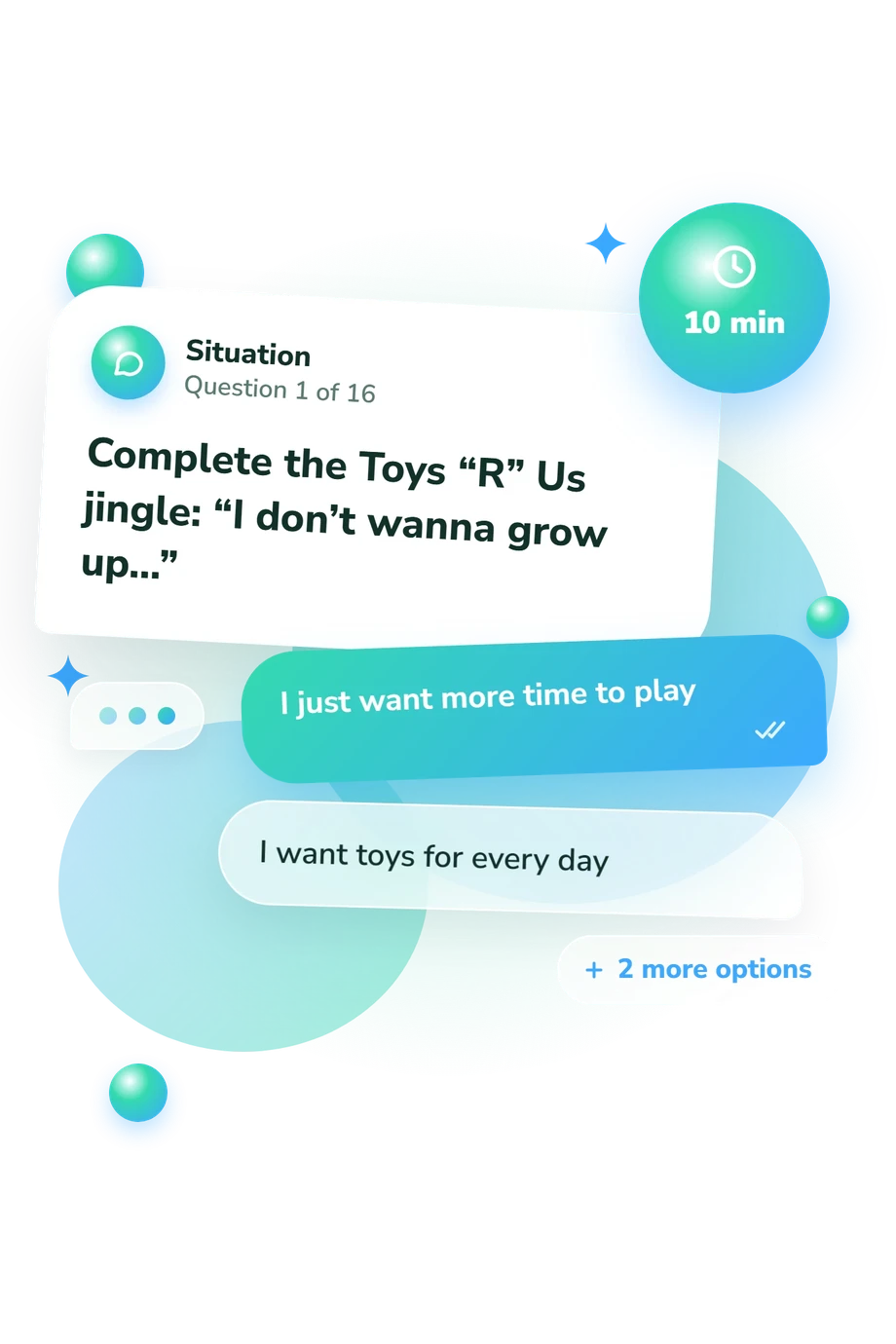
- I just want more time to play
- I want toys for every day
- I’ll be a kid forever
- I’m a Toys “R” Us kid
- Big Red gum
- Doublemint Gum
- Juicy Fruit gum
- Fruit Stripe gum
- Meow Mix, Meow Mix, please deliver
- Fill my bowl and please deliver
- Give me dinner, make it quicker
- Chicken dinner, now deliver
Commercial Jingle Quiz - Description and methodology of the test
People who enjoy testing cultural knowledge can use this commercial jingle quiz as a focused memory challenge built around recognition and retrieval. As an advertising jingle test, it invites anyone interested in recalling familiar advertising to see how quickly partial cues lead to a correct answer. The result offers a concise view of performance on this specific set of prompts.
What This Assessment Explores
These questions examine recall from familiar advertising. Some ask you to complete a sung line; others identify a brand or product from a slogan or campaign cue. The total reflects performance on these tasks, not general intelligence.
Four formats contribute to the total:
- Lyric completion asks whether a familiar line brings its next words to mind.
- Brand matching asks you to connect a sung phrase with its product.
- Campaign cues test recognition of the wider context around a commercial.
- Similar-slogan choices require you to distinguish closely related advertising lines.
For anyone curious about cultural memory, this jingle recall quiz offers a single focused result, not separate scores for each task. Commercial Jingle Knowledge runs 0-16: Emerging Recall (0-6) means some jingles remain elusive; Familiar Ear (7-12) reflects broad recognition; and Jingle Expert (13-16) indicates accurate recall of most lyrics and brand associations.
Methodology and Scientific Basis
Each item presents a lyric or advertising prompt with four answer choices. You select the option that completes the line or identifies its brand or product. Written prompts, not sung audio, present these jingle knowledge questions, so performance depends on recognizing wording and retrieving an answer.
One point is awarded for every correct response, producing the displayed total. The bands describe performance on this item set rather than population norms. No subscores cover lyric completion, brand recognition, or cue discrimination.
Research on advertising and jingle memory supplies context, not validation for this questionnaire. Yalch’s study examines musical presentation and slogan recall; Alexomanolaki, Loveday, and Kennett address implicit learning and retrieval through music; Allan considers attention and memory in advertising. Their methods differ from these written, four-choice prompts, so they do not establish this questionnaire’s reliability or scoring validity.
Interpret the result as familiarity with featured campaigns and the ability to distinguish supplied alternatives. Performance may vary with language, culture, age, media exposure, repeated advertising, and concentration. It is a focused recall exercise, not a standardized measure of memory.
- Yalch, Richard F. (1991). Memory in a jingle jungle: Music as a mnemonic device in communicating advertising slogans. Journal of Applied Psychology, 76(2), 268-275. 10.1037/0021-9010.76.2.268
- Alexomanolaki, Margarita, Catherine Loveday, and Chris Kennett. (2007). Music and Memory in Advertising: Music as a Device of Implicit Learning and Recall. Music, Sound, and the Moving Image, 1(1), 51-71. 10.3828/msmi.1.1.7
- Allan, David. (2006). Effects of Popular Music in Advertising on Attention and Memory. Journal of Advertising Research, 46(4), 434-444. 10.2501/S0021849906060491
Updated: