
Color Mood Quiz
How the Scales are Structured
Who Usually Takes This Test?
See How You Compare
Below is a preview of how scores are typically distributed across each scale.
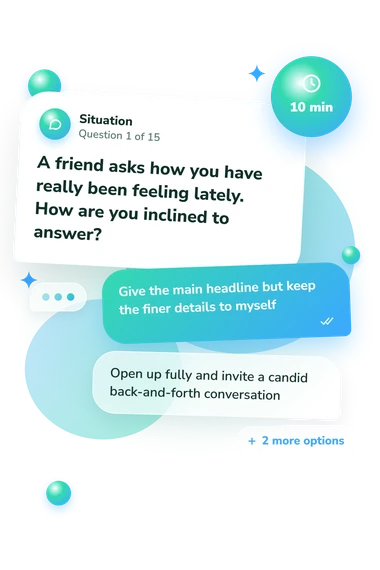
Example Questions From the Test
- Give the main headline but keep the finer details to myself
- Open up fully and invite a candid back-and-forth conversation
- Offer a simple answer and retain most of the experience privately
- Share a few meaningful details with clear boundaries
- Mist blue, soft gray, and smooth stone
- Clear sky blue, amber, and fresh green
- Electric magenta, tangerine, and bright gold
- Sage, cream, and muted apricot
- Turn up lively music and launch into something active
- Settle into a quiet corner and let the hour remain spacious
- Change scenery with a walk, errand, or engaging project
- Do one familiar activity at an unhurried pace
Color Mood Quiz - Description and methodology of the test
People who want a quick, structured way to notice how color, feeling, and everyday choices fit together may find the color mood quiz useful. It is designed for self-reflection when social needs, energy, or emotional attention feel different from usual. Using colors as expressive prompts, it offers a gentle way to consider a current mood profile across connection, activation, and reflection without treating any mood as better than another.
What This Assessment Explores
Questions use color prompts across social situations, free time, memories, art, music, and reactions. The profile captures how connection, activation, and emotional attention feel today, without judging one mood as better. The result can help you consider how stress, rest, setting, or routine may shape current responses.
The three dimensions are:
- Connection Style (0-15) shows fit with contact: Private Orbit (0-5) favors space, Selective Bridge (6-10) supports purposeful connection, and Open Circle (11-15) reflects shared expression.
- Emotional Tempo (0-15) shows activation rather than positive or negative mood: Quiet Current (0-5) is subdued, Shifting Current (6-10) changes with setting, and Vivid Current (11-15) seeks stimulation and intensity.
- Reflective Depth (0-15) shows emotional elaboration, not intelligence or emotional health: Light Touch (0-5) moves on, Focused Reflection (6-10) examines selected feelings, and Layered Reflection (11-15) follows nuance, memory, and meaning.
Methodology and Evidence Base
Each item describes a familiar situation and offers four choices, combining verbal reactions with color palettes, scenes, lighting, or imagery. Choosing the option closest to your present experience converts preferences into a structured profile.
For scoring, the questionnaire groups responses into three mood dimensions and places each total in one of the three displayed bands. The questionnaire does not specify how answers add points, so wording or color alone cannot establish fixed values.
The use of colour prompts is conceptually consistent with the Manchester Color Wheel instrument, where color choice indicates current emotional states rather than a universal code. Russell’s circumplex model separates activation from affective direction; Palmer and Schloss address ecological associations in color preference; and Trapnell and Campbell distinguish reflection from rumination. These sources provide conceptual parallels, not validation of this questionnaire, which is not an adaptation of any one.
Read the profile as a current-state description. Sleep, stress, setting, personal associations, and self-report bias can shape these responses. Descriptive bands support self-reflection about current responses; they do not establish a diagnosis.
- Carruthers, Helen R., Julie Morris, Nicholas Tarrier, and Peter J. Whorwell. "The Manchester Color Wheel: Development of a Novel Way of Identifying Color Choice and Its Validation in Healthy, Anxious and Depressed Individuals." BMC Medical Research Methodology 10 (2010): 12. 10.1186/1471-2288-10-12
- Russell, James A. "A Circumplex Model of Affect." Journal of Personality and Social Psychology 39, no. 6 (1980): 1161-1178. 10.1037/h0077714
- Palmer, Stephen E., and Karen B. Schloss. "An Ecological Valence Theory of Human Color Preference." Proceedings of the National Academy of Sciences of the United States of America 107, no. 19 (2010): 8877-8882. 10.1073/pnas.0906172107
- Trapnell, Paul D., and Jennifer D. Campbell. "Private Self-Consciousness and the Five-Factor Model of Personality: Distinguishing Rumination from Reflection." Journal of Personality and Social Psychology 76, no. 2 (1999): 284-304. 10.1037/0022-3514.76.2.284