
2 Corinthians Bible Quiz
How the Scales are Structured
Who Usually Takes This Test?
See How You Compare
Below is a preview of how scores are typically distributed across each scale.
Example Questions From the Test
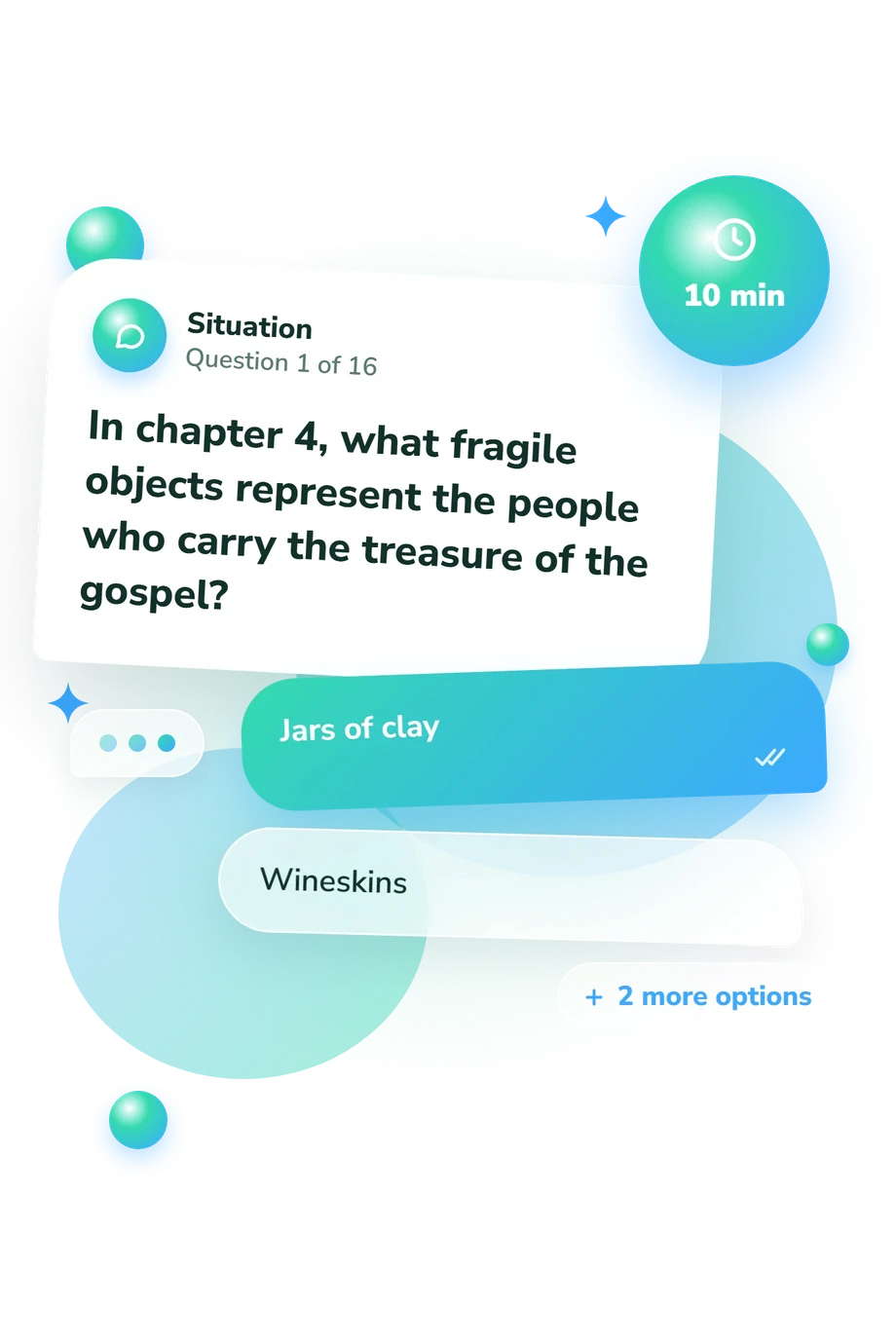
- Jars of clay
- Wineskins
- Fishing nets
- Bronze lamps
- Concern about how the gift compares with everyone else’s
- Reluctance overcome by pressure from community leaders
- Expectation of immediate repayment in equal value
- Cheerfulness based on a freely decided gift
- Public recognition for enduring shame
- Repentance leading toward salvation without regret
- Freedom from responsibility for past conduct
- Permanent sorrow as proof of sincerity
2 Corinthians Bible Quiz - Description and methodology of the test
For readers who want to check their grasp of Paul’s message, this assessment offers a focused way to revisit 2 Corinthians. The 3.02 quiz payroll deductions 1 suits Bible-study participants, students, and anyone returning to the letter’s central arguments. A Bible quiz on 2 Corinthians can clarify which teachings, images, and practical applications are familiar and which passages deserve closer reading.
What the Test Measures
The assessment checks knowledge of the letter rather than personality, religious commitment, or general biblical literacy. Its items cover teachings, images, situations, and applications, including gospel treasure in fragile jars, walking by faith, comfort in suffering, generosity, reconciliation, spiritual conflict, self-examination, and strength through weakness. The result reflects familiarity with recurring ideas, not a judgment about belief.
The result uses these bands:
- 2 Corinthians Knowledge (0-16) shows the number of correct answers and the breadth of recall.
- Foundation (0-6) indicates recognition of some themes, with rereading likely to add context.
- Developing (7-12) indicates a solid grasp of many passages, with connections still growing.
- Strong (13-16) indicates detailed knowledge and application of central teachings.
For personal study, a 2 Corinthians knowledge test can support rereading, group review, and discussion. It does not measure spiritual maturity or the quality of someone’s faith.
Methodology and Evidence Base
Each item uses four answer options with one best answer. Some questions test direct recall; others present a situation and ask which teaching fits it. One point is awarded for each correct response, and the total is read through the three result bands without inventing a clinical cutoff or diagnosis. The format rewards choosing the best-supported option rather than writing an original commentary.
Content is conceptually consistent with 2 Corinthians. Alexandra R. Brown’s annotations help situate the passages; Murray J. Harris provides detailed commentary on the Greek text; and B. J. Oropeza examines death and life, hardship, rivalry, generosity, and reconciliation. These works support the selection and framing of biblical material, but this questionnaire is not an adaptation of their publications.
As a self-administered Bible knowledge quiz, it has an educational purpose rather than standardized psychometric status. Performance may vary with prior study, translation familiarity, memory, guessing, and interpretation of paraphrased situations. Read the result as a snapshot of current familiarity; a 2 Corinthians study quiz can guide rereading and discussion, but cannot establish theological depth or settle interpretive differences.
- Coogan, Michael D., ed.; Marc Z. Brettler, Carol A. Newsom, and Pheme Perkins, associate eds. The New Oxford Annotated Bible: New Revised Standard Version with the Apocrypha: An Ecumenical Study Bible. 5th ed. Oxford University Press, 2018. 2 Corinthians annotations by Alexandra R. Brown.
- Harris, Murray J. The Second Epistle to the Corinthians: A Commentary on the Greek Text. New International Greek Testament Commentary. Eerdmans, 2005.
- Oropeza, B. J. Exploring Second Corinthians: Death and Life, Hardship and Rivalry. Society of Biblical Literature Press, 2016. 10.2307/j.ctt1bpm99d
Updated: