
Are You Smarter Than a 10 Year Old Quiz
How the Scales are Structured
Who Usually Takes This Test?
See How You Compare
Below is a preview of how scores are typically distributed across each scale.
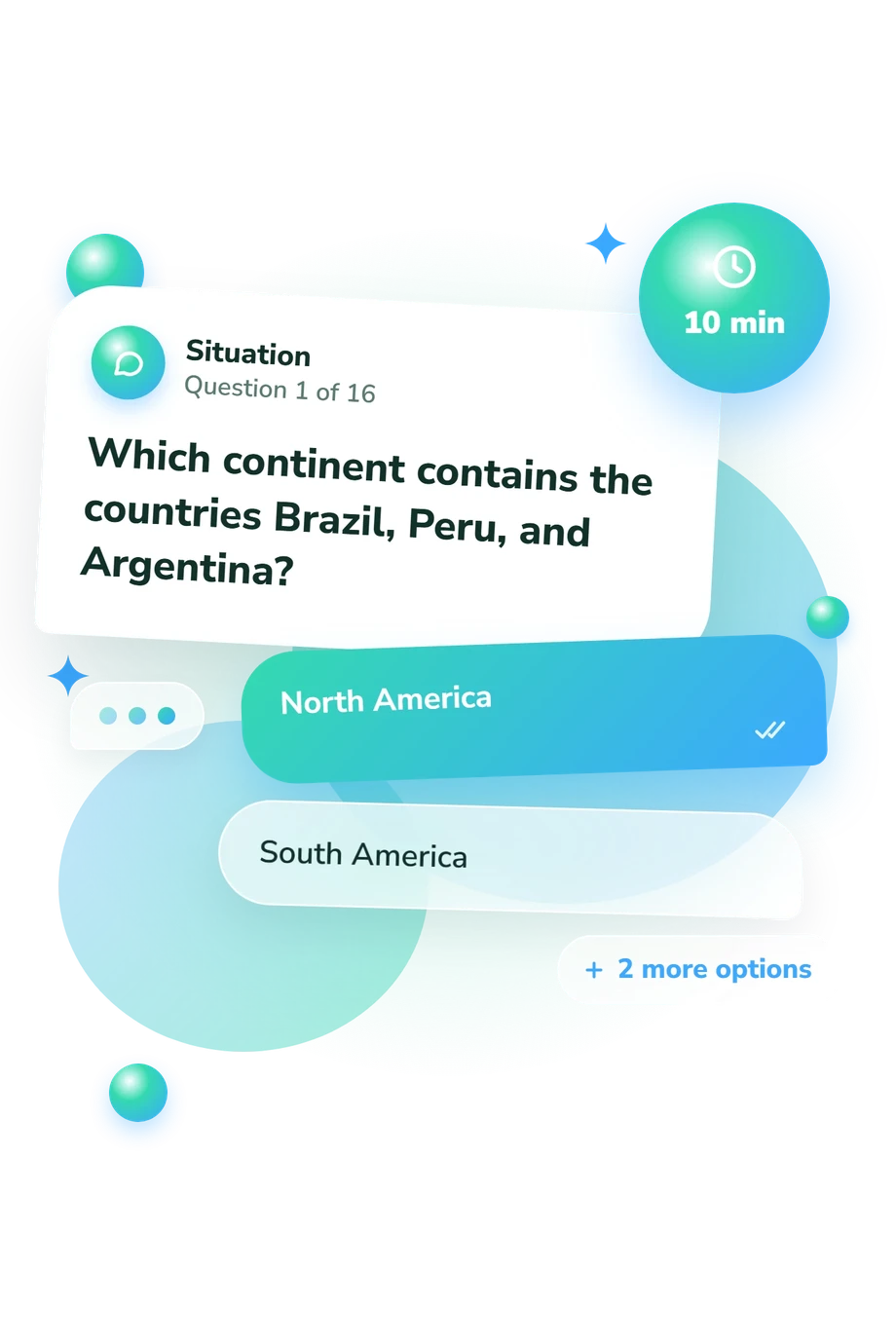
Example Questions From the Test
- North America
- South America
- Africa
- Europe
- 6
- 8
- 7
- 9
- Earth rotating on its axis
- Earth orbiting the Sun
- The Moon orbiting Earth
- Clouds blocking sunlight
Are You Smarter Than a 10 Year Old Quiz - Description and methodology of the test
People curious about their performance on broad school-level knowledge questions can use this assessment to see how they handle familiar material across subjects. This questionnaire puts the idea behind Are You Smarter Than a 10 Year Old Quiz Questions into practice through correct answers to broad school-level questions, including elementary application of facts and rules. The result makes this school-level general knowledge quiz useful for noticing strengths and gaps.
What This Assessment Measures
Questions range across geography, arithmetic, fractions, geometry, time, science, language, evidence, food chains, weather inference, and simple data interpretation. Together, they examine whether you can retrieve familiar facts and apply basic rules when distractors are present.
Here, the are you smarter than a ten year old quiz framing gives this questionnaire a playful age-level label, while the result remains a recreational picture of broad school-level knowledge.
The result uses the Age 10 General Knowledge scale (0-16), divided into these bands:
- Building Foundations (0-6) shows that you recognize some core ideas and have common school concepts to revisit.
- Developing Knowledge (7-12) indicates a solid base, although some topics remain challenging.
- Strong Knowledge (13-16) reflects at least about 80% correct answers across this broad set.
Methodology and Evidence Base
Each item offers four answer options and asks for one response. The displayed result reports performance on the correct-answer scale and its bands.
The closest conceptual comparison is BEFKI GC-K, a measure of crystallized knowledge within Horn and Cattell’s distinction between crystallized and fluid abilities. This questionnaire is consistent with that framework only as a comparison: it checks broad school-level knowledge and elementary application of facts and rules, not crystallized intelligence as a formal construct. It is not an adaptation of BEFKI GC-K; its items and scale are specific to this online assessment.
Goecke and colleagues found that fact knowledge did not change with response format in their study, supporting multiple choice as a practical delivery method. Vermeiren and colleagues provide English-language context for general-knowledge testing, but their work does not validate this questionnaire.
Interpretation should account for the fact that, as a general knowledge test, results may reflect language familiarity, prior schooling, memory, guessing, and attention; this online assessment has no documented norms or standardization, so its bands are descriptive for this set rather than evidence of general intelligence.
- Schipolowski, Stefan, Oliver Wilhelm, Ulrich Schroeders, Anastassiya Kovaleva, Christoph J. Kemper, and Beatrice Rammstedt. (2013). BEFKI GC-K: A Short Scale for the Measurement of Crystallized Intelligence. Methods, Data, Analyses, 7(2), 153-181. 10.12758/mda.2013.010
- Goecke, Benjamin, Marlena Staab, Catherine Schittenhelm, and Oliver Wilhelm. (2022). Stop Worrying about Multiple-Choice: Fact Knowledge Does Not Change with Response Format. Journal of Intelligence, 10(4), 102. 10.3390/jintelligence10040102
- Horn, John L., and Raymond B. Cattell. (1966). Refinement and Test of the Theory of Fluid and Crystallized General Intelligences. Journal of Educational Psychology, 57(5), 253-270. 10.1037/h0023816
- Vermeiren, Hanke, Aaron Vandendaele, and Marc Brysbaert. (2023). Validated Tests for Language Research with University Students Whose Native Language Is English: Tests of Vocabulary, General Knowledge, Author Recognition, and Reading Comprehension. Behavior Research Methods, 55(3), 1036-1068. 10.3758/s13428-022-01856-x
Updated: