
Advert Quiz
How the Scales are Structured
Who Usually Takes This Test?
See How You Compare
Below is a preview of how scores are typically distributed across each scale.
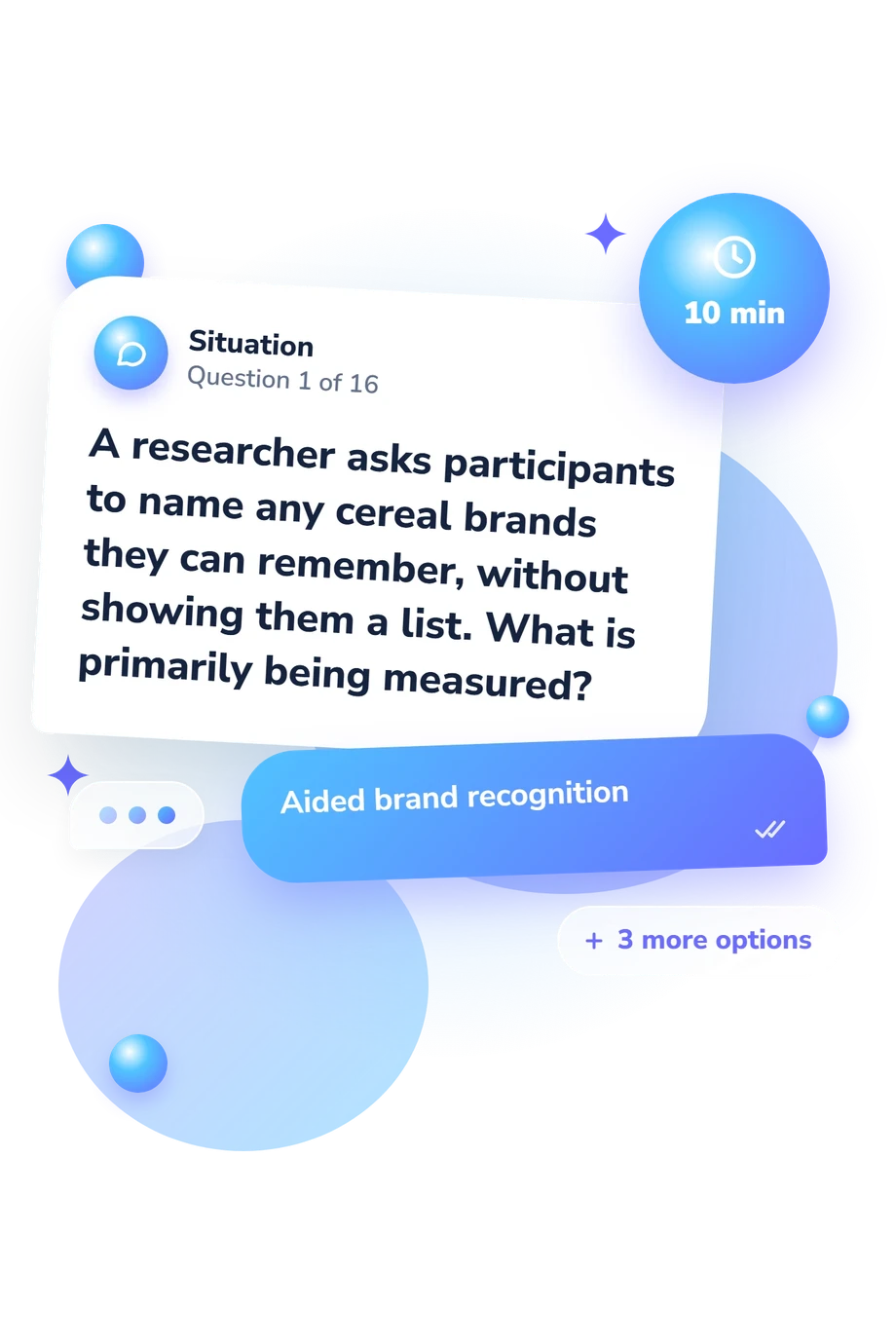
Example Questions From the Test
- 1%
- 1%
- 5%
- 5%
- 2%
- 5%
- 20%
- 5%
- Reminder advertising
- Institutional advertising
- Comparative advertising
- Product placement
Advert Quiz - Description and methodology of the test
For anyone who wants a practical check of advertising knowledge, the advert quiz turns familiar campaign language into a focused self-assessment. It suits learners, marketers, and curious viewers who want to recognize common concepts and apply them to simple examples. Its examples span advertising formats and digital campaign metrics, making this advertising knowledge quiz a practical way to review how messages work across media.
What This Assessment Explores
The assessment measures knowledge of advertising strategy, formats, persuasion, terminology, and campaign calculations; this advertising quiz focuses on applied concepts, not personal brand memory. Questions cover unaided brand recall, aided brand recognition, planning, persuasive devices, native advertising, and calculations; respondents identify these concepts and apply them to scenarios rather than test personal memory or recognition ability.
Key themes are:
- Brand awareness concepts distinguish unaided recall from aided recognition.
- Persuasion and language cover comparisons, puffery, jingles, testimonials, and calls to action.
- Planning and measurement connect audiences and scheduling with formats and campaign metrics.
The Advert Knowledge scale runs from 0-16. Foundational (0-6) reflects recognition of some advert ideas, with formats, terminology, and metrics to review. Developing (7-12) reflects understanding of common concepts, with application and measurement to strengthen. Strong (13-16) reflects a broad, reliable grasp of strategy, formats, persuasion, and calculations.
Methodology and Scientific Basis
Each item presents one question with four answer choices combining terminology, recognition, scenarios, and short calculations. Each correct answer earns one point, and the displayed bands interpret the total. The fixed-choice format yields one overall knowledge score; the themes describe question content, not separate subscores or a personality measure.
The questionnaire works as an advertising knowledge test whose topics overlap with the Advertising Literacy Scale for Children (Rozendaal et al., 2016), which examines recognition of commercial intent and persuasive strategies. Malmelin’s multidimensional account and Rozendaal, Lapierre, van Reijmersdal, and Buijzen’s work on advertising effects offer related conceptual context, while Belch and Belch support terminology for planning, formats, persuasion, and campaign calculations. Together, these sources provide conceptual reference points; they do not establish this online questionnaire as an adaptation, standardized measure, or validated instrument.
Interpret the overall result as a snapshot of applied knowledge, since responses can vary with attention, prior exposure, and carefulness; it is not a norm-referenced estimate.
- Rozendaal, Esther, Suzanna Opree, and Moniek Buijzen. "Development and validation of a survey instrument to measure children's advertising literacy." Media Psychology, 19(1), 2016, 72-100. 10.1080/15213269.2014.885843
- Malmelin, Nando. "What is Advertising Literacy? Exploring the Dimensions of Advertising Literacy." Journal of Visual Literacy, 29(2), 2010, 129-142. 10.1080/23796529.2010.11674677
- Rozendaal, Esther, Matthew A. Lapierre, Eva A. van Reijmersdal, and Moniek Buijzen. "Reconsidering Advertising Literacy as a Defense Against Advertising Effects." Media Psychology, 14(4), 2011, 333-354. 10.1080/15213269.2011.620540
- Belch, George E., and Michael A. Belch. Advertising and Promotion: An Integrated Marketing Communications Perspective. 12th ed., McGraw-Hill Education, 2021.
Updated: