
American Literature Quiz
How the Scales are Structured
Who Usually Takes This Test?
See How You Compare
Below is a preview of how scores are typically distributed across each scale.
Example Questions From the Test
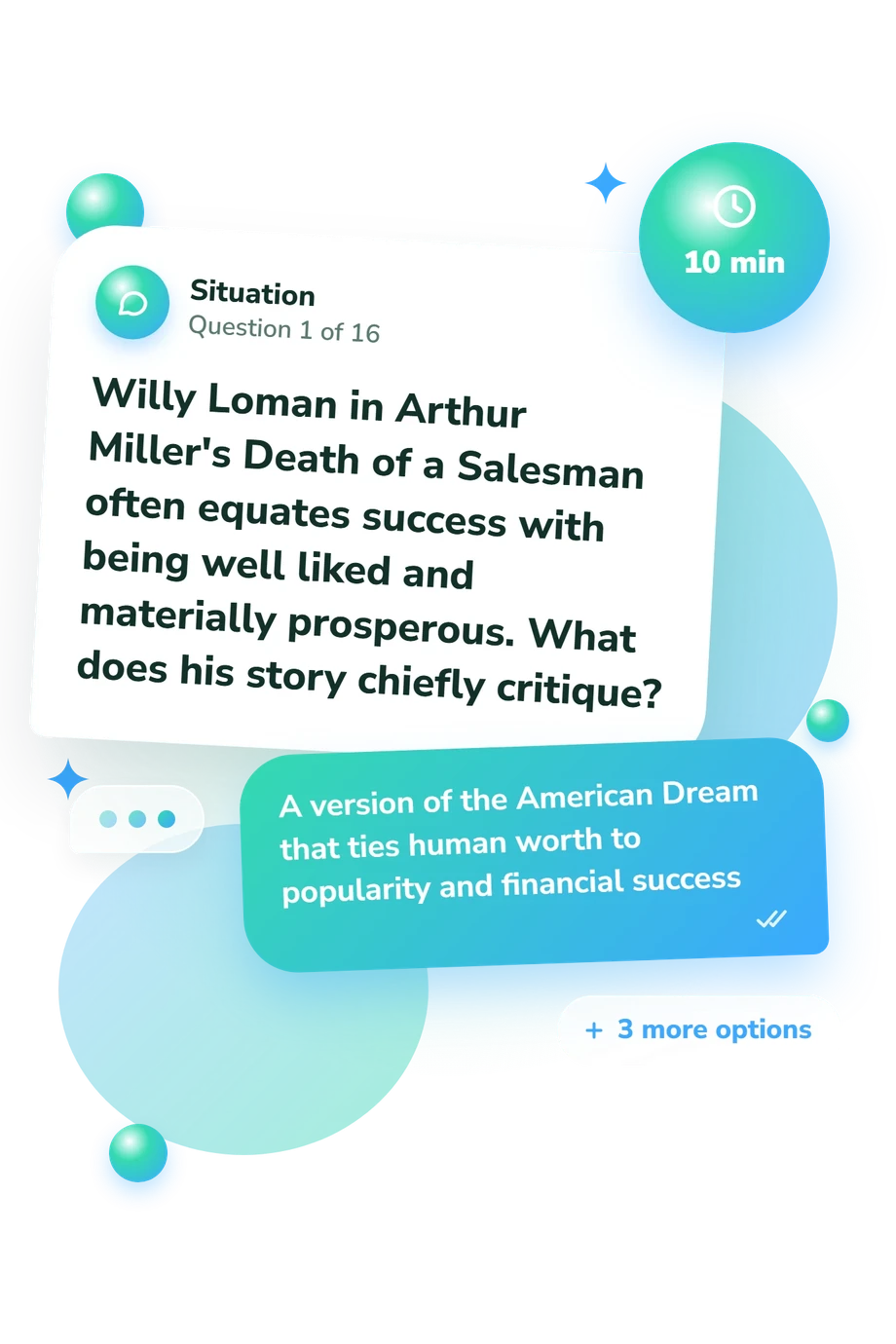
- A version of the American Dream that ties human worth to popularity and financial success
- The refusal of American workers to pursue any form of ambition
- The belief that family relationships matter more than professional achievement
- A business culture that rewards technical education rather than personal charm
- William Cullen Bryant
- Henry Wadsworth Longfellow
- Walt Whitman
- Wallace Stevens
- Ishmael
- Captain Ahab
- Starbuck
- Queequeg
American Literature Quiz - Description and methodology of the test
Readers who want to connect familiar titles with authors, movements, and literary techniques can use this assessment as a focused knowledge check. The assessment uses american literature quiz questions to indicate how securely you recognize major works and interpretive ideas across the tradition. It is designed for independent study as well as classroom preparation. The questions can also serve as an American literature study guide for targeted review.
What This Assessment Explores
Across the set, American literature practice questions cover authors, works, symbols, narrators, themes, historical context, and literary movements. Some test recognition; others connect form or character with meaning. Together, they make a broad survey of literary knowledge and interpretation.
The questions sample four connected thematic areas:
- Author recognition shows whether you connect writers with texts.
- Themes and symbols show how you link images or conflicts with larger ideas.
- Form and technique reveal attention to narration, chronology, syntax, and style.
- Context and interpretation show how you relate choices to movements and history.
Together, these areas contribute to one aggregate American Literature Knowledge score, which runs from 0-16. Foundations to build (0-6) signals review needs; Developing survey knowledge (7-12) shows a useful grasp with connections to strengthen; Strong survey knowledge (13-16) reflects accurate links among texts, techniques, themes, and contexts.
Methodology and Evidence Base
Respondents encounter an American literature quiz with answers selected from four response choices; each item has one best answer about a text, context, or interpretation. Scoring is direct: each correct answer contributes one point to the aggregate score.
The coverage is conceptually consistent with CLEP American Literature, which joins survey knowledge with interpretation, but this questionnaire is not an adaptation of that examination. Ruland and Bradbury provide historical context for periods, movements, authors, and cultural change. The questionnaire is conceptually consistent with the ETS 4HMF content specification, which pairs literary knowledge with interpretation, but it is not built from that examination outline. Deane's work supports building meanings from textual features rather than from titles alone.
The displayed bands describe performance on these 16 questions: a higher band reflects more keyed answers across this selection, not mastery of American literature as a whole. Scores depend on the tested content, prior exposure, and the respondent's self-report, so missed questions can guide focused review and further reading.
- College Board. CLEP American Literature. College Board, 2020.
- Ruland, Richard, and Malcolm Bradbury. From Puritanism to Postmodernism: A History of American Literature. Viking, 1991.
- Educational Testing Service. Test Content-Literature in English (4HMF). Educational Testing Service, 2011.
- Deane, Paul. Building and Justifying Interpretations of Texts: A Key Practice in the English Language Arts. ETS Research Report Series, 2020, pp. 1-53. 10.1002/ets2.12304
Updated: