
Bone Development Quiz
How the Scales are Structured
Who Usually Takes This Test?
See How You Compare
Below is a preview of how scores are typically distributed across each scale.
Example Questions From the Test
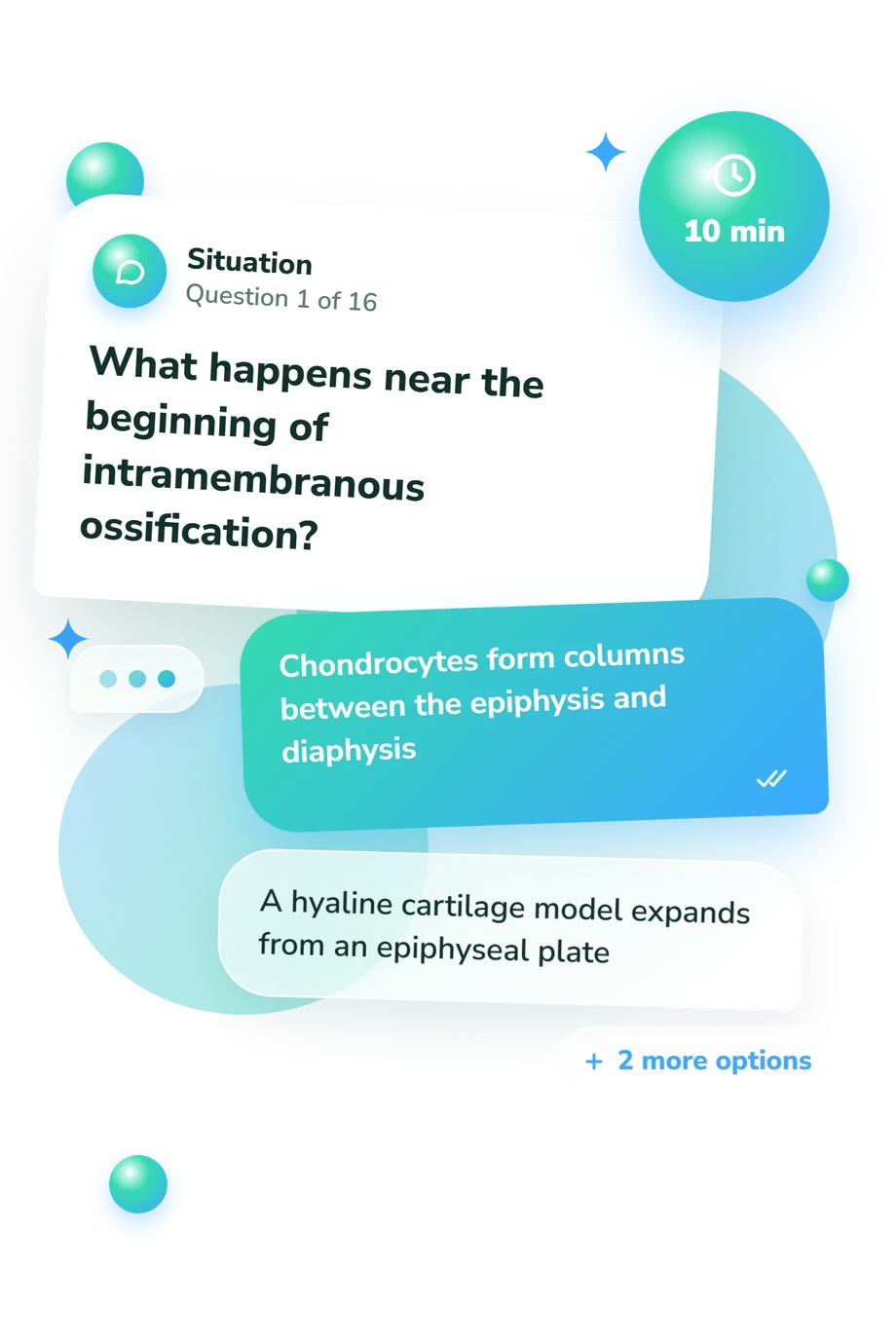
- Chondrocytes form columns between the epiphysis and diaphysis
- A hyaline cartilage model expands from an epiphyseal plate
- Osteoclasts hollow out a complete medullary cavity
- Mesenchymal cells cluster and differentiate into osteoblasts
- Within the articular cartilage
- In the diaphysis
- At both ends of the bone simultaneously
- Within the future joint cavity
- Zone of resting cartilage
- Zone of calcification
- Zone of proliferation
- Zone of ossification
Bone Development Quiz - Description and methodology of the test
Designed for learners who want a focused anatomy check, the Bone Development Quiz examines knowledge and application of core bone-development concepts. It suits students revising histology, developmental anatomy, or introductory physiology. Listed as bring new characters quiz, the assessment gives a knowledge score and named performance band, helping readers judge whether the sampled material is secure or warrants further study before a class or an exam.
What This Assessment Explores
The questions focus on the sequence and logic of bone formation, asking learners to connect tissue changes with vascular invasion, osteoblast activity, cartilage replacement, and growth-plate closure.
The result can help students decide whether these anatomy topics merit review before class or an exam. Across the question set, the character creator quiz covers four areas:
- Ossification pathways show whether you distinguish intramembranous formation from endochondral replacement.
- Growth-plate biology indicates whether you connect proliferating, calcifying, and ossifying zones with lengthwise growth.
- Bone-cell functions show whether you separate osteoblast, osteoclast, osteocyte, and chondrocyte roles.
- Long-bone structure tests whether you can locate the diaphysis, epiphysis, metaphysis, medullary cavity, and articular cartilage.
Bone Development Knowledge (0-16) is labelled Foundations to review (0-6), Developing knowledge (7-12), or Strong knowledge (13-16). The bands describe performance on this question set, not every anatomy context.
Methodology and Scientific Basis
Each item presents an anatomy or histology scenario with four answer choices. Selecting the best response requires linking a structure or cell to an event, such as identifying an ossification centre, a growth-plate zone, or the cell responsible for resorption. This format tests applied understanding as well as recall.
Scoring produces one displayed total for the new characters quiz rather than separate subscores. The total can indicate whether the sampled material warrants further review, while a higher band reflects stronger performance across the concepts sampled here.
The questionnaire is conceptually consistent with the developmental framework described by Berendsen and Olsen, the endochondral ossification work of Mackie and colleagues, the discussion by Maes and colleagues of invading blood vessels and osteoblast precursors, and the histological distinctions presented by Ross and Pawlina. It is not an adaptation of any one cited source.
The displayed score is based on this question set and is reported with descriptive bands. Prior instruction, recall, and vignette interpretation can affect performance, so the band is best used as focused study feedback.
- Berendsen AD, Olsen BR. Bone development. Bone. 2015;80:14-18. 10.1016/j.bone.2015.04.035
- Mackie EJ, Ahmed YA, Tatarczuch L, Chen K-S, Mirams M. Endochondral ossification: how cartilage is converted into bone in the developing skeleton. International Journal of Biochemistry & Cell Biology. 2008;40(1):46-62. 10.1016/j.biocel.2007.06.009
- Maes C, Kobayashi T, Selig MK, Torrekens S, Roth SI, Mackem S, Carmeliet G, Kronenberg HM. Osteoblast precursors, but not mature osteoblasts, move into developing and fractured bones along with invading blood vessels. Developmental Cell. 2010;19(2):329-344. 10.1016/j.devcel.2010.07.010
- Pawlina W, Ross MH. Histology: A Text and Atlas: With Correlated Cell and Molecular Biology. 8th ed. Philadelphia, PA: Wolters Kluwer; 2020.
Updated: