
British Music Quiz
How the Scales are Structured
Who Usually Takes This Test?
See How You Compare
Below is a preview of how scores are typically distributed across each scale.
Example Questions From the Test
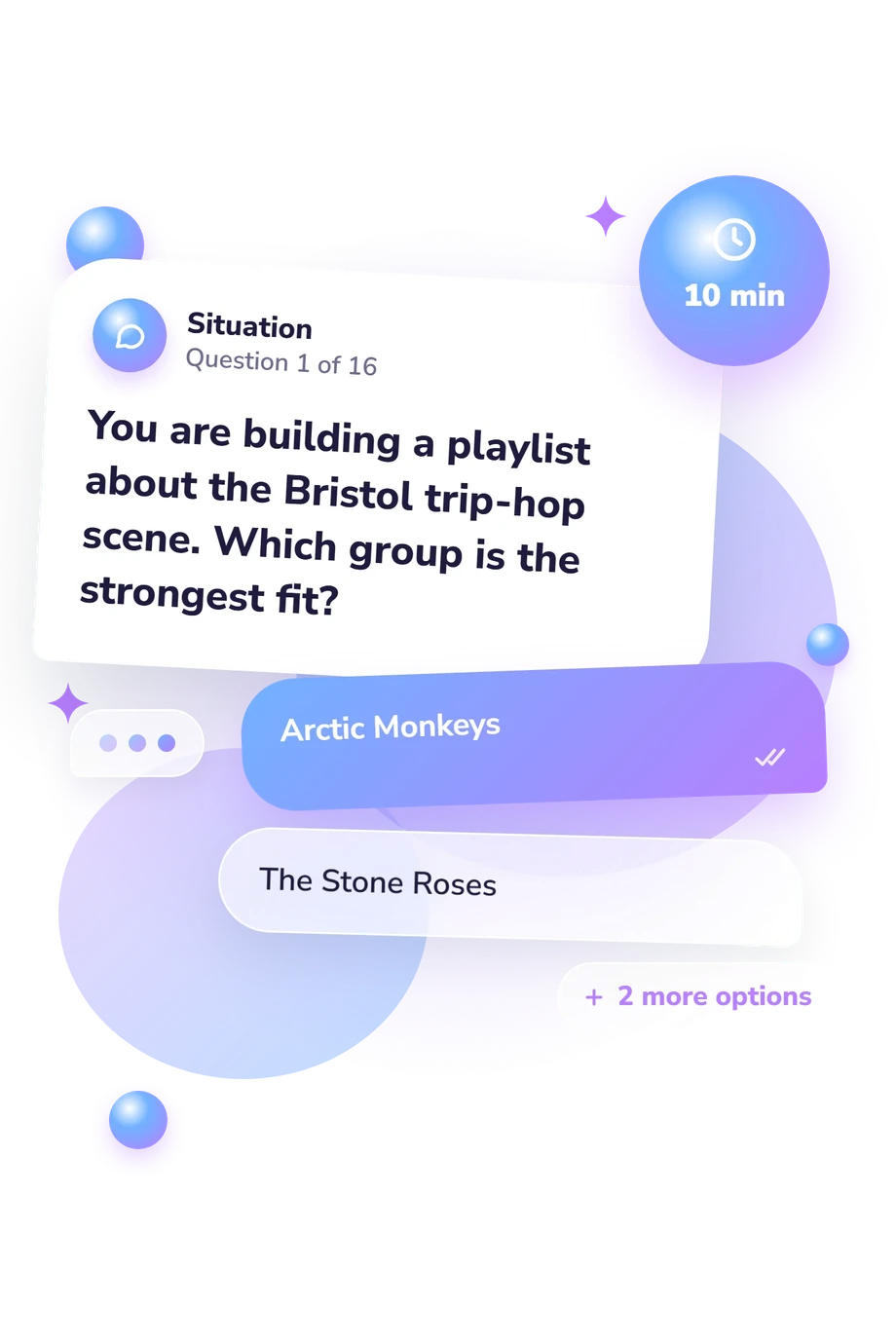
- Arctic Monkeys
- The Stone Roses
- Franz Ferdinand
- Massive Attack
- She is a Greek student studying sculpture at Saint Martin’s
- She is a French fashion student working in Soho
- She is an American singer visiting London
- She is a German photographer attending an exhibition
- “Baba O’Riley” by The Who
- “Bohemian Rhapsody” by Queen
- “A Day in the Life” by The Beatles
- “Kashmir” by Led Zeppelin
British Music Quiz - Description and methodology of the test
For readers testing their grasp of British artists, recordings and scenes, Business Finance Quiz Questions and Answers provides a structured knowledge challenge. Its music quiz questions and answers connect familiar names with albums, lyrics, movements and places, making the format accessible to curious listeners and fans checking how broadly their memories hold across decades. The result offers a compact profile of remembered strengths and areas that may invite further listening.
What This Assessment Explores
The assessment tests recognition across British popular music rather than personal taste. Items connect performers with albums, lyrics, movements, regional scenes, festival culture and places, creating a broad picture of cultural recall. This British music quiz suits curious listeners and fans checking the range of their knowledge.
The result groups recognition into these areas:
- Artists and recordings show whether you connect performers with signature albums, songs, personas and vocal roles.
- Scenes and movements indicate whether you identify regional traditions, post-punk, trip-hop, Britpop and related settings.
- Lyrics, places and influences reveal whether you recognize story details, literary sources, festival locations and cities linked with landmark bands.
British Music Knowledge runs from 0 to 16: Starting Listener (0-6) signals familiar touchstones with room to explore; Developing Knowledge (7-12) indicates solid command with some gaps; Music Expert (13-16) reflects wide, accurate knowledge.
Methodology and Evidence Base
Each item offers four answer options, and the respondent selects the choice that best fits the musical fact, lyric, location or cultural connection being tested. The score rises with correct recognition, while the displayed band summarizes breadth of recall. As a music trivia quiz, it rewards familiarity with cultural details, not genre preference.
The questionnaire can be read alongside the cultural framework of Frith, Straw and Street (2001), which relates popular music to genres, industries, audiences and social meaning. Harris (2004) provides especially relevant context for the Britpop items, while Stratton and Zuberi (2014) broaden the background for Black popular music in Britain. These books offer conceptual context; they are not validation studies for this questionnaire, which is an online British music knowledge test rather than an adaptation of their instruments.
Performance can vary with memory, attention, listening history and familiarity when choosing among options. The result does not establish musical expertise in every setting or provide standardized norms. It is most useful for self-reflection: it highlights remembered strengths and points toward scenes, decades or artists worth revisiting.
- The Cambridge Companion to Pop and Rock, edited by Simon Frith, Will Straw, and John Street. Cambridge University Press, 2001. 10.1017/CCOL9780521553698.
- Britpop!: Cool Britannia and the Spectacular Demise of English Rock, John Harris. Da Capo Press, 2004. ISBN 9780306813672.
- Black Popular Music in Britain Since 1945, edited by Jon Stratton and Nabeel Zuberi. Ashgate, 2014. ISBN 9781409469131.
Updated: