
Are You a Munch Quiz
How the Scales are Structured
Who Usually Takes This Test?
See How You Compare
Below is a preview of how scores are typically distributed across each scale.
Example Questions From the Test
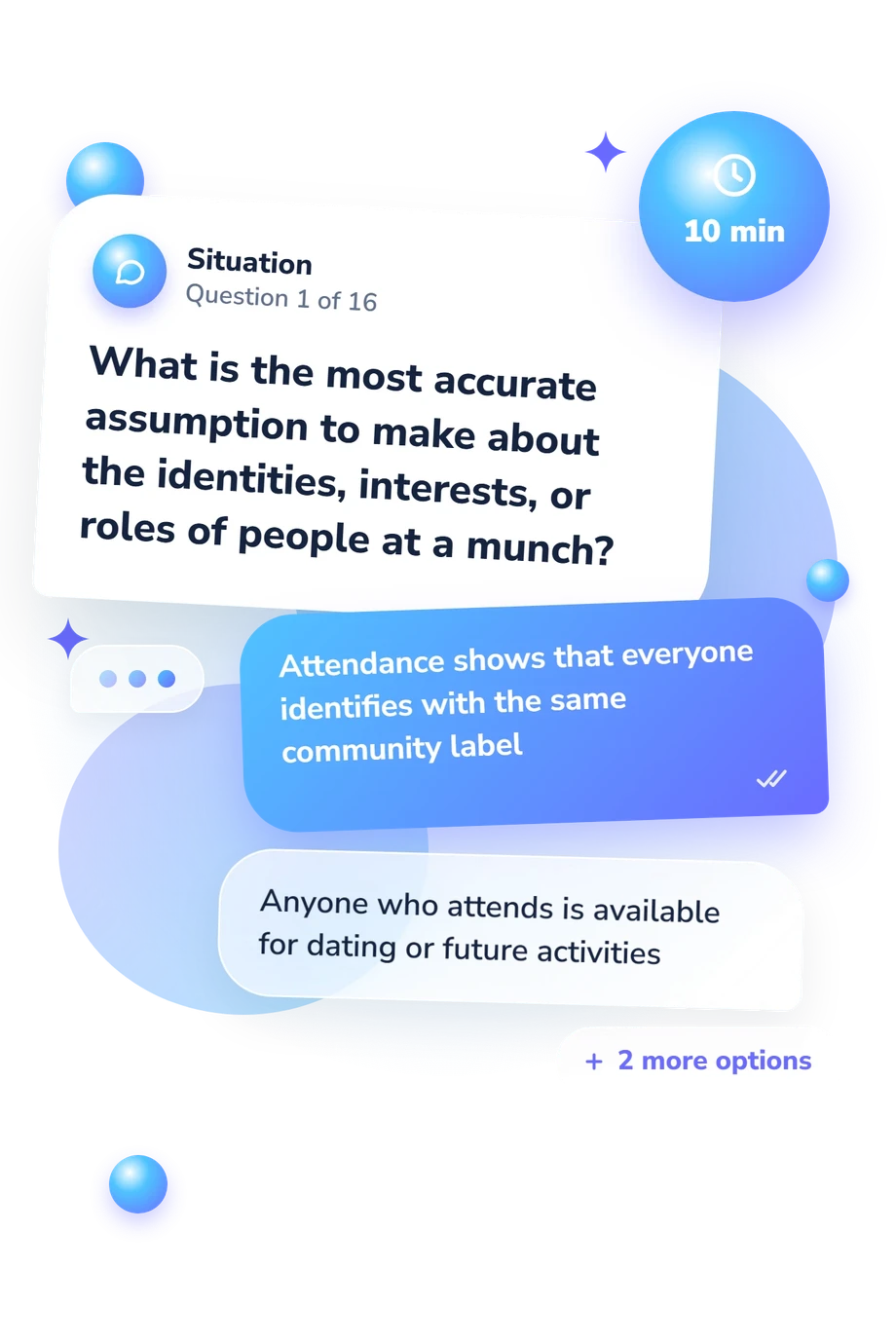
- Attendance shows that everyone identifies with the same community label
- Anyone who attends is available for dating or future activities
- Experienced attendees can usually identify another person’s role from clothing
- People may attend for varied reasons, so individual identities and interests should not be inferred
- Attend without asking because all munches use the same admission rules
- Rely on an attendee’s description from a different local event
- Contact the organizer or consult the event’s official information before attending
- Assume public-venue events cannot set attendance requirements
- Hug briefly because friendly contact is expected at social events
- Wait for the newcomer to object if they dislike physical contact
- Ask the organizer which attendees normally permit hugs
- Ask before hugging and comfortably accept a different greeting
Are You a Munch Quiz - Description and methodology of the test
People who are new to kink-community social events, or who want to check their etiquette knowledge, can use the Are You a Munch Quiz to examine how they understand respectful participation. The munch quiz focuses on practical decisions around consent, privacy, boundaries, and public-venue conduct. It gives readers a focused picture of current knowledge and highlights topics worth reviewing before a real event.
What This Assessment Explores
Rather than asking about identity, the assessment checks whether someone can distinguish a gathering from a play-focused event and avoid assumptions about attendees. It examines boundaries, discomfort, privacy, photography, disclosure, and venue expectations. This munch etiquette quiz treats etiquette as respect for autonomy and safety, not fluency with labels or private interests.
The scenarios cover these situations, while the score reflects knowledge of how they should be handled rather than whether the respondent will behave that way at an event. It reflects four areas:
- Social purpose and assumptions: it measures understanding that attendees have varied identities, interests, and reasons.
- Consent and boundaries: it measures recognition that consent is specific, ongoing, and freely given.
- Privacy and disclosure: it measures recognition of when identification, photographs, and discussion can affect privacy.
- Venue and conduct: it measures understanding that venue rules shape conduct.
Methodology and Evidence Base
Each item presents a brief social situation with four response options. The alternatives distinguish consent-aware conduct from assumptions that attendance, alcohol, familiarity, or openness automatically grant permission. As a munch knowledge test, the questionnaire applies practical principles to ordinary event decisions rather than asking respondents to identify a community label.
The result is reported on one displayed educational scale, Munch Gathering Knowledge, ranging from 0-16. The visitor sees Foundations to build (0-6), Developing knowledge (7-12), or Strong knowledge (13-16). It measures understanding of what a munch is and how consent, privacy, and venue rules apply; the score does not confirm readiness or guarantee safety at a particular gathering.
Webster and Ivanov (2019) describe munches as social spaces, while Webster and Klaserner (2019) examine community socializing. The scenarios are conceptually consistent with those studies, consent principles discussed by Dunkley and Brotto (2020), and privacy concerns examined by Bezreh, Weinberg, and Edgar (2012). The online questionnaire has no stated standardization or normative data; its displayed bands are educational catalogue bands, not validated norms. Bands guide learning; self-report varies, so review local event rules.
- Webster, Craig, and Stanislav Hristov Ivanov. “Events Are Bound to Happen, Spank You Very Much: The Importance of Munch Events in the BDSM Community.” Event Management, vol. 23, no. 4, 2019, pp. 669-684. 10.3727/152599518X15403853721529
- Webster, Craig, and Molly Klaserner. “Fifty Shades of Socializing: Slosh and Munch Events in the BDSM Community.” Event Management, vol. 23, no. 1, 2019, pp. 135-147. 10.3727/152599518X15378845225401
- Dunkley, Cara R., and Lori A. Brotto. “The Role of Consent in the Context of BDSM.” Sexual Abuse, vol. 32, no. 6, 2020, pp. 657-678. 10.1177/1079063219842847
- Bezreh, Tanya, Thomas S. Weinberg, and Timothy Edgar. “BDSM Disclosure and Stigma Management: Identifying Opportunities for Sex Education.” American Journal of Sexuality Education, vol. 7, no. 1, 2012, pp. 37-61. 10.1080/15546128.2012.650984
Updated: