
AP US History Chapter 6 Quiz
How the Scales are Structured
Who Usually Takes This Test?
See How You Compare
Below is a preview of how scores are typically distributed across each scale.
Example Questions From the Test
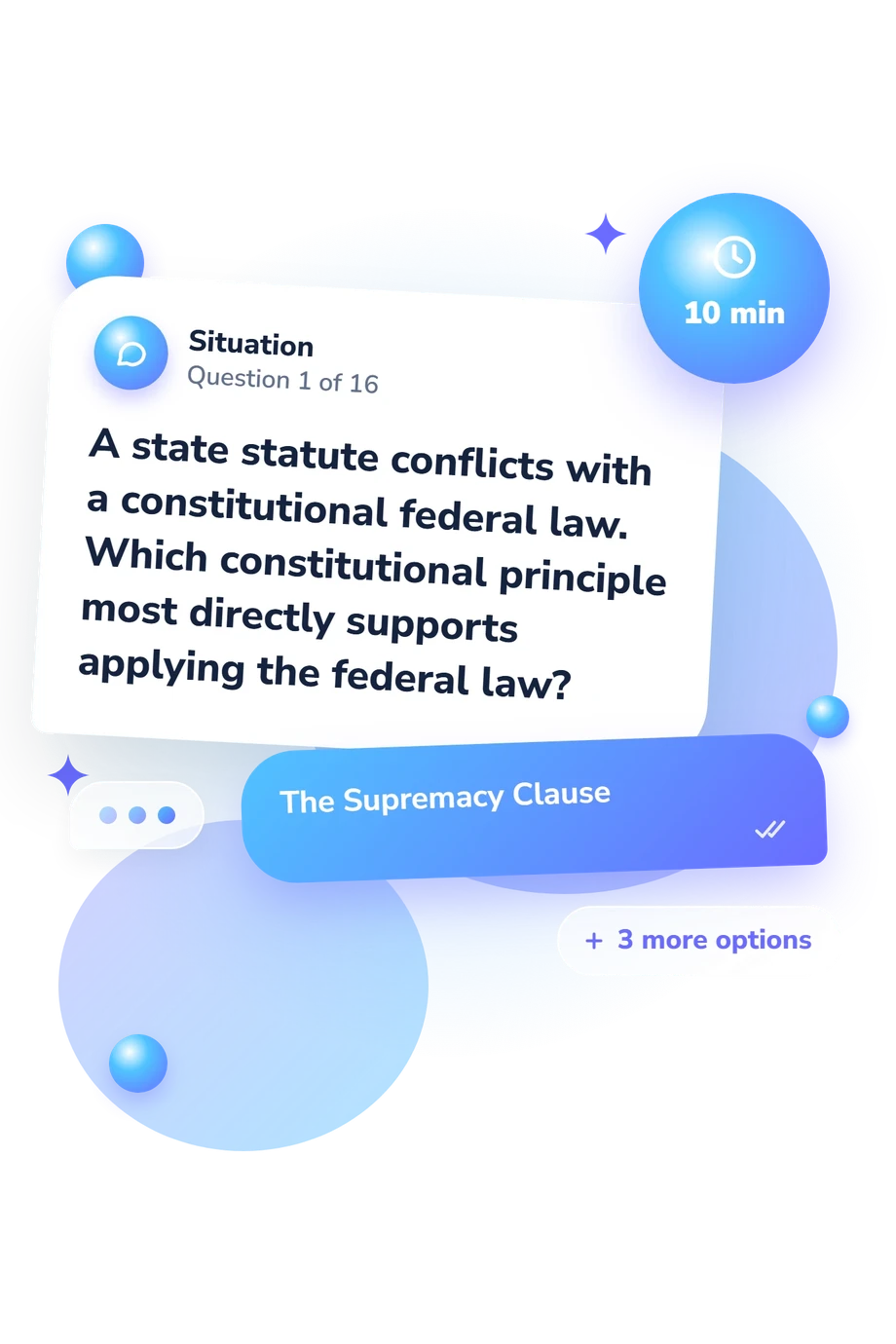
- The Supremacy Clause
- The Full Faith and Credit Clause
- The Guarantee Clause
- The Ex Post Facto Clause
- The Senate
- The House of Representatives in every election
- The president's Cabinet
- The Electoral College
- Common Sense
- Letters from a Farmer in Pennsylvania
- The Federalist Papers
- The Virginia and Kentucky Resolutions
AP US History Chapter 6 Quiz - Description and methodology of the test
Students preparing for a unit assessment can use this questionnaire to check whether they connect constitutional ideas with events of the Early Republic. The APUSH Chapter 6 quiz emphasizes historical understanding rather than isolated name recall. Its result can show which content deserves another pass before classwork or an exam. The AP US History Chapter 6 Quiz is therefore suited to learners who want a focused check of chapter knowledge.
What This Assessment Measures
Content covers the Constitution and Early Republic through principles, compromises, institutions, policy, diplomacy, and conflict. It is intended for students reviewing course material, with the result showing which connections are secure and which need another pass. An APUSH Chapter 6 review can use these dimensions to organize study rather than count names.
These groups show what the result samples:
- Constitutional structure shows whether you can apply supremacy, checks and balances, representation, and amendment.
- Ratification and compromise measure your grasp of debates and agreements behind the new government.
- Federal policy and institutions cover Hamiltonian programs, executive authority, and enforcement of national law.
- Political conflict and diplomacy test party controversy, neutrality, treaties, and western trade.
The single scale is AP U.S. History Chapter 6 Knowledge (0-16), with Foundation to Review (0-6), Developing Command (7-12), and Strong Command (13-16).
Methodology and Evidence Base
Each item presents a historical question or scenario with four answer choices. The respondent selects the best answer, and the result is a total number of correct responses mapped to the displayed band. The fixed-choice format cannot show how a student would construct an argument, explain causation, or use evidence in writing.
Content is conceptually consistent with Brinkley, Giggie, and Huebner (2022), and its chronology fits the AP U.S. History framework described by College Board (2026). The set provides AP US history chapter 6 practice questions that can guide targeted revision. Hamilton, Madison, and Jay’s Federalist essays provide primary context for representation, federal power, and ratification. Smith, Breakstone, and Wineburg (2019) supports the emphasis on historical thinking in assessment, but does not validate this questionnaire.
The result provides a correct-answer total and descriptive bands rather than a population comparison or reported reliability statistic. As a chapter-focused self-check, it covers selected course content. Memory, classroom phrasing, and current study context can affect performance. Fixed-choice items sample selected knowledge, not the full range of historical reasoning, writing, sourcing, or course mastery.
- Brinkley, Alan, John M. Giggie, and Andrew J. Huebner. The Unfinished Nation: A Concise History of the American People. 10th ed., chapter 6, “The Constitution and the New Republic.” McGraw Hill, 2022.
- College Board. AP U.S. History Course and Exam Description, Effective Fall 2026. College Board, 2026.
- Hamilton, Alexander, James Madison, and John Jay. The Federalist Papers. Edited by Clinton Rossiter, with introduction and notes by Charles R. Kesler. Signet Classic, 2003.
- Smith, Mark, Joel Breakstone, and Sam Wineburg. “History Assessments of Thinking: A Validity Study.” Cognition and Instruction, vol. 37, no. 1, 2019, pp. 118-144. 10.1080/07370008.2018.1499646
Updated: