
Biology Quiz for Class 8
How the Scales are Structured
Who Usually Takes This Test?
See How You Compare
Below is a preview of how scores are typically distributed across each scale.
Example Questions From the Test
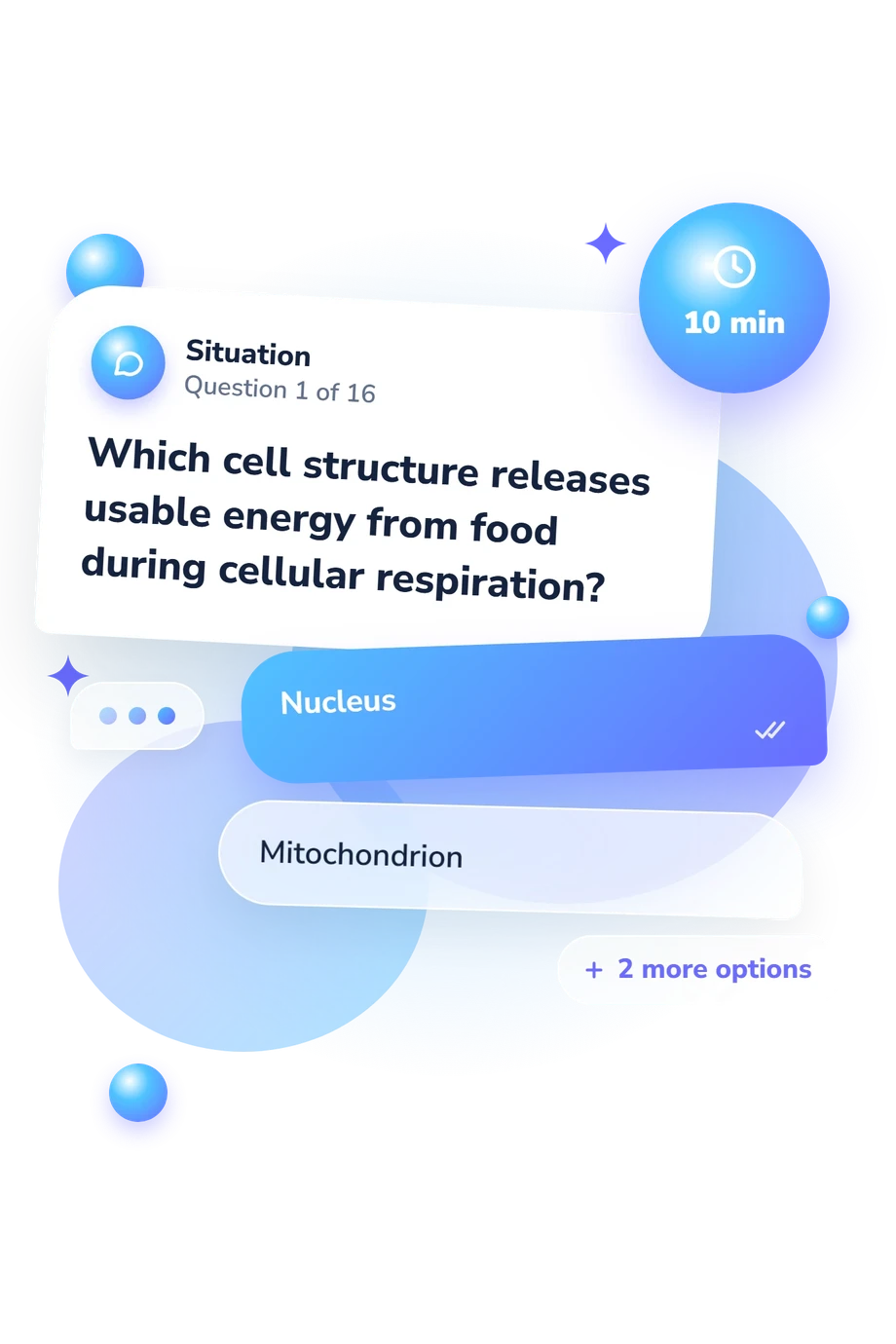
- Nucleus
- Mitochondrion
- Vacuole
- Cell wall
- Water moves into the cell by osmosis.
- Salt leaves the cell by active transport.
- Water moves out of the cell by osmosis.
- The cell wall is broken down by enzymes.
- Germination
- Fertilization
- Seed dispersal
- Pollination
Biology Quiz for Class 8 - Description and methodology of the test
Teachers, parents, and Class 8 learners can use this black history biology quiz to connect core biology learning with the achievements of Black scientists and medical researchers. Using this black history month quiz printable can help identify topics that deserve review rather than simply recall isolated names. The questions place historical contributions inside curriculum themes such as cells, ecosystems, and human body systems.
What This Assessment Explores
The questionnaire checks whether a Class 8 learner can apply core biology ideas while recognizing contributions by Black scientists. It suits review or independent study; the result describes demonstrated knowledge, not a clinical or intellectual label.
Items cover cells, energy, osmosis, photosynthesis, body systems, ecology, and antibiotic resistance. Historical prompts connect these themes with Ernest Everett Just, Charles Drew, George Washington Carver, and Henrietta Lacks. As a printable black history quiz, it combines conceptual reasoning with science-history recall.
The combined result draws on these content areas:
- Class 8 Biology and Black Science History Knowledge runs from 0-16: Building Foundations (0-6), Developing Knowledge (7-12), or Strong Knowledge (13-16) reflects increasing command of the combined content.
- Biology processes test explanations of cellular, organismal, and ecological relationships.
- Black science history tests whether the learner links people and discoveries with significance.
Methodology and Scientific Basis
Each item presents a short prompt with four answer choices, asking the learner to select the explanation or fact that best fits. The set mixes knowledge questions with application scenarios involving osmosis, food webs, reflexes, blood vessels, natural selection, and yeast respiration. In this black science history quiz, historical knowledge sits alongside biology rather than in a separate trivia section.
The outcome is one combined knowledge score based on performance across the items. The displayed bands are descriptive review levels; prior instruction, language, guessing, and familiarity with named scientists can affect performance.
National Research Council (2012) provides a compatible educational framework through its emphasis on inquiry, recurring concepts, and foundational ideas; this questionnaire is conceptually consistent with that framework, not an adaptation of it. Carey (2008) supports the historical context, while Byrnes and Newman (2014) give closer context for Just’s research and Gey, Coffman, and Kubicek (1952) document the early HeLa cell-culture work. The cited works support the content and its conceptual alignment, but they do not establish this questionnaire's reliability, validity, or cut scores.
- Quinn, Helen R., Wyatt W. Anderson, Tanya M. Atwater, et al. 2012. A Framework for K-12 Science Education: Practices, Crosscutting Concepts, and Core Ideas. Washington, DC: The National Academies Press. 10.17226/13165
- Carey, Charles W., Jr. 2008. African Americans in Science: An Encyclopedia of People and Progress. 2 vols. Santa Barbara, CA: ABC-CLIO.
- Byrnes, W. Malcolm, and Stuart A. Newman. 2014. Ernest Everett Just: Egg and Embryo as Excitable Systems. Journal of Experimental Zoology Part B: Molecular and Developmental Evolution 322(4):191-201. 10.1002/jez.b.22567
- Gey, George Otto, Ward D. Coffman, and Mary Toye Kubicek. 1952. Tissue Culture Studies of the Proliferative Capacity of Cervical Carcinoma and Normal Epithelium. Cancer Research 12(4):264-265.
Updated: