
Are You Easily Scared Quiz
How the Scales are Structured
Who Usually Takes This Test?
See How You Compare
Below is a preview of how scores are typically distributed across each scale.
Example Questions From the Test
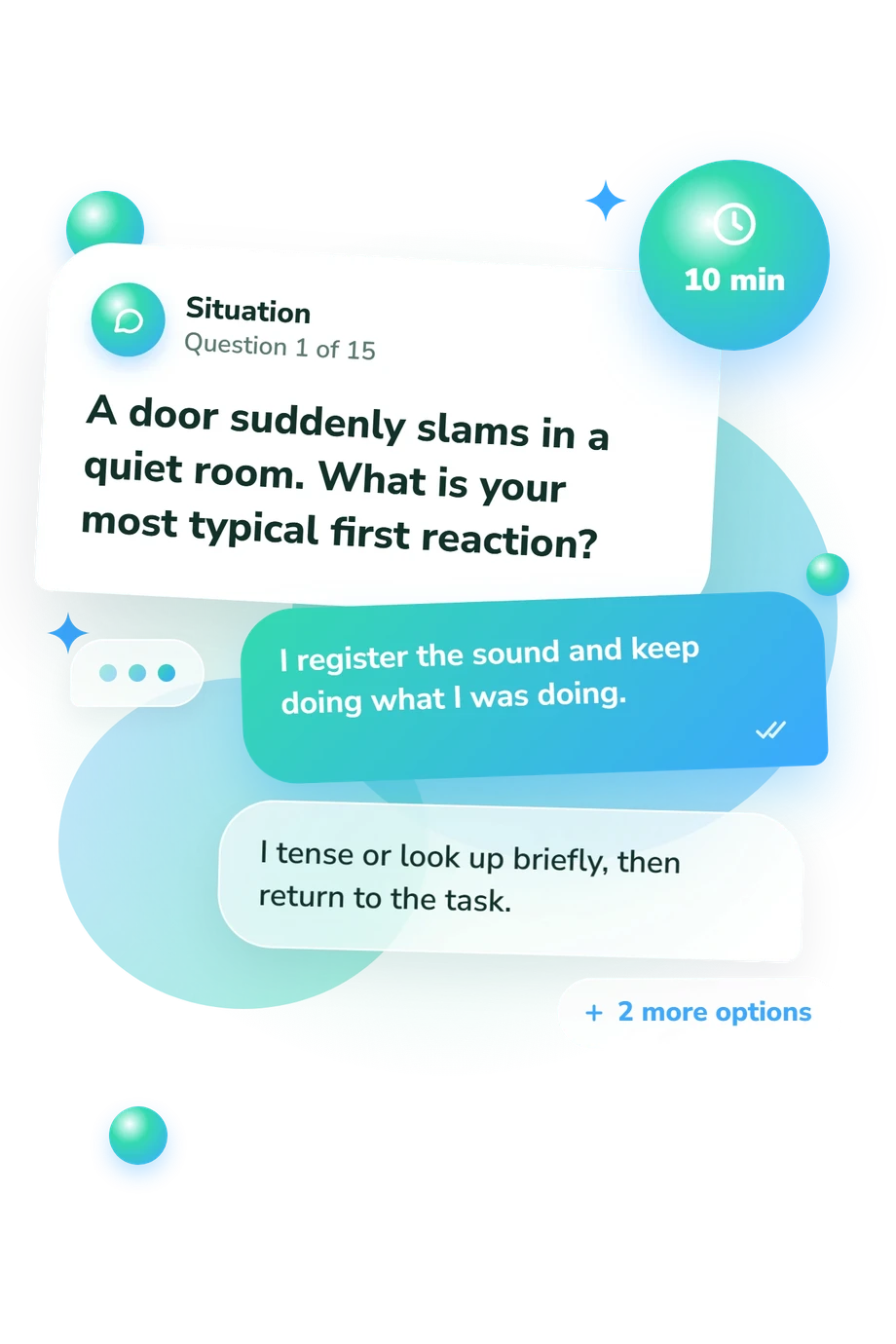
- I register the sound and keep doing what I was doing.
- I tense or look up briefly, then return to the task.
- I jump noticeably and need a moment to reset.
- My whole body reacts, and it takes several moments to settle.
- Possible problems occupy a lot of my attention and make the wait frightening.
- I repeatedly imagine difficult outcomes, even while trying to prepare.
- I have a few uneasy thoughts but can redirect my attention.
- I mainly focus on practical details and leave the rest until the appointment.
- I turn around without much physical reaction.
- I feel a small jolt but answer them right away.
- I visibly flinch and briefly lose track of what I was doing.
- I react sharply and remain physically unsettled after answering.
Are You Easily Scared Quiz - Description and methodology of the test
People who want to understand their reactions to surprise, uncertainty, and frightening experiences can use the Are You Easily Scared Quiz as a focused self-reflection tool. The profile separates fear before an event, the first response to sudden stimulation, and what remains afterward. It gives readers considering a fear response quiz a clearer way to notice patterns without treating one result as a fixed identity.
What This Assessment Explores
Fear can begin before uncertainty, appear as a bodily jolt, or remain active afterward. The questions examine anticipation, startle sensitivity, and fear’s influence on attention, routines, and choices. It suits people reflecting on everyday reactions, not seeking a fixed label.
Viewed as an easily scared test, it separates imagined danger, abrupt reaction, and continued avoidance. A higher result in one area does not mean an identical pattern appears elsewhere.
The result presents three dimensions with descriptive bands:
- Anticipatory Fear (0-15) measures fear building around uncertainty: Limited anticipation (0-5), Situational anticipation (6-10), or Strong anticipation (11-15).
- Startle Sensitivity (0-15) measures the first reaction to abrupt stimuli: Steady response (0-5), Noticeable startle (6-10), or Strong startle (11-15).
- Fear Recovery and Impact (0-15) measures lingering fear and its influence on choices: Brief influence (0-5), Moderate carryover (6-10), or Lasting influence (11-15).
Methodology and Scientific Basis
Items use short scenarios about sudden sounds or movements, uncertain waiting, frightening media or settings, and what follows a scare. Four ordered responses move from little or brief reaction toward stronger, more persistent, or more disruptive effects. This self-report fear sensitivity test captures reported experience, not a physiological startle reflex.
Three separate scores summarize the questionnaire. Higher values indicate more fear buildup, immediate reactivity, or carryover according to each scale’s definition. The bands are descriptive; no standardized weighting formula, population norms, reliability coefficients, or clinical cutoffs are stated.
Vaidyanathan et al. (2009) supplies the closest conceptual link through trait-fear and potentiated-startle research. Grillon et al. (1991) addresses anticipatory anxiety; Chen et al. (2026) adds measurement context for startle and surprise; and Huff et al. (2009) concerns persistence and return of conditioned fear. These studies support the constructs but do not validate this online questionnaire as an adaptation.
Stress, fatigue, and self-awareness can shift self-report, so read the profile as a snapshot rather than a fixed trait. If fear limits daily life or leaves you feeling unsafe, trusted support may help.
- Vaidyanathan, U., Patrick, C. J., & Bernat, E. M. (2009). Startle reflex potentiation during aversive picture viewing as an indicator of trait fear. Psychophysiology, 46(1), 75-85. 10.1111/j.1469-8986.2008.00751.x
- Chen, J., Landman, A., Derumigny, A., Stroosma, O., van Paassen, M. M., & Mulder, M. (2026). Development and validation of the startle and surprise Inventories and Visual Analogue scales. Ergonomics, 69(8), 1612-1625. 10.1080/00140139.2025.2529317
- Grillon, C., Ameli, R., Woods, S. W., Merikangas, K., & Davis, M. (1991). Fear-potentiated startle in humans: Effects of anticipatory anxiety on the acoustic blink reflex. Psychophysiology, 28(5), 588-595. 10.1111/j.1469-8986.1991.tb01999.x
- Huff, N. C., Hernandez, J. A., Blanding, N. Q., & LaBar, K. S. (2009). Delayed extinction attenuates conditioned fear renewal and spontaneous recovery in humans. Behavioral Neuroscience, 123(4), 834-843. 10.1037/a0016511
Updated: