
Alpha Beta Sigma Quiz
How the Scales are Structured
Who Usually Takes This Test?
See How You Compare
Below is a preview of how scores are typically distributed across each scale.
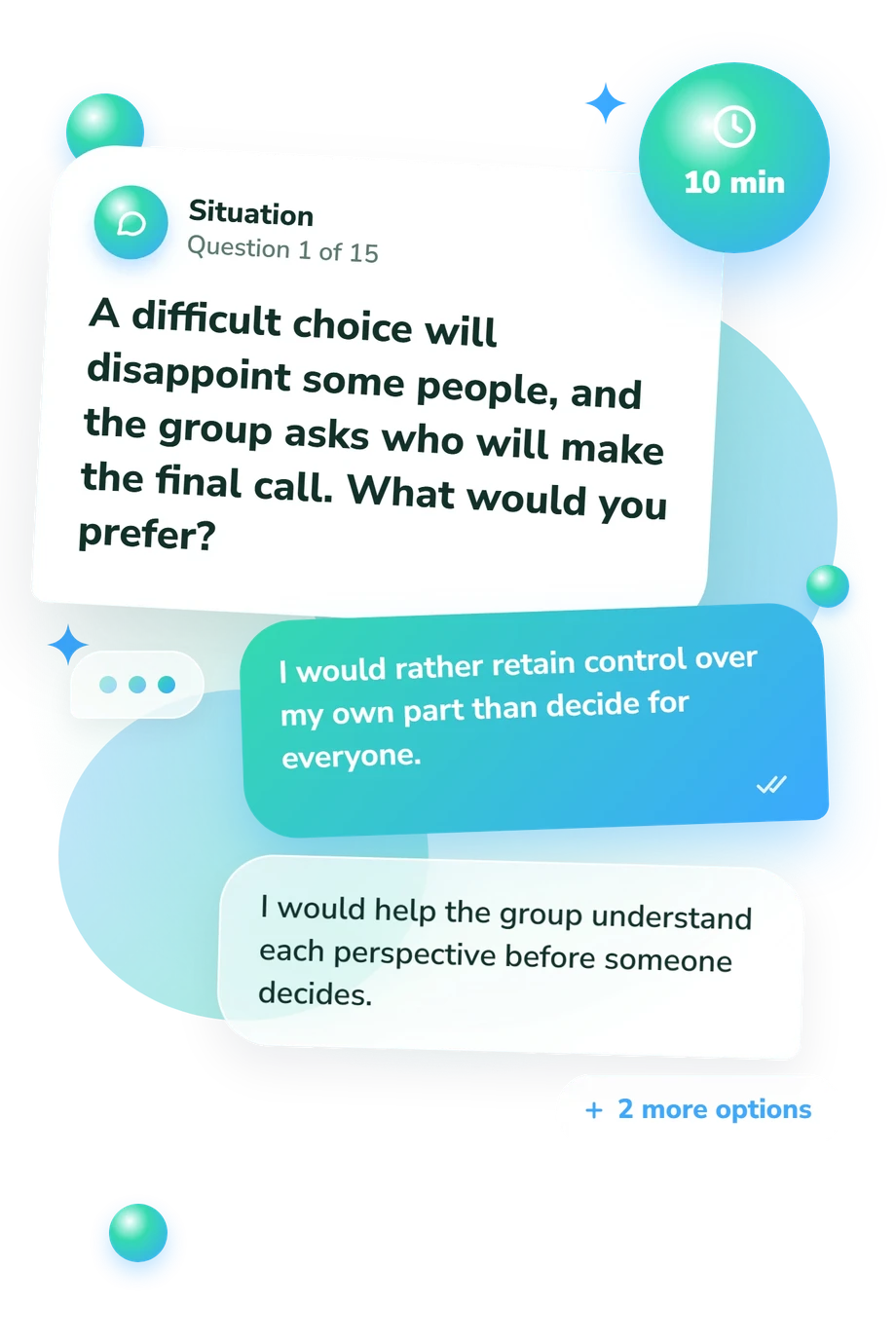
Example Questions From the Test
- I would rather retain control over my own part than decide for everyone.
- I would help the group understand each perspective before someone decides.
- I would make the call if I had the clearest relevant knowledge.
- I would accept final responsibility and communicate the decision directly.
- Its value drops considerably if it does not earn recognition or influence.
- It still matters, though I wish more people had shared the experience.
- I value it privately but may adjust how I present future work.
- Its value remains largely unchanged because meeting my own purpose was the main point.
- Being recognized as the person who drove the result.
- Knowing my individual contribution met my own standards.
- Receiving sincere appreciation from the people I worked beside.
- Seeing the whole group credited and its relationships strengthened.
Alpha Beta Sigma Quiz - Description and methodology of the test
For readers deciding whether this questionnaire fits a difficult social or work situation, the Alpha Beta Sigma Quiz offers a structured way to examine recurring choices. As an alpha beta sigma test, it helps clarify how you respond when recognition, belonging, responsibility, or personal freedom pull in different directions. The result describes relative affinities rather than placing you on a social ladder.
What This Assessment Explores
These scenarios examine responsibility, recognition, belonging, and independence. They suit readers exploring everyday preferences, not people seeking rank or fixed identity.
The result describes three overlapping patterns of alpha, beta, and sigma affinity, so a person can value autonomy while contributing to groups.
The scales are:
- Alpha Affinity (0-15) measures comfort with visibility, influence, competition, and taking charge, not superiority or social rank; bands are Situational Alpha (0-5), Flexible Alpha (6-10), and Strong Alpha Affinity (11-15).
- Beta Affinity (0-15) measures cooperation, reliability, shared credit, and group continuity, without implying weakness or lower status; bands are Selective Collaborator (0-5), Adaptive Collaborator (6-10), and Strong Beta Affinity (11-15).
- Sigma Affinity (0-15) measures autonomy, self-defined goals, independent decisions, and comfort outside conventional status structures, without implying isolation or superiority; bands are Socially Anchored (0-5), Selectively Independent (6-10), and Strong Sigma Affinity (11-15).
Methodology and Scientific Basis
Each item presents a social or work dilemma with four response choices. The options vary in emphasis: taking charge, supporting group continuity, negotiating disagreement, protecting autonomy, or acting from personal standards. Responses are combined into three separate affinity scores; the result bands describe the pattern of the selected answers.
The scoring can help readers interpret alpha beta sigma traits as context-sensitive preferences, not permanent roles. Choices about recognition, conventions, competition, and responsibility may shift with the situation, relationships, or current priorities.
Abele and Wojciszke’s agency-communion model is the closest conceptual anchor for distinguishing influence-oriented and relationship-oriented patterns. This questionnaire is conceptually consistent with that work, not an adaptation of it. Wiggins’s interpersonal taxonomy, Bakan’s agency-communion framework, and Leary’s interpersonal model provide additional context for social behavior and self-direction.
The questionnaire presents each score through descriptive bands for its displayed range. Because responses are self-reported, current circumstances, self-presentation, and self-awareness can shape the profile, which is best read as a structured snapshot rather than a diagnosis.
- Abele, Andrea E., and Bogdan Wojciszke. (2007). Agency and communion from the perspective of self versus others. Journal of Personality and Social Psychology, 93(5), 751-763. 10.1037/0022-3514.93.5.751
- Wiggins, Jerry S. (1979). A psychological taxonomy of trait-descriptive terms: The interpersonal domain. Journal of Personality and Social Psychology, 37(3), 395-412. 10.1037/0022-3514.37.3.395
- Bakan, David. (1966). The Duality of Human Existence: An Essay on Psychology and Religion. Chicago: Rand McNally.
- Leary, Timothy. (1957). Interpersonal Diagnosis of Personality: A Functional Theory and Methodology for Personality Evaluation. New York: Ronald Press Company.
Updated: