
Asian Culture Quiz
How the Scales are Structured
Who Usually Takes This Test?
See How You Compare
Below is a preview of how scores are typically distributed across each scale.
Example Questions From the Test
- Diwali
- Vesak
- Onam
- Holi
- Kanji
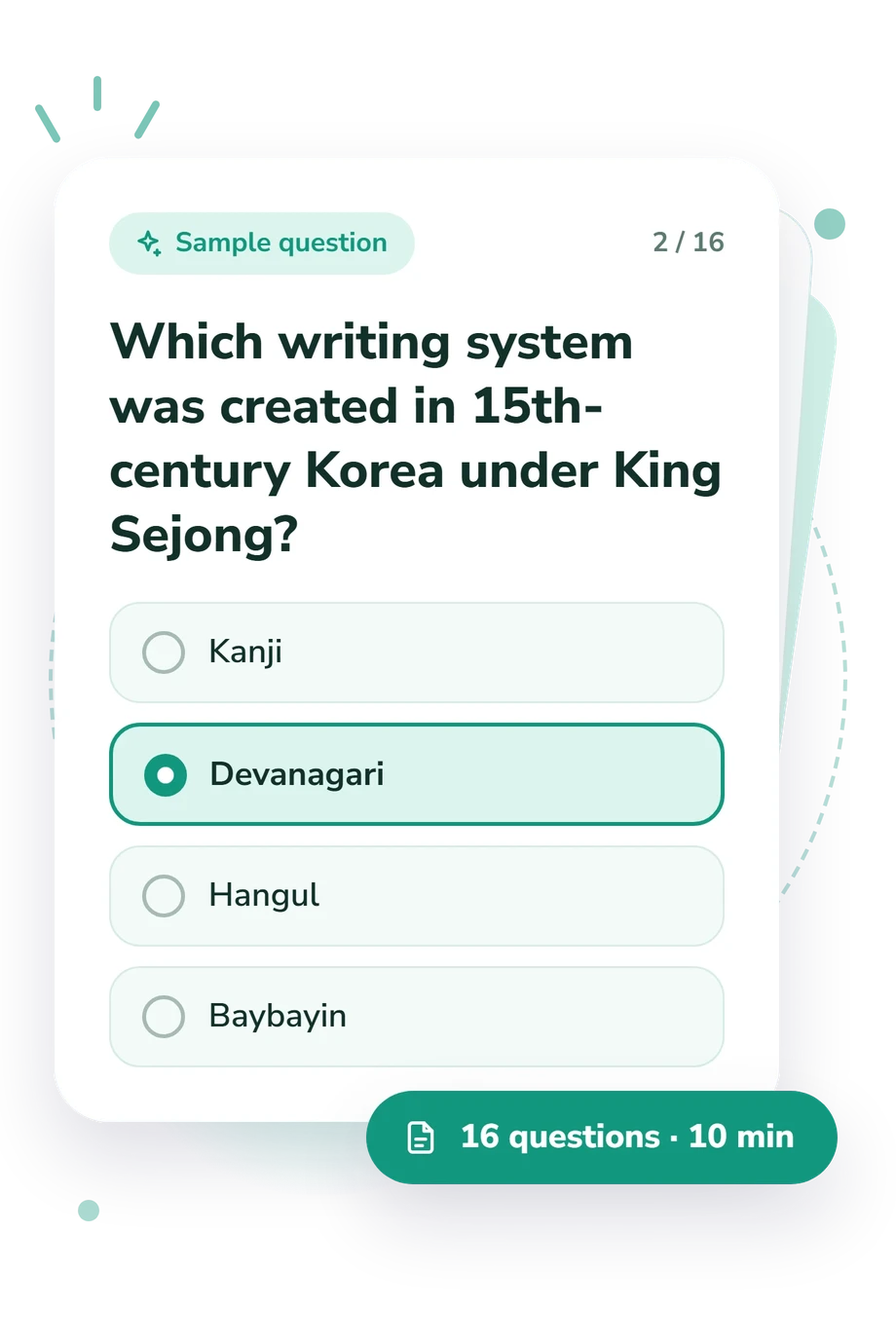
- Devanagari
- Hangul
- Baybayin
- Four rhyming lines with equal meter
- Three parts following a 5-7-5 pattern of sound units
- Five lines following a 5-7-5-7-7 pattern
- Fourteen lines ending in a couplet
Asian Culture Quiz - Description and methodology of the test
People who want to broaden their understanding of Asian traditions can use this Asian Culture Quiz as a focused starting point. The Asian quiz questions suit curious learners, travelers, students, and anyone reviewing cultural knowledge across regions. Results place performance in an overall band summarizing recognition of key customs, celebrations, writing systems, artistic practices, and everyday etiquette across the sampled material.
What This Assessment Explores
This quiz measures cultural knowledge rather than personality, belief, or identity. It asks respondents to recognize practices and concepts from Asian regions, including historical exchange and present-day customs. Across the sampled material, the Asian culture knowledge test provides one overall band rather than separate scores by topic.
The questions sample these areas:
- Festivals and religious observances connect celebrations with names and customary practices.
- Writing, language, literature, and the arts test recognition of scripts, poetic forms, performance traditions, textiles, objects, and culturally specific terms.
- Customs and family traditions test respectful behavior, social gestures, food practices, and intergenerational observances.
Asian Culture Knowledge: 0-16 is reported as Foundation (0-6), Developing (7-12), or Strong (13-16). The bands move from introductory recognition, through uneven knowledge, to consistently strong performance across the sampled material; they are not a judgment of familiarity with every Asian culture.
Methodology and Evidence Base
Each item presents a short cultural scenario or factual prompt with four answer choices. Some ask you to identify a term, script, object, or art form; others ask which behavior or interpretation best fits a custom. The format therefore combines recall with simple contextual judgment. Factual and scenario-based Asian culture trivia questions assess cultural recognition, not live intercultural behavior.
Responses are condensed into one overall knowledge result rather than separate country or region scores. The band summarizes performance across the tested material, while the subject areas suggest useful directions for further reading. No extra scoring rule should be inferred beyond that displayed result.
The conceptual reference point is Global Awareness Profile (Corbitt, 1998). This questionnaire is conceptually consistent with that work, not an adaptation of it. Griffith, Wolfeld, Armon, Rios, and Liu (2016), together with Deardorff (2006), place cultural knowledge alongside other parts of intercultural competence. The online result has no stated population norms or clinical interpretation; education, exposure, memory, and current attention can affect performance, so use it to identify learning interests rather than rank cultural sophistication.
- J. Nathan Corbitt (1998). Global Awareness Profile. Yarmouth, ME: Intercultural Press.
- Richard L. Griffith, Leah Wolfeld, Brigitte K. Armon, Joseph Rios, and Ou Lydia Liu (2016). Assessing Intercultural Competence in Higher Education: Existing Research and Future Directions. ETS Research Report Series, 2016(2), 1-44. 10.1002/ets2.12112
- Darla K. Deardorff (2006). Identification and Assessment of Intercultural Competence as a Student Outcome of Internationalization. Journal of Studies in International Education, 10(3), 241-266. 10.1177/1028315306287002
Updated: