
Australian History Quiz
How the Scales are Structured
Who Usually Takes This Test?
See How You Compare
Below is a preview of how scores are typically distributed across each scale.
Example Questions From the Test
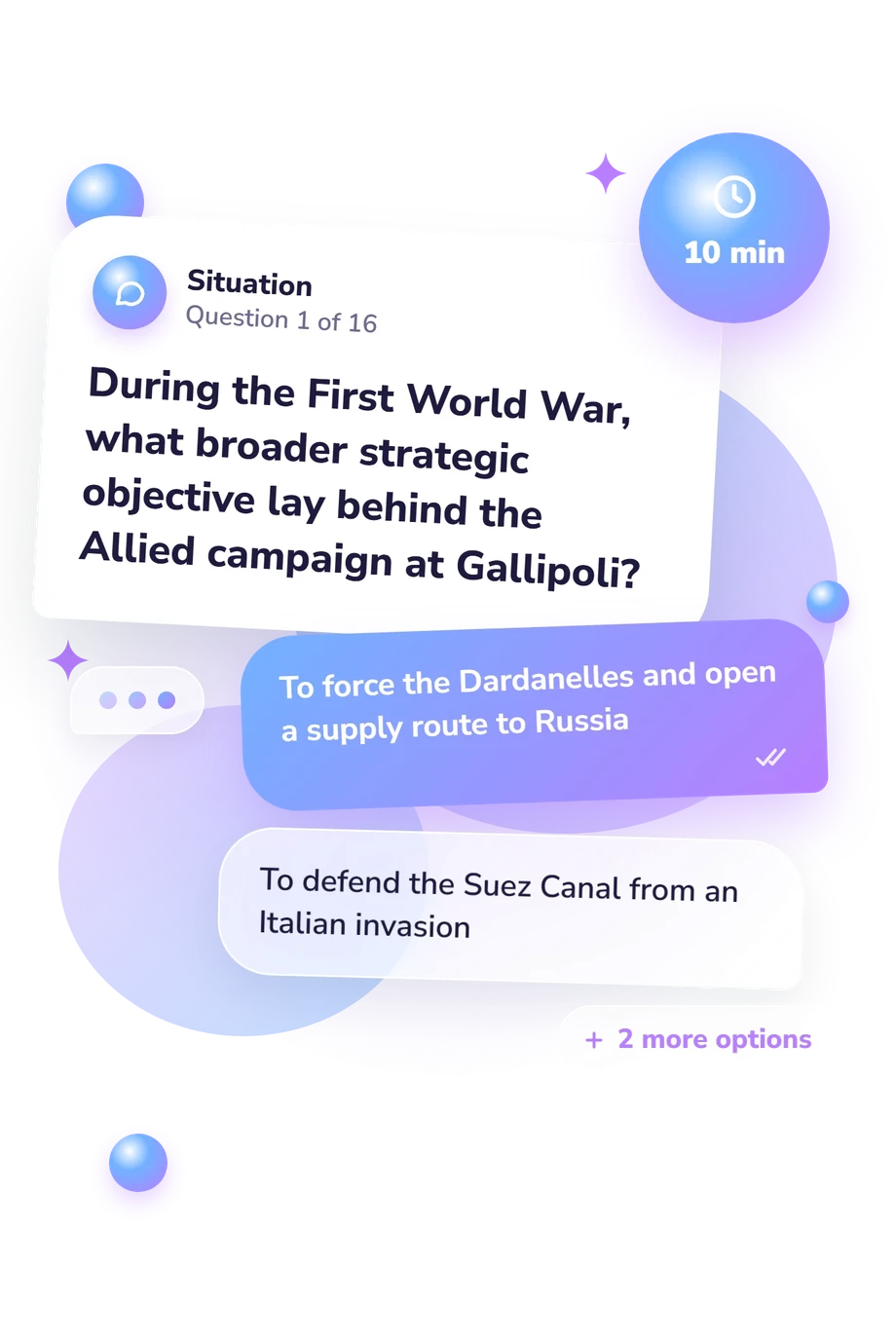
- To force the Dardanelles and open a supply route to Russia
- To defend the Suez Canal from an Italian invasion
- To capture German colonies in the Pacific
- To prevent Austria-Hungary from occupying France
- To restrict non-European immigration to Australia
- To end transportation of British convicts
- To reserve parliamentary seats for recent migrants
- To encourage immigration from every part of Asia
- Abel Tasman
- James Cook
- Willem Janszoon
- Matthew Flinders
Australian History Quiz - Description and methodology of the test
Readers who want to test their grasp of Australia’s past can use the Australian History Quiz as a focused learning exercise. It suits students, lifelong learners, and curious adults who want to connect landmark events with their causes and consequences. Results from this Australian history test indicate an overall knowledge band and a broad direction for further study.
What This Assessment Measures
This questionnaire examines Indigenous and colonial experience, federation, migration, war, social policy, land rights, and national identity. Its questions combine factual recognition with basic historical interpretation, asking readers to connect events with causes, consequences, or wider significance. The Australian history topics fall into three connected areas:
- Indigenous history and continuity connect archaeological evidence, colonisation, terra nullius, native title, and recognition.
- Colonial expansion, federation, war, and migration link the First Fleet, gold rushes, Gallipoli, Singapore, and postwar population policy.
- Rights and social change connect the 1967 referendum, Wave Hill, the Stolen Generations, and the National Apology.
The single Australian History Knowledge scale runs from 0-16, awarding one point per correct answer. Foundations to build (0-6) signals areas for review; Developing knowledge (7-12) shows useful understanding with some gaps; Strong knowledge (13-16) reflects broad, accurate understanding and historical connections.
Methodology and Evidence Base
Each item presents a historical question with four answer choices, creating an objective multiple-choice knowledge assessment. Scoring is direct: a correct response contributes one point, and the total reflects the number of answers identified accurately.
Historical works by Peel and Twomey provide chronological and thematic content references, while work by Attwood and Markus helps contextualise the referendum item. The High Court’s Mabo v Queensland (No 2) decision supports the native title and terra nullius question, while the Human Rights and Equal Opportunity Commission’s 1997 findings supply context for the Stolen Generations and the 2008 National Apology. The cited historical works serve as content references rather than a source instrument or validation basis for the score.
The result gives broad direction for Australian history study rather than a topic-specific profile. Its bands are descriptive knowledge levels rather than population-based norms. Results can vary with prior schooling, recall, wording, topic selection, and uncertainty between plausible distractors, so they are most useful for directing further study rather than serving as a complete measure of historical understanding.
- Peel, Mark, and Christina Twomey. A History of Australia. 2nd ed., Palgrave Macmillan, 2018. ISBN 9781137605498.
- Attwood, Bain, and Andrew Markus. “(The) 1967 (Referendum) and All That: Narrative and Myth, Aborigines and Australia.” Australian Historical Studies, vol. 29, no. 111, 1998, pp. 267-288. 10.1080/10314619808596073.
- High Court of Australia. Mabo v Queensland [No 2] (1992) 175 CLR 1; [1992] HCA 23.
- Human Rights and Equal Opportunity Commission. Bringing Them Home: Report of the National Inquiry into the Separation of Aboriginal and Torres Strait Islander Children from Their Families. Sydney, 1997.
Updated: