
Are You a Muggle or a Wizard Quiz
How the Scales are Structured
Who Usually Takes This Test?
See How You Compare
Below is a preview of how scores are typically distributed across each scale.
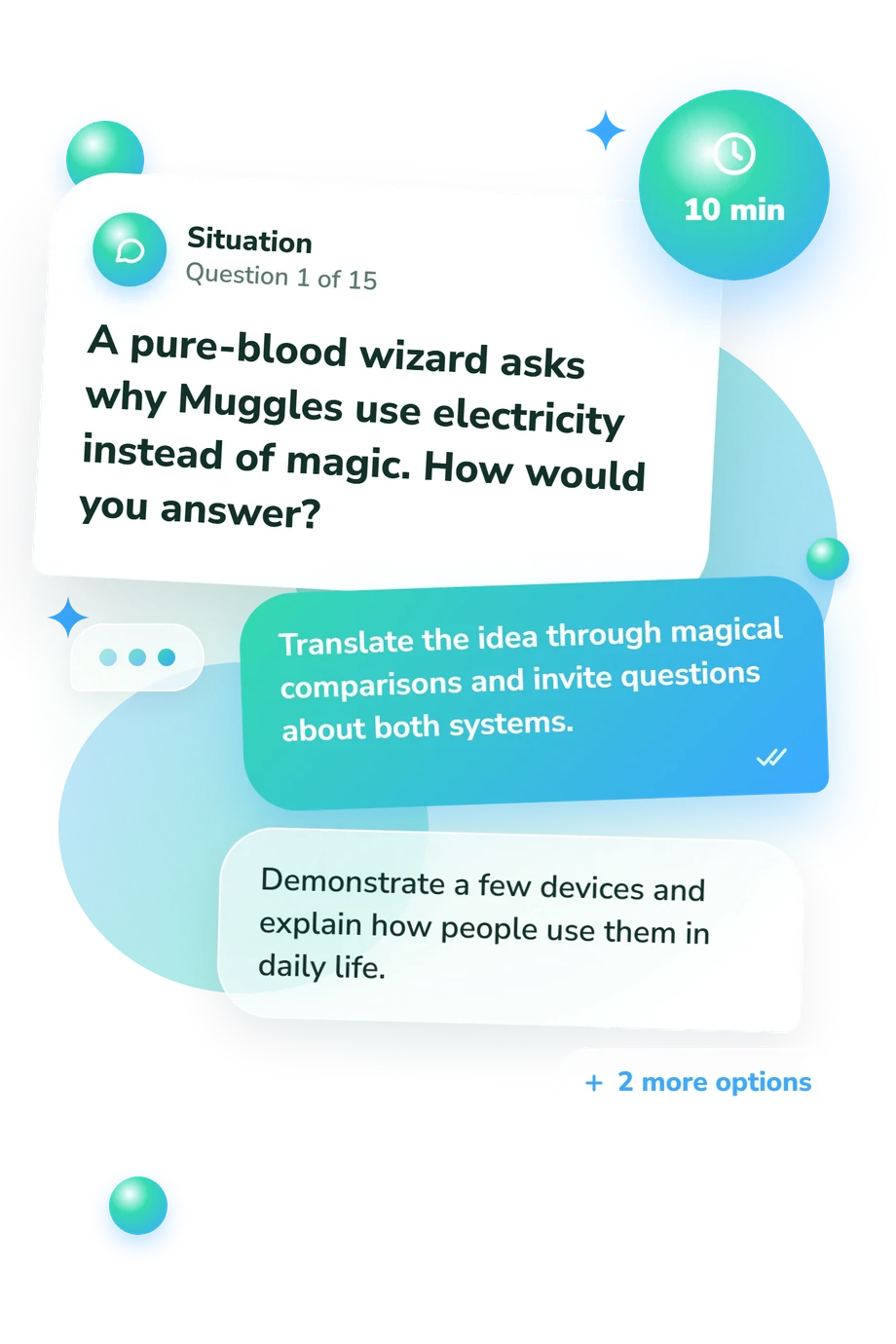
Example Questions From the Test
- Translate the idea through magical comparisons and invite questions about both systems.
- Demonstrate a few devices and explain how people use them in daily life.
- Recommend a clear Muggle Studies guide or knowledgeable teacher.
- Suggest they explore it independently if the subject interests them.
- Replace it with a reliable electric kettle and use it normally.
- Check the plug and mechanism first, then consider magical help.
- Ask someone experienced with magic to repair it.
- Reach for a wand and try Reparo straight away.
- Coordinate magical containment with a believable explanation for staff and customers.
- Manage the shop staff while someone else handles the creature.
- Join the magical search and leave public explanations to another person.
- Work only with the team whose methods I already understand best.
Are You a Muggle or a Wizard Quiz - Description and methodology of the test
Readers who enjoy the Harry Potter world can use the Are You a Muggle or a Wizard Quiz to reflect on how ordinary institutions, magical customs, and life between both communities feel to them. The result is intended for fans who want a playful affinity profile, not a lore-recall challenge. The playful format also makes this a muggle or wizard test of which settings and habits feel most natural.
What This Test Measures
Questions present practical and magical situations-repairing a kettle, explaining electricity, balancing traditions, choosing a workplace. They examine comfort, participation, and cultural preference rather than lore.
As a muggle or wizard quiz, it asks whether ordinary systems, magical culture, or cooperation across both feels most natural. The result is a playful fictional affinity profile, not a canonical claim about ancestry, ability, or status.
The three dimensions are:
- Muggle (0-15) measures nonmagical affinity: Magic-Curious (0-5) welcomes magic, Grounded Explorer (6-10) balances familiarity with openness, and Muggle at Heart (11-15) favors ordinary culture.
- Two-Worlds Bridge (0-15) measures connection: One-World Focus (0-5) prefers one culture, Occasional Connector (6-10) shifts when needed, and Two-Worlds Bridge (11-15) coordinates both.
- Wizard (0-15) measures wizarding attraction: Selective Visitor (0-5) enjoys glimpses, Emerging Spellcaster (6-10) welcomes learning, and Wizard at Heart (11-15) embraces wizarding traditions.
Methodology and Evidence Base
Each item presents a situation with four response choices. Options span practical nonmagical habits, direct magical involvement, selective participation, cooperation, and preference for setting. Choose the response closest to your instinct.
Answers produce three scores, but the questionnaire does not document how choices are weighted. The three ranges and named bands organize the results, but the questionnaire does not state how each response contributes to a score.
This wizard or muggle questionnaire is conceptually consistent with the Multicultural Identity Styles Scale (Ward et al., 2018): its bridge scenarios resemble hybrid and alternating identity styles, but it is not identified as an adaptation.
Huynh et al. (2018) offer context for harmony, distance, and tension in cultural settings, helping frame these cross-community situations without establishing scoring evidence.
Groene and Hettinger (2016) supply contextual support for fictional affiliation and fandom rather than validation of these scores.
Results capture imaginative preference at one moment. Mood, familiarity with the fictional world, and response style may affect self-report; the categories are descriptive because no norms or validation are documented for this questionnaire.
- Ward, Colleen, Caroline Ng Tseung-Wong, Agnes Szabo, Tamara Qumseya, and Uma Bhowon. Hybrid and Alternating Identity Styles as Strategies for Managing Multicultural Identities. Journal of Cross-Cultural Psychology, 49(9), 2018, 1402-1439. 10.1177/0022022118782641
- Huynh, Que-Lam, Verònica Benet-Martínez, and Angela-MinhTu D Nguyen. Measuring variations in bicultural identity across U.S. ethnic and generational groups: Development and validation of the Bicultural Identity Integration Scale-Version 2 (BIIS-2). Psychological Assessment, 30(12), 2018, 1581-1596. 10.1037/pas0000606
- Groene, Samantha L., and Vanessa E. Hettinger. Are you “fan” enough? The role of identity in media fandoms. Psychology of Popular Media Culture, 5(4), 2016, 324-339. 10.1037/ppm0000080
Updated: