
7th Grade Genetics Quiz
How the Scales are Structured
Who Usually Takes This Test?
See How You Compare
Below is a preview of how scores are typically distributed across each scale.
Example Questions From the Test
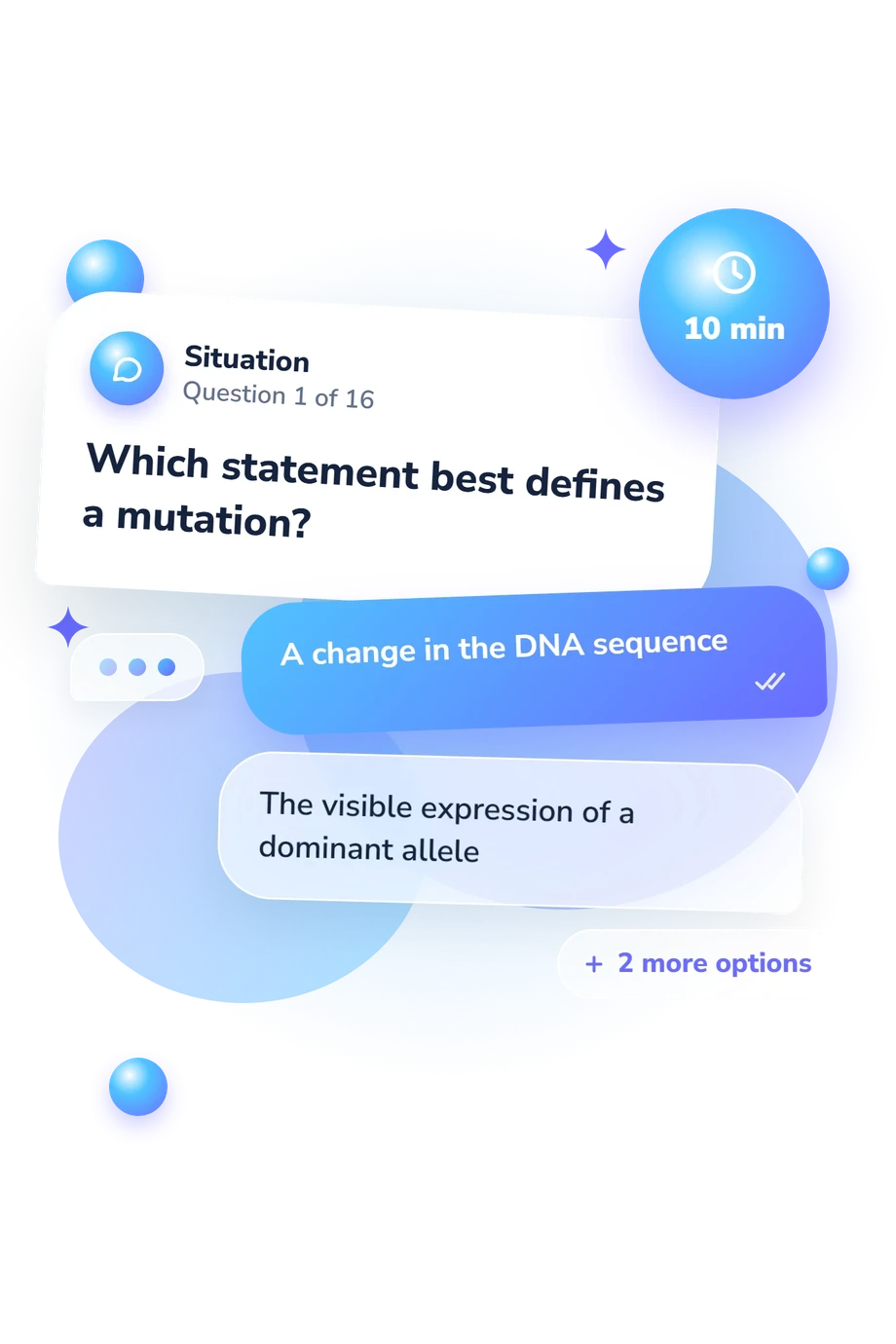
- A change in the DNA sequence
- The visible expression of a dominant allele
- The passing of an unchanged trait from parent to offspring
- The separation of allele pairs when sex cells form
- DNA is made of genes, but neither is associated with chromosomes.
- Genes are made of chromosomes that leave the cell nucleus.
- Genes are segments of DNA located on chromosomes.
- Chromosomes are small sections found inside individual genes.
- It produces identical body cells for growth.
- It produces sex cells with half the usual number of chromosomes.
- It doubles the chromosome number in every body cell.
- It guarantees that all offspring have identical alleles.
7th Grade Genetics Quiz - Description and methodology of the test
Learners deciding whether they are ready for a heredity unit check can use the 7th grade genetics quiz to identify which ideas deserve another look before they move on. This 7th grade science genetics quiz suits learners who need to choose between moving ahead and revisiting a specific concept. The result offers a focused picture of current understanding rather than a broad judgment about biology achievement.
What This Assessment Explores
The questions examine how well a learner connects genetic information with observable outcomes. They cover genes, DNA, chromosomes, mutations, alleles, genotype, phenotype, environmental influence, meiosis, and simple inheritance. A learner revising a middle-school unit can use this genetics quiz for 7th grade to locate a concept needing practice.
The displayed 7th Grade Genetics Knowledge scale spans 0-16 and uses three bands: Building Foundations (0-6), Developing Knowledge (7-12), and Strong Knowledge (13-16). These bands describe developing, mostly secure, or strong command of grade-level ideas.
Four content areas represented by the questions are:
- Genes, DNA, chromosomes, and mutations show whether genetic information is defined and located correctly.
- Genotype, phenotype, and environment show whether inherited information is distinguished from visible traits.
- Meiosis and allele separation show whether sex-cell formation is understood.
- Dominant-recessive inheritance shows whether genotypes and cross outcomes can be inferred.
Methodology and Scientific Basis
Each item uses a short definition or scenario followed by four answer choices. The selected-response format asks the learner to identify relationships, apply dominant-recessive rules, infer an unknown genotype, or calculate a simple probability. It checks vocabulary and transfer of an idea to a familiar biological example.
Conceptually, the content is consistent with a genetics assessment studied by Williams and colleagues, which examines how students connect genetic structures with reproduction and inherited traits. It also aligns with Lewis and Wood-Robinson's work on inheritance. The National Research Council also treats heredity as a core idea for explaining patterns and applying concepts. This questionnaire is not a reproduction or validated adaptation of those sources.
The questionnaire reports performance on the displayed knowledge scale and uses the supplied descriptive bands for interpretation. The result from this 7th grade genetics test can guide review of vocabulary, cell division, or inheritance reasoning. Performance may be affected by guessing, recent instruction, wording familiarity, and transfer to a new cross. The score is therefore a study prompt, not a complete measure of scientific understanding.
- Williams, Michelle, Angela Haydel DeBarger, Beronda L. Montgomery, Xuechun Zhou, and Erika Tate (2012). Exploring middle school students' conceptions of the relationship between genetic inheritance and cell division. Science Education, 96(1), 78-103. 10.1002/sce.20465
- Lewis, Jenny, and Colin Wood-Robinson (2000). Genes, chromosomes, cell division and inheritance - do students see any relationship? International Journal of Science Education, 22(2), 177-195. 10.1080/095006900289949
- National Research Council (2012). A Framework for K-12 Science Education: Practices, Crosscutting Concepts, and Core Ideas. Washington, DC: The National Academies Press. 10.17226/13165
Updated: