
Bible Quiz in Telugu
How the Scales are Structured
Who Usually Takes This Test?
See How You Compare
Below is a preview of how scores are typically distributed across each scale.
Example Questions From the Test
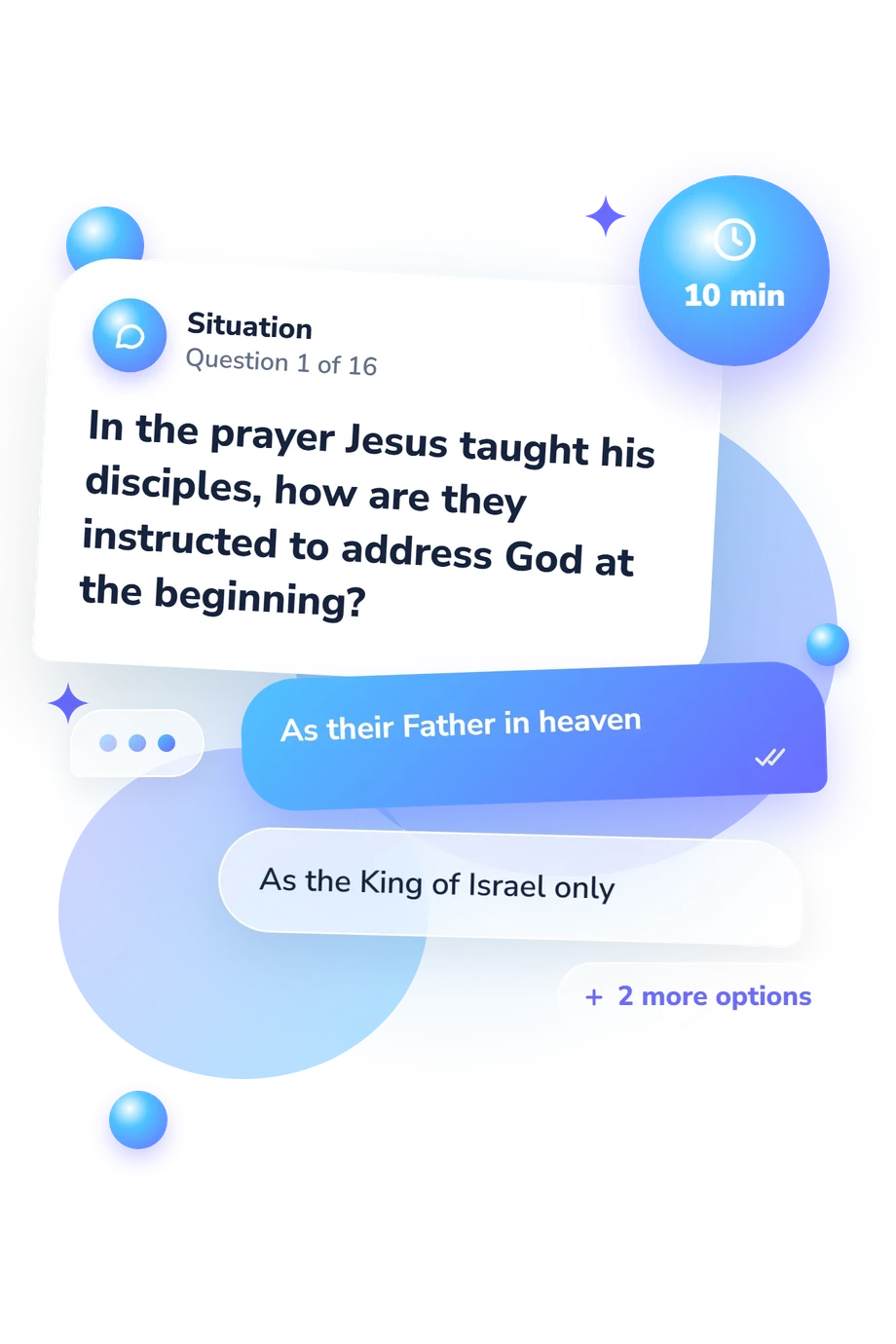
- As their Father in heaven
- As the King of Israel only
- As the Lord of the Temple
- As the God of Abraham alone
- The stone is moved and the tomb is empty
- The disciples have moved into the tomb
- The entrance is still sealed and guarded
- A written copy of the Law has appeared inside
- Prophecy, teaching, healing
- Power, status, eloquence
- Love, joy, peace
- Visions, dreams, miracles
Bible Quiz in Telugu - Description and methodology of the test
People studying the Bible in Telugu, revising for a group discussion, or returning to familiar passages may find this bible quiz in telugu a practical way to organize a short review. It suits individual learners and study groups who want questions spanning stories, teachings, people, and events. As an online Telugu Bible quiz, this test offers a convenient Telugu-language starting point for deciding what to read next.
What This Assessment Measures
The questions sample familiar stories, teachings, people, places, book locations, Gospel episodes, parables, and wisdom sayings. They therefore examine recognition and simple connections across biblical material rather than personal devotion.
The displayed result uses one scale, Bible Knowledge (0-16), with Foundation to build (0-6), Developing knowledge (7-12), and Strong knowledge (13-16). This broad Bible knowledge quiz score reflects recognition of narratives and teachings, not faith or denominational understanding.
The thematic groups are:
- Narrative recall covers major events, journeys, miracles, and parables.
- Teaching recognition covers lessons, responses, and wisdom sayings.
- Biblical context covers people, places, books, and episode sequence.
People studying scripture in Telugu or revisiting passages can use the result to select topics for review; no band captures the whole of biblical literacy.
Methodology and Evidence Base
Each item presents one question with four answer choices. The prompts test factual recall or recognition of a teaching, event, or response. These Bible quiz questions in Telugu help identify which parts of the narrative are easiest to retrieve.
The result display presents a descriptive score in one of three named bands. Interpretation should follow that displayed result: it summarizes performance on these questions and is not a measure of faith or denominational understanding. The bands can guide review of biblical narratives and teachings without describing all biblical literacy.
Methodologically, the content is conceptually consistent with the Bible Knowledge Scale (Krull & McCloy, 2022), a published knowledge reference, but this questionnaire is not presented as an adaptation of that instrument. Gourlay, Dennery, and Pew provide related evidence about biblical knowledge and literacy; they do not establish equivalence in norms, reliability, or validity.
Memory, attention, language familiarity, and prior exposure to particular passages can affect performance. The result is best used as a focused study prompt and self-reflection tool, not as a complete assessment of biblical literacy or a diagnostic classification.
- Krull, Douglas S., and Rodney A. McCloy. (2022). Add to Your Faith Virtue and to Virtue Knowledge: A Bible Knowledge Scale. Journal of Psychology and Christianity, 41(2), 106-117.
- Gourlay, Kenneth H. (2013). An Assessment of Bible Knowledge among Adult Southern Baptist Sunday School Participants. Christian Education Journal, 10(1), 7-29. 10.1177/073989131301000102
- Dennery, Cecilia Arona Baptiste. (2012). A Correlational Study of Biblical Literacy and the Level of Leadership, Discipleship, and Demographics in an African American Church in Delaware. Doctoral dissertation, Wilmington University.
- Pew Forum on Religion & Public Life. (2010). U.S. Religious Knowledge Survey. Washington, DC: Pew Research Center.
Updated: