
Algebra 2 Chapter 3 Quiz
How the Scales are Structured
Who Usually Takes This Test?
See How You Compare
Below is a preview of how scores are typically distributed across each scale.
Example Questions From the Test
- y equals negative 2 times x, plus 4
- y equals 2 times x, plus 4
- y equals negative x, plus 2
- y equals 2 times x, minus 4
- The point with coordinates x = 1 and y = 5
- The point with coordinates x = 3 and y = 6
- The point with coordinates x = 3 and y = 3
- The point with coordinates x = −3 and y = −9
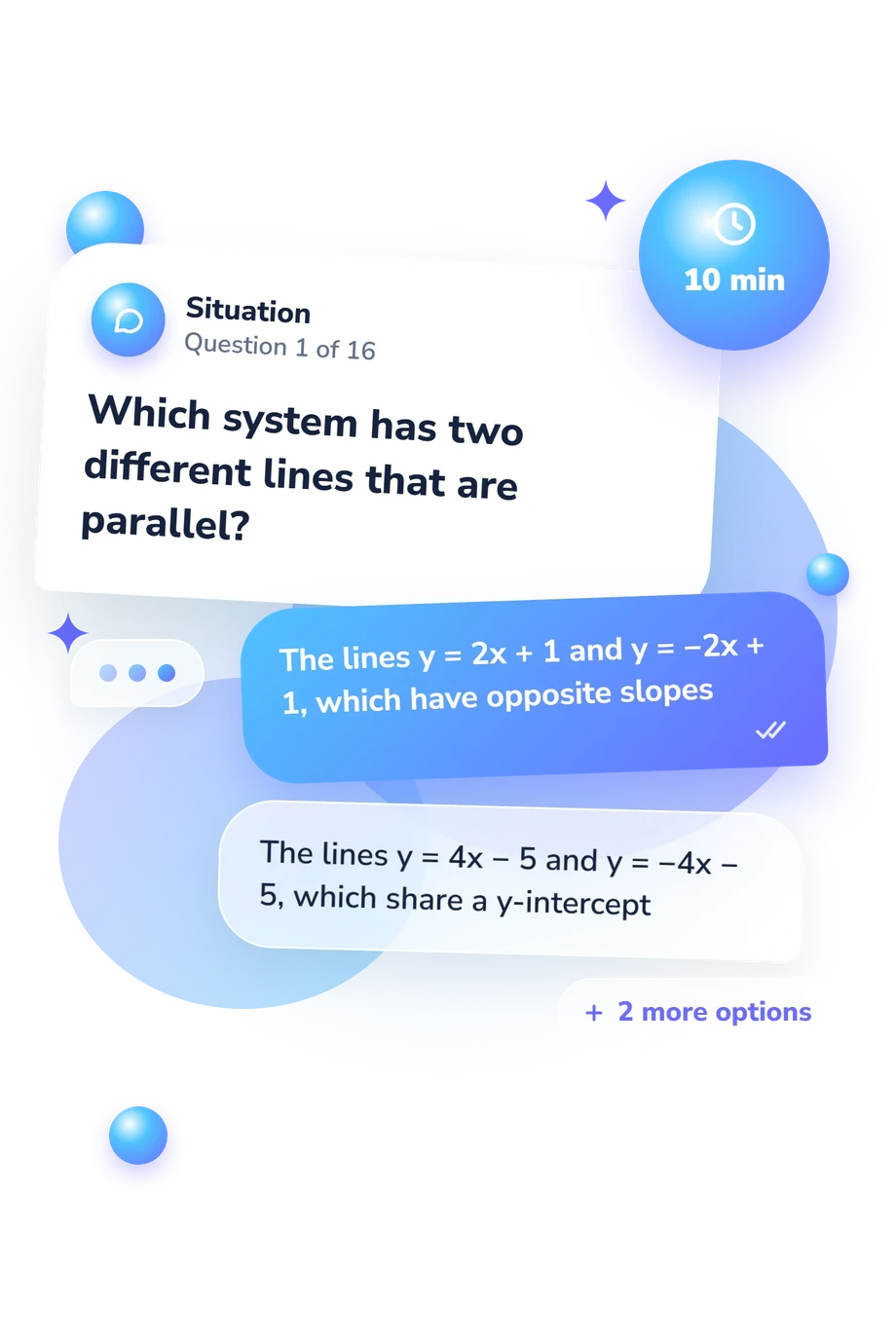
- y = 2x + 3 and 2y = 4x − 3
- 2x + y = 6 and y = −2x + 6
- 3x − y = 6 and y = −3x + 6
- x + y = 4 and y = x + 4
Algebra 2 Chapter 3 Quiz - Description and methodology of the test
For students deciding whether to continue reviewing or move on, this assessment offers a concise check of current understanding. The Algebra 2 Chapter 3 Quiz provides a reference point before homework or an assessment. It can also support Algebra 2 Chapter 3 practice. Its result reflects topic knowledge, not mathematical ability.
What This Assessment Explores
The questions are intended for learners studying linear systems, graphing, inequalities, and modeling. They connect equations with visual features, classify systems, and translate conditions into constraints. The result shows how consistently Chapter 3 concepts are applied across symbolic, graphical, and contextual situations.
The thematic groups below show what the result draws on:
- Graphing and transformations show how slope, intercepts, shifts, and boundary conventions are used.
- Systems and intersections show whether parallel, coincident, and crossing lines are recognized and solved.
- Inequalities and modeling show how constraints, shaded regions, and practical relationships are translated.
When reviewing quiz answers for Algebra 2 Chapter 3, consider why an option fits the equation, graph, or situation. Algebra 2 Chapter 3 Knowledge runs from 0-16: Foundations to revisit (0-6), Developing knowledge (7-12), and Strong knowledge (13-16). These bands indicate consistency across the tested skills, not mathematical aptitude.
Methodology and Evidence Base
Each item presents an algebraic or applied situation with four answer choices. The respondent selects an equation, ordered pair, graph description, classification, or interpretation. This format samples procedural recognition and mathematical meaning in context, including boundary conventions, system classifications, and model conditions.
The displayed result is a single total, but the response-to-score rule, including any weighting or correction for guessing, is unspecified. Frary (1988) distinguishes multiple-choice scoring from formula scoring intended to correct guessing. The quiz content is conceptually consistent with the topics in Larson et al. (2007), but it is not an adaptation of that source. The Common Core standards serve as a content reference rather than validation evidence. No formula-scoring rule is stated, so the result should be interpreted only as the displayed total.
For a learner using this chapter 3 algebra test, the score can guide targeted review. No norm-referenced interpretation or reliability evidence is established for this quiz. Results may vary with recent instruction, word-problem familiarity, calculator use, guessing, and current attention. Because the questions focus on one chapter, the score cannot represent overall mathematical ability.
- Larson, Ron, Laurie Boswell, Timothy D. Kanold, and Lee Stiff. Algebra 2. McDougal Littell, 2007.
- National Governors Association Center for Best Practices and Council of Chief State School Officers. Common Core State Standards for Mathematics. 2010.
- Frary, Robert B. “Formula Scoring of Multiple-Choice Tests (Correction for Guessing).” Educational Measurement: Issues and Practice, vol. 7, no. 2, 1988, pp. 33-38. 10.1111/j.1745-3992.1988.tb00434.x
Updated: