
Adventures of Tom Sawyer Quiz
How the Scales are Structured
Who Usually Takes This Test?
See How You Compare
Below is a preview of how scores are typically distributed across each scale.
Example Questions From the Test
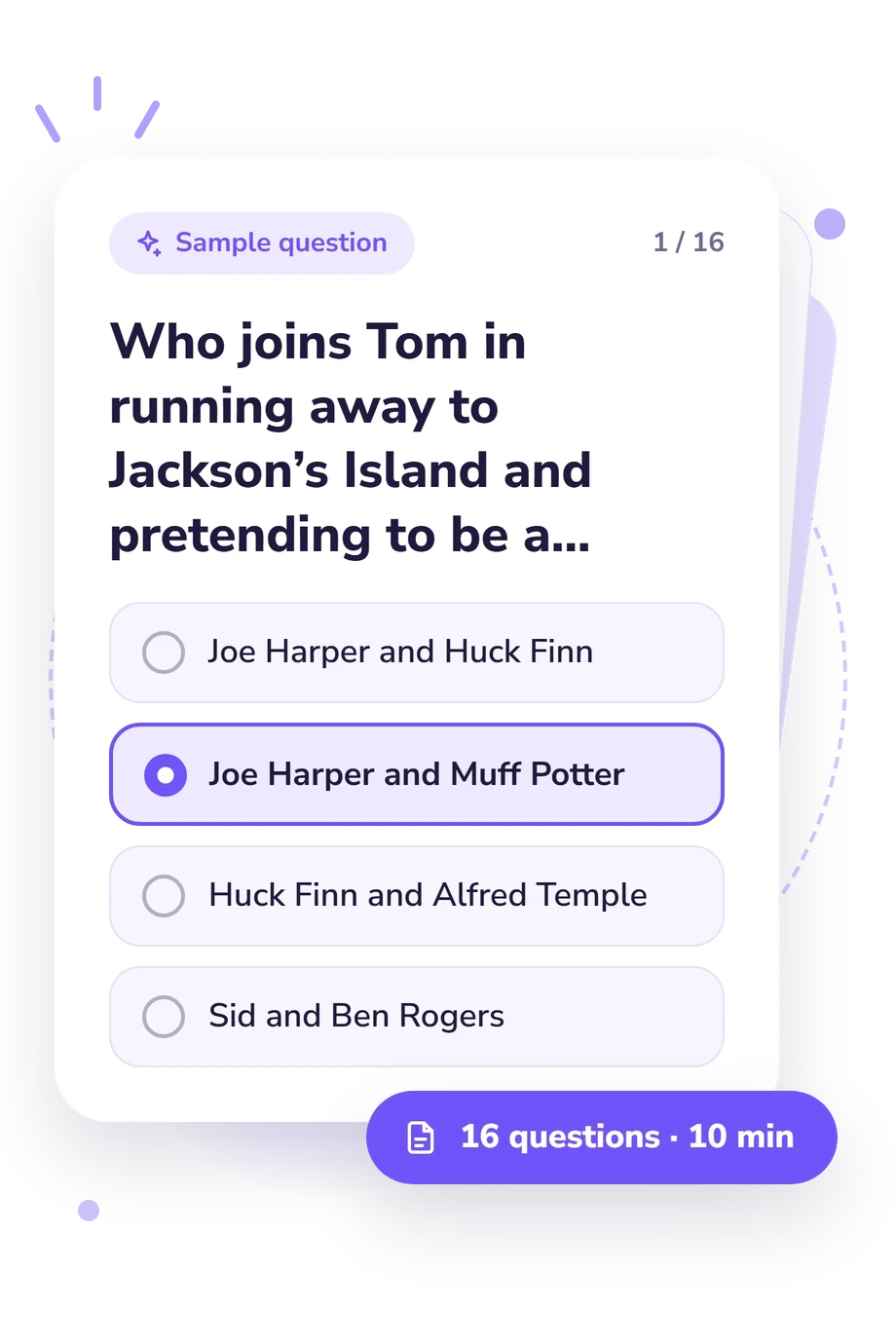
- Joe Harper and Huck Finn
- Joe Harper and Muff Potter
- Huck Finn and Alfred Temple
- Sid and Ben Rogers
- Peter falls asleep under the bed
- Peter reacts wildly and races around the room
- Peter carries the bottle into the yard
- Peter refuses it and scratches Tom
- He has traded small possessions for other children’s tickets
- He has persuaded Mary to give him her award tickets
- He has secretly memorized the required verses overnight
- He has convinced the superintendent that he is a visiting student
Adventures of Tom Sawyer Quiz - Description and methodology of the test
Readers who want to check how well they remember Mark Twain’s novel can use this assessment as a focused literary recall exercise. The Adventures of Tom Sawyer Quiz is intended for students, book-club members, and anyone revisiting the story who wants a clear picture of remembered details. As a quiz on Tom Sawyer, it turns remembered events into a structured result highlighting plot, characters, motives, and themes.
What This Assessment Explores
The questions connect characters, motives, places, and consequences, moving from Tom’s relationships with Becky, Huck, and Aunt Polly to episodes involving the fence, graveyard, island, cave, and Injun Joe. As a Tom Sawyer knowledge test, the result helps show whether you recall headline events, character motives, and links among plot and themes, while indicating which passages are worth revisiting.
The areas represented by the items are:
- Character and relationship items show whether you remember who acts, helps, deceives, or changes.
- Plot and consequence items measure what happens and why later events follow.
- Setting and literary context items test places, authorship, social expectations, courage, secrecy, and adventure.
Results use the Adventures of Tom Sawyer Knowledge scale, from 0-16: Starting Point (0-6), Developing Knowledge (7-12), and Strong Knowledge (13-16). These bands describe performance on this quiz, not overall reading ability.
Methodology and Evidence Base
Each item uses a multiple-choice format with four answer options. The prompts ask for a character, event, motive, location, author, or consequence, so the method is structured literary recall rather than an attitude or personality measure. The total reflects the respondent’s selected answers across the questionnaire; the displayed bands organize performance into the three levels named above.
The content comes from Mark Twain’s novel, which supplies the characters, episodes, setting, and narrative details being tested. Hill’s 1961 analysis and Girsang and colleagues’ 2022 study provide literary context for the novel’s composition, structure, social expectations, and gendered power relations. These sources help frame why the quiz includes questions about plot structure, social expectations, gendered power relations, and the motives behind characters’ choices.
When the goal is to identify remembered knowledge quickly, this Tom Sawyer reading quiz helps decide what to reread or discuss, especially around plot turns, character motives, and themes. Its coverage depends on the selected scenes and facts, so it may miss understanding of other passages; familiarity with individual items and guessing among four choices can also affect the total.
- Twain, Mark. The Adventures of Tom Sawyer. American Publishing Company, 1876.
- Hill, Hamlin L. "The Composition and the Structure of Tom Sawyer." American Literature, vol. 32, no. 4, 1961, pp. 379-392. 10.2307/2922275.
- Girsang, Martina, Elita Modesta Sembiring, Veracy Silalahi, Srisofian Sianturi, and Linda Linda. "Exploring the Language Usage in Mark Twain's Novel 'Adventures of Tom Sawyer': Hegemonic Masculinity Analysis." REiLA: Journal of Research and Innovation in Language, vol. 4, no. 2, 2022, pp. 197-208. 10.31849/reila.v4i2.9598.
Updated: