
Am I Homicidal Quiz
How the Scales are Structured
Who Usually Takes This Test?
See How You Compare
Below is a preview of how scores are typically distributed across each scale.
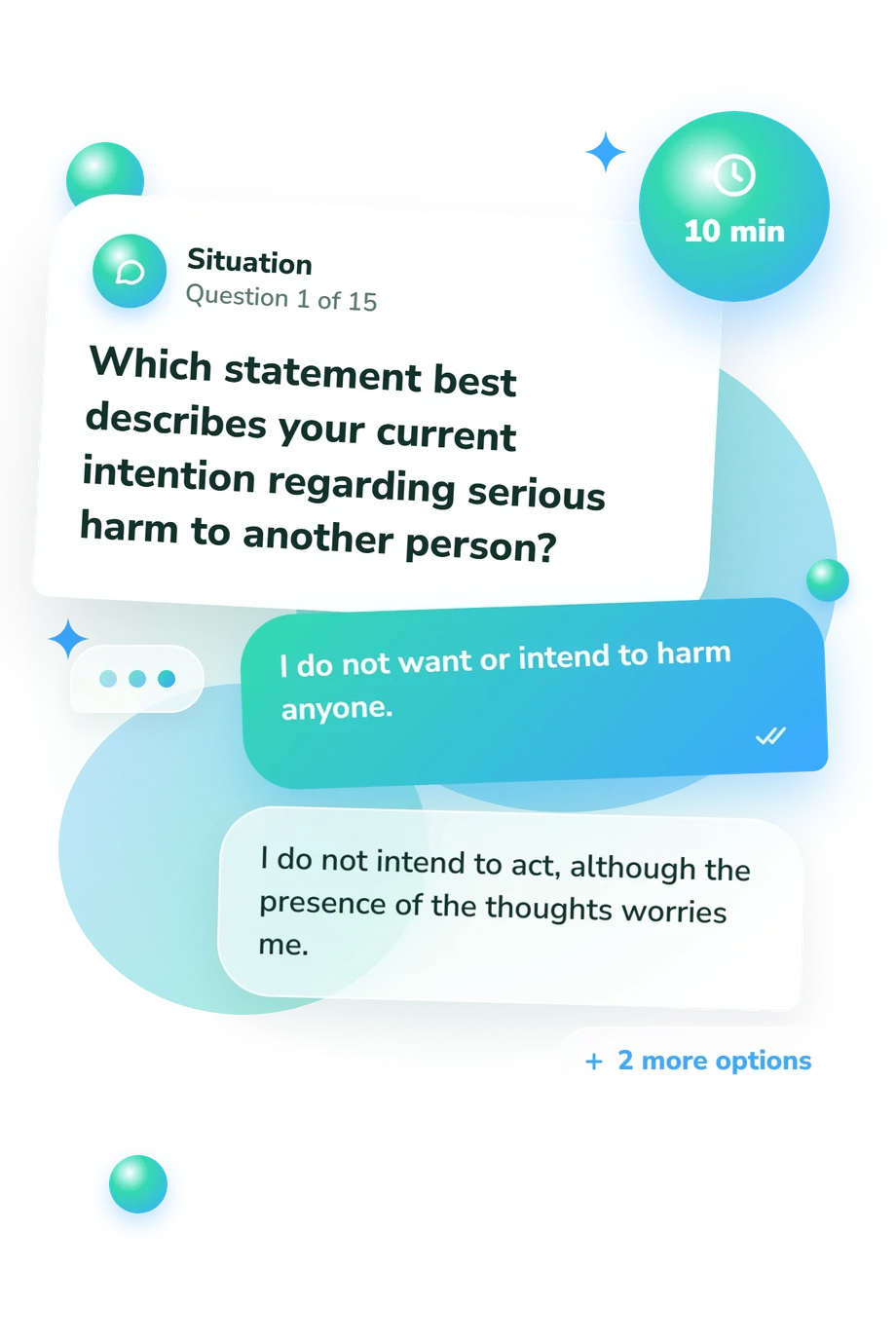
Example Questions From the Test
- I do not want or intend to harm anyone.
- I do not intend to act, although the presence of the thoughts worries me.
- I do not have a firm decision, and I am uncertain what I might do under a trigger or confrontation.
- I intend, expect, or may choose to seriously harm someone.
- I have not had thoughts like that.
- A brief, unwanted image or thought occurred and quickly passed.
- Unwanted thoughts have returned or have been difficult to dismiss, although I do not want to act on them.
- The thoughts have included a desire or urge to kill or seriously injure someone.
- I have no current violent urge and feel able to continue using nonviolent choices.
- I have distressing thoughts, but I feel in control and am using coping or support.
- I am not fully certain I can maintain control without another person helping me.
- I cannot ensure safety, or I believe someone may be in immediate danger from me.
Am I Homicidal Quiz - Description and methodology of the test
People who feel frightened by violent thoughts, uncertain about their control, or worried about another person’s immediate safety may use the Am I Homicidal Quiz to organize what is happening now. It is a violent thoughts self-assessment, not a verdict about character. The result highlights urges, intent, preparation, proximity, and access to support so the next safe step is clearer.
What This Assessment Explores
The questionnaire examines current violent thoughts, urges, control, intent, preparation, proximity, and access to support. It also notes protective responses, including leaving conflict and accepting help.
The result is organized into three scales:
- Immediate Control and Support Needs (0-15) shows No indicator in these items (0), Support would be useful (1-2), or Urgent protection needed (3-15).
- Intent and Preparation (0-15) shows No indicator in these items (0), Concerning movement (1-2), or Immediate action threshold (3-15).
- Violent Thoughts and Urges (0-15) shows No current indicator (0), Worth discussing (1-2), or Prompt support warranted (3-15).
As a homicidal ideation quiz, it helps distinguish distressing thoughts from reduced control, movement toward a target, or preparation. A single red-flag response overrides the total and should guide immediate safety action.
Methodology and Scientific Basis
This structured self-report presents each item as a safety-relevant situation with four ordered response choices, moving from nonviolent control toward stronger urges, reduced control, threats, approach behavior, preparation, or recent serious harm. Responses are grouped into the three displayed scales, each reported on a 0-15 range; the scoring description does not establish a fixed point value for every answer.
Conceptually, the questionnaire is consistent with I-HAVAT (Malik et al., 2019), which addresses violent and homicidal ideation, and with Reynolds and McCrea’s 2017 study of spontaneous violent and homicide thoughts. Thienhaus and Piasecki (1998) support attention to intent, access to means, proximity, agitation, substance use, and recent behavior in violence assessment. It is not presented as an adaptation or standardized administration of those published works.
As a homicidal thoughts test, it uses reflective bands, not validated clinical, legal, or violence-prediction cutoffs. Scores can shift with honesty, distress, intoxication, sleep loss, interpretation of choices, and willingness to disclose. A red-flag response overrides a low total: create distance from the person and weapons, involve a trusted person, and contact emergency or crisis services.
- Salma Malik, Kevin Young, Sophia Walker, and Mirela Loftus. "A Novel Approach to Assess Violent and Homicidal Ideation: The I-HAVAT©." Adolescent Psychiatry, 9(2), 2019, 100-117. 10.2174/2210676608666181016161516
- Joshua J. Reynolds and Sean M. McCrea. "Spontaneous Violent and Homicide Thoughts in Four Homicide Contexts." Psychiatry, Psychology and Law, 24(4), 2017, 605-627. 10.1080/13218719.2016.1259540
- Ole J. Thienhaus and Melissa Piasecki. "Assessment of Psychiatric Patients' Risk of Violence Toward Others." Psychiatric Services, 49(9), 1998, 1129-1147. 10.1176/ps.49.9.1129
Updated: