
Alternative Energy Quiz
How the Scales are Structured
Who Usually Takes This Test?
See How You Compare
Below is a preview of how scores are typically distributed across each scale.
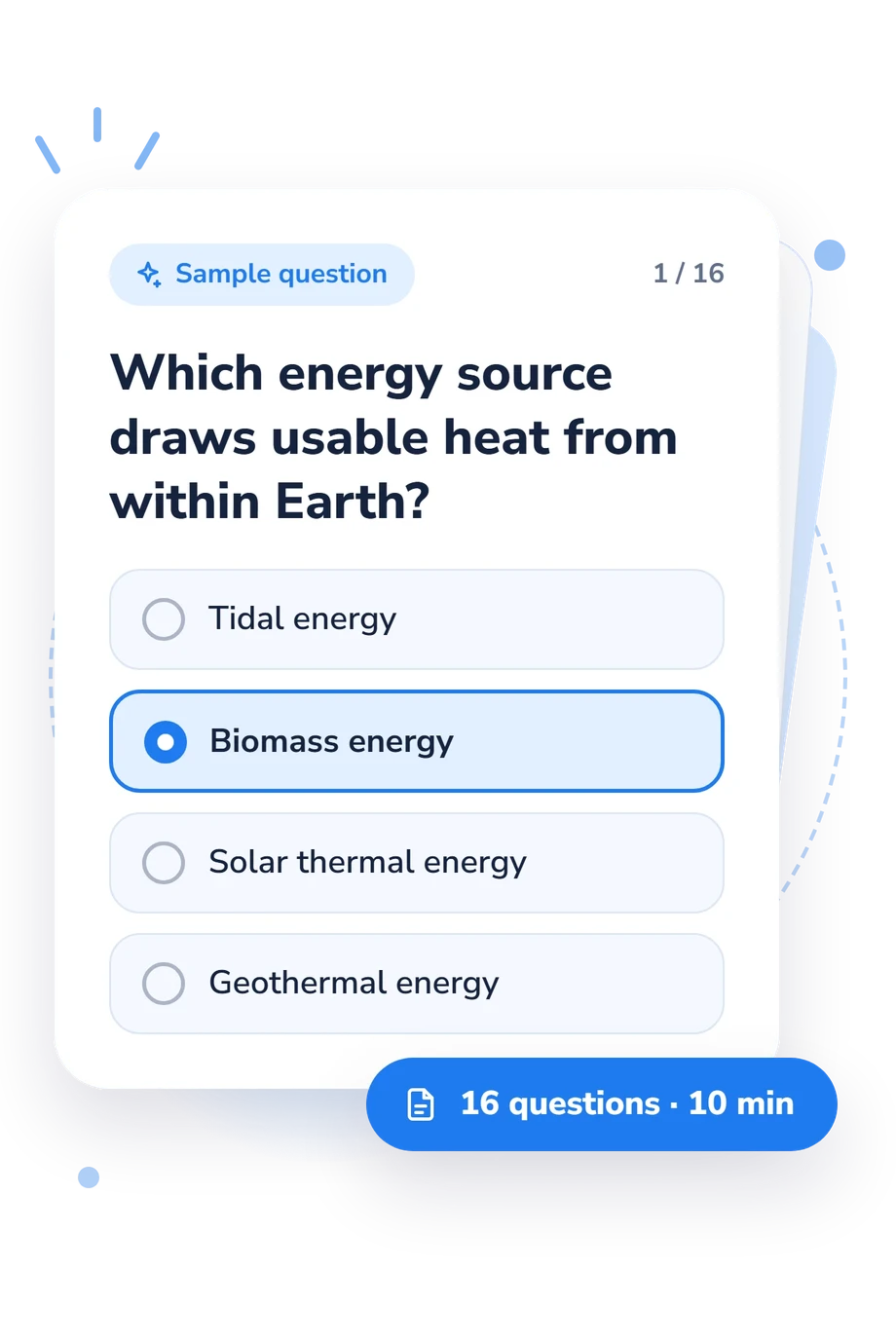
Example Questions From the Test
- Tidal energy
- Biomass energy
- Solar thermal energy
- Geothermal energy
- Chemical energy directly into electrical energy
- Kinetic energy into mechanical motion and then electrical energy
- Thermal energy into nuclear energy and then electricity
- Electrical energy into wind and then mechanical motion
- Electric current
- Stored chemical fuel
- Geothermal heat
- Moving air
Alternative Energy Quiz - Description and methodology of the test
Designed for learners who want a clear foundation in modern energy systems, this assessment turns core science into practical comparisons. The alternative energy quiz is useful for students, curious adults, and anyone reviewing how technologies move energy from source to service. These renewable energy quiz questions can show which concepts feel secure and where further study would make decisions about power, storage, and efficiency.
What This Assessment Explores
Energy knowledge is treated as a connected system. As an alternative energy assessment, it asks whether you can link a resource with its conversion pathway, operating conditions, end use, and tradeoffs. The result works best as a learning profile, showing which ideas are secure and which deserve review.
The questions examine three areas:
- Technology recognition shows whether you can distinguish geothermal, wind, solar, hydroelectric, biomass, tidal, and hydrogen systems.
- Energy conversion and efficiency show whether you can follow changes among heat, light, chemical, kinetic, gravitational, mechanical, and electrical forms while judging demand reduction.
- Storage, grids, and impacts indicate how you understand batteries, pumped storage, capacity factor, dispatchability, predictability, lifecycle effects, and the difference between renewable and impact-free.
The catalogue uses one scale: Alternative Energy Knowledge, 0-16. Foundations to Build is 0-6, Developing Knowledge is 7-12, and Strong Knowledge is 13-16.
Methodology and Scientific Basis
Each item presents a short energy scenario or definition with four answer choices. Across the alternative energy questions, the respondent selects the best explanation, so the format tests conceptual discrimination rather than agreement. Items move from identifying sources and energy forms to applying capacity factor, storage, heat pumps, lifecycle effects, and microgrid operation.
The result is reported on the single displayed 0-16 scale. It covers recognition of technologies, energy conversions, storage choices, grid operation, and environmental tradeoffs.
Bodzin (2012) is a related study of energy-resources knowledge. The questionnaire is conceptually consistent with that study and with the energy-literacy dimensions discussed by DeWaters and colleagues (2011, 2013), while not reproducing or adapting those instruments.
Interpret the result as a current snapshot of knowledge. Familiarity with terminology, prior education, guessing, and testing context can affect performance, so use it to identify topics for further study.
- Bodzin, Alec M. (2012). Investigating Urban Eighth-Grade Students’ Knowledge of Energy Resources. International Journal of Science Education, 34(8), 1255-1275. 10.1080/09500693.2012.661483
- DeWaters, Jan E., Qaqish, Basil, Graham, Mary E., and Powers, Susan E. (2013). Designing an Energy Literacy Questionnaire for Middle and High School Youth. The Journal of Environmental Education, 44(1), 56-78. 10.1080/00958964.2012.682615
- DeWaters, Jan E., and Powers, Susan E. (2011). Energy Literacy of Secondary Students in New York State (USA): A Measure of Knowledge, Affect, and Behavior. Energy Policy, 39(3), 1699-1710. 10.1016/j.enpol.2010.12.049
Updated: