
Anime Archetype Quiz
How the Scales are Structured
Who Usually Takes This Test?
See How You Compare
Below is a preview of how scores are typically distributed across each scale.
Example Questions From the Test
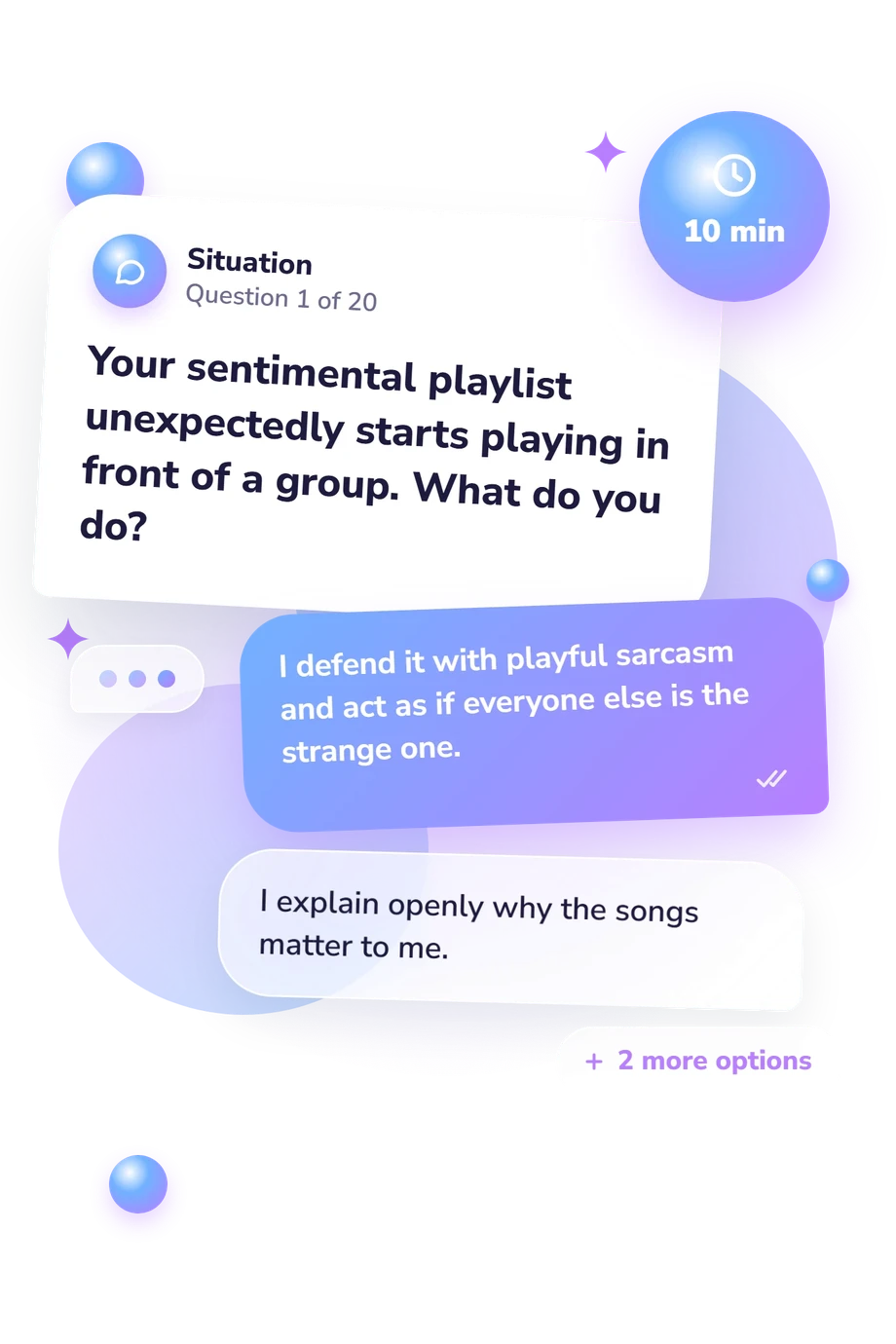
- I defend it with playful sarcasm and act as if everyone else is the strange one.
- I explain openly why the songs matter to me.
- I switch it off quickly and hope the attention moves on.
- I shrug as though it is no big deal, but let it keep playing.
- “Maybe a little—don't get smug about it.”
- “Yes, a lot. I'm really glad you're back.”
- I give a small nod because saying more feels difficult.
- I calmly say that I noticed their absence more than expected.
- I celebrate openly and invite others into the excitement.
- I feel delighted but prefer to enjoy it privately.
- I make a playful understatement that hints at my excitement.
- I show a small smile and calmly confirm that I am pleased.
Anime Archetype Quiz - Description and methodology of the test
Designed for readers who want a light way to compare their own social style, this anime archetype quiz uses everyday reactions as prompts for affinity with five fictional dere patterns. Its scenarios explore anime character types through warmth, reserve, composure, and teasing. The situations also involve affection, disagreement, attention, and trust. They connect those experiences with themes of intense or exclusive devotion.
What This Assessment Explores
Across its scenarios, the assessment examines expressiveness, warmth, conflict style, practical care, and resonance with fictional motifs. As an anime girl archetypes quiz, it presents these as playful fictional patterns rather than measures of virtue or relationship quality.
The five dimensions are:
- Dandere (0-12) indicates quiet observation and private warmth: Socially Forward 0-4; Reserved Streak 5-8; Signature Dandere Energy 9-12.
- Deredere (0-12) indicates open affection and optimism: Understated Warmth 0-4; Sunny Streak 5-8; Signature Deredere Energy 9-12.
- Kuudere (0-12) indicates composure, concise reactions, and practical loyalty: Expressive Presence 0-4; Cool-Headed Streak 5-8; Signature Kuudere Energy 9-12.
- Tsundere (0-12) indicates warmth through teasing or guardedness: Directer Style 0-4; Noticeable Tsundere Streak 5-8; Signature Tsundere Energy 9-12.
- Yandere (0-12) indicates fictional intense or exclusive devotion: Spacious Attachment 0-4; Intense Attachment Streak 5-8; Yandere-Style Intensity 9-12.
Methodology and Scientific Basis
Each item presents a social or relational situation with four response choices. Their differences in openness, reserve, humor, composure, and devotion focus make the task a forced-choice self-report: you select the reaction that feels most natural, not a correct answer.
Scores appear independently on a 0-12 scale. The highest profile is the strongest affinity, and scores within one point suggest a blend. The bands indicate increasing resemblance to a fictional style; they are not clinical cutoffs, and no unlisted point value should be inferred from the ranges.
Braga Jr. et al. (2018) discuss recurring dere patterns in anime, while Togashi (2011) examines traits and language associated with a prominent dere subtype. These publications offer context for fictional anime archetypes; the questionnaire uses its own displayed bands and scoring to organize each profile and identify the strongest affinity or a close blend.
Because responses depend on mood, context, and self-perception, the result is a snapshot of how the scenarios fit your answers at that moment. Fictional intensity should never excuse jealousy, surveillance, isolation, threats, or coercion.
- Braga Jr., Amaro Xavier, Gabriela Maria Cavalcanti Ferreira Lessa Santos, and Mariana Petróvana Ferreira da Silva. "Comic Archetypes: Kuroko no Basket and the Use of the 'Deres'." Revista Cajueiro, vol. 1, no. 1, 2018, pp. 88-119.
- Togashi, Junichi. "Properties of the Tsundere Character and Their Relationship to Linguistic Expression-A Case Study of Tsundere Expressions." In Role Language Studies: Developments, edited by Satoshi Kinsui, Kuroshio Publishers, 2011, pp. 279-295.
- Seko, Yukari, and Minako Kikuchi. "Mentally Ill and Cute as Hell: Menhera Girls and Portrayals of Self-Injury in Japanese Popular Culture." Frontiers in Communication, vol. 7, 2022, article 737761. 10.3389/fcomm.2022.737761
Updated: