
African Civilizations Quiz
How the Scales are Structured
Who Usually Takes This Test?
See How You Compare
Below is a preview of how scores are typically distributed across each scale.
Example Questions From the Test
- Great Zimbabwe
- Carthage
- Old Kingdom Egypt
- Kanem-Bornu
- Phoenician naval settlement in the Horn of Africa
- Roman military government along the Niger River
- A sophisticated Yoruba urban and artistic center
- Nubian pyramid construction near Meroe
- The voting practices of independent farming villages
- The construction of trans-Saharan camel saddles
- The burial customs of ancient Carthaginian sailors
- Court life, royal authority, and remembered events in Benin
African Civilizations Quiz - Description and methodology of the test
People who want a structured way to review kingdoms, cities, belief systems, trade routes, and historical evidence can use the African Civilizations Quiz. Its broad coverage makes it useful for students, teachers, and independent readers who want African history knowledge while organizing a study plan. The questions also invite attention to how places, periods, and sources connect, rather than rewarding isolated name recall.
What This Assessment Explores
Taken together, the questions cover ancient African civilizations and later states, testing broad historical understanding rather than one region’s story. They ask whether you can connect rulers and institutions with geography, exchange, culture, and historical sources.
Your result uses one catalogue scale: African Civilizations Knowledge (0-16). It counts correct answers and has three bands: Foundations to build (0-6), Developing knowledge (7-12), and Strong knowledge (13-16). Together, they indicate increasing command of civilizations and evidence across periods and regions.
The main themes behind that score are:
- Political history shows how states, dynasties, rulers, and institutions organized power.
- Trade and connections show how African societies interacted through desert, river, and ocean routes.
- Culture and belief show what art, architecture, language, and religious exchange reveal.
- Historical reasoning shows whether you compare viewpoint, purpose, and evidence before accepting a claim.
Methodology and Evidence Base
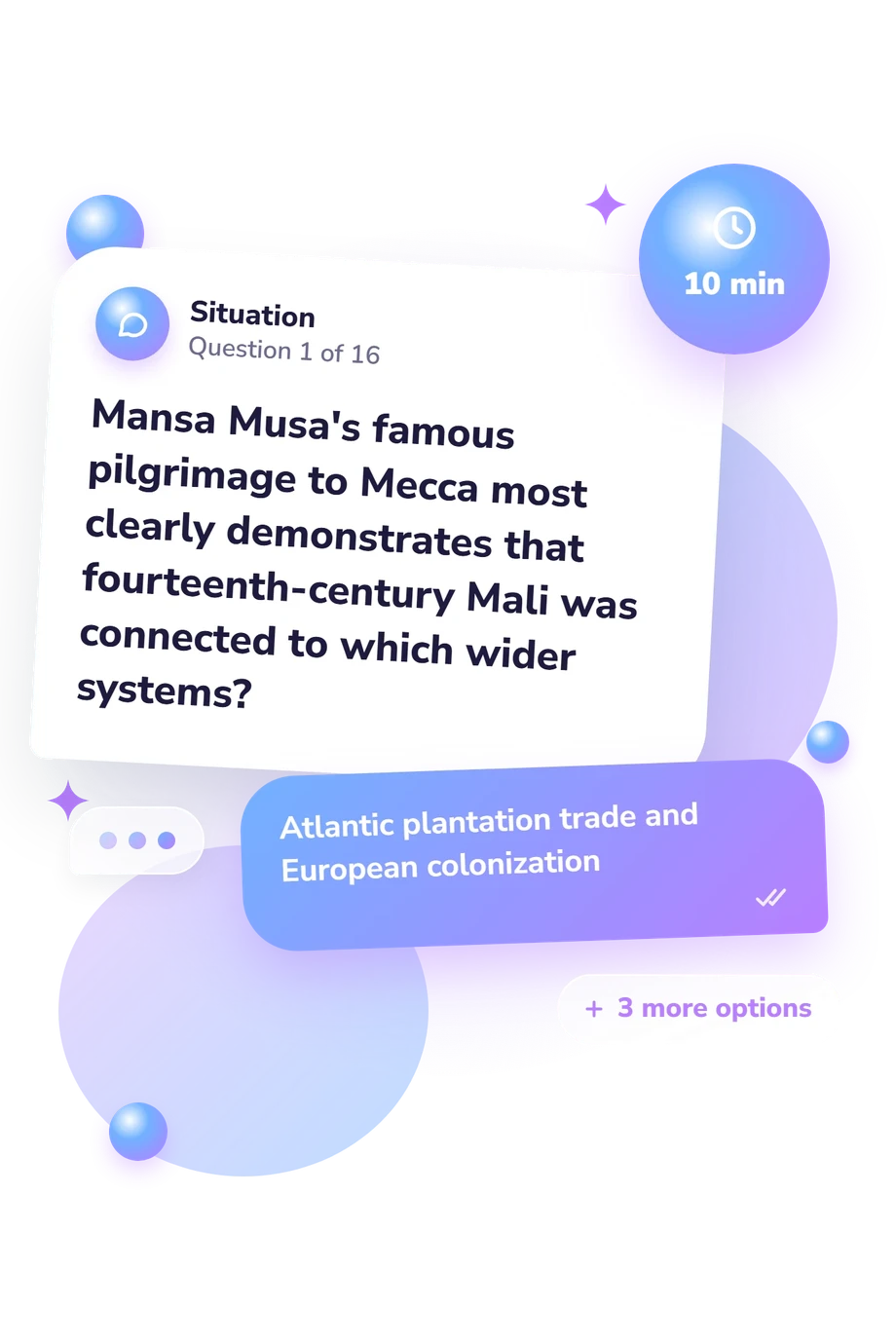
Each item presents a historical question with four answer choices. The format includes African history questions that ask for a civilization or development, while other items use brief scenarios involving archaeology, oral tradition, written records, trade, or environment. The method therefore combines factual recognition with basic source-based reasoning: a strong result reflects recall plus the ability to interpret clues.
Scoring is direct: each correct answer adds one point to the displayed total, making this a raw correct-answer knowledge quiz. The bands organize performance on this question set; they are not a percentile, school grade, or measure of general intelligence.
Historical content references include Ehret’s 2002 survey, Fage and Oliver’s 1979 coverage, and Niane’s 1984 UNESCO volume. They provide context for chronology, regional breadth, and historical evidence, while the quiz itself is scored only through the displayed correct-answer total. The quiz provides a snapshot of knowledge, but guessing, uneven prior exposure, and selected examples may affect the total. Use the result to choose topics for review and further reading.
- Ehret, Christopher. The Civilizations of Africa: A History to 1800. University Press of Virginia, 2002.
- Fage, J. D., and Roland Anthony Oliver, eds. The Cambridge History of Africa, Volume 2: From c.500 BC to AD 1050. Cambridge University Press, 1979. 10.1017/CHOL9780521215923.
- Niane, Djibril Tamsir, ed. General History of Africa, IV: Africa from the Twelfth to the Sixteenth Century. UNESCO, 1984.
Updated: