
1 John Quiz
How the Scales are Structured
Who Usually Takes This Test?
See How You Compare
Below is a preview of how scores are typically distributed across each scale.
Example Questions From the Test
- Purifying oneself as Christ is pure
- Withdrawing from everyone who does not share the hope
- Attempting to calculate when Christ will appear
- Treating present conduct as spiritually irrelevant
- Sin is simply a lack of religious knowledge
- Sin is any experience of fear
- Sin is lawlessness
- Sin is uncertainty about the future
- The apostle who founded the congregation
- Jesus Christ the righteous
- An angel appointed to each believer
- The believer’s own clear conscience
1 John Quiz - Description and methodology of the test
Readers who want to examine how well they understand the First Letter of John can use the 1 Peter Quiz as a focused reading check. It suits someone revisiting the letter, studying its recurring ideas, or looking for passages that deserve closer attention. A 1 John Bible quiz can show strengths in recognizing its language, theological claims, and practical reasoning rather than measuring faith or spiritual maturity.
What This Assessment Explores
Rather than asking for personal testimony, the questionnaire checks recognition of the letter’s teachings and their connections. Items address sin, confession, obedience, love, fear, discernment, eternal life, prayer, and Jesus’ identity. A 1 John study quiz helps readers test recall while keeping the letter’s practical reasoning in view.
The questions cluster around three areas:
- Core claims appear through the Word of life, fellowship, eternal life, and Jesus as the Christ.
- Moral practice is examined through light and darkness, confession, love, refusal to help, and fear.
- Discernment and assurance are connected with testing messages, God’s will, prayer, testimony, and the advocate with the Father.
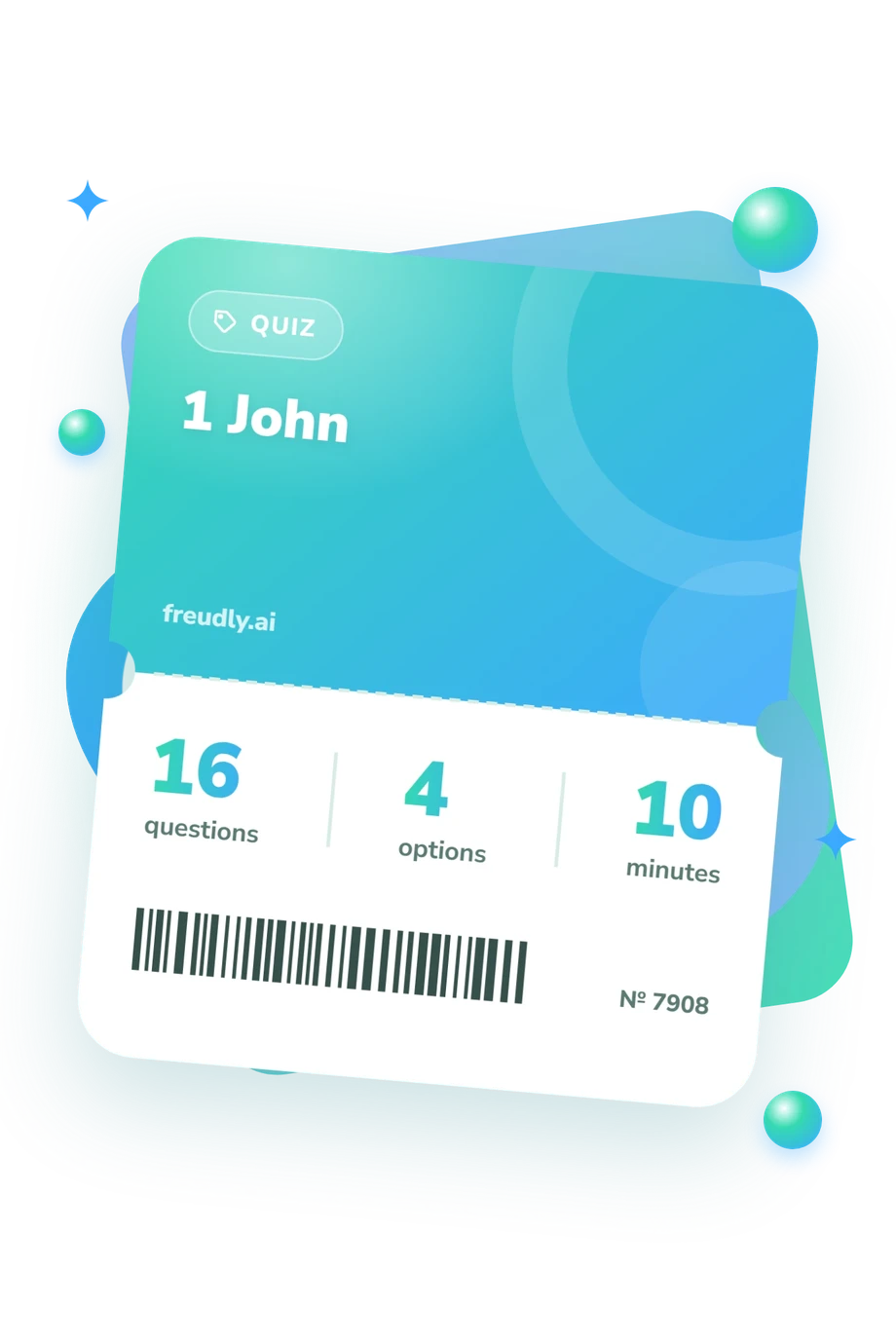
Its single displayed scale, 1 John Knowledge (0-16), reports performance on the questions rather than faith or spiritual maturity. The bands are Foundation to Build (0-6), Developing Understanding (7-12), and Strong Understanding (13-16).
Methodology and Evidence Base
Each item presents a biblical situation, interpretive question, or statement with four choices. The respondent selects the option that best matches 1 John’s wording and argument, making this a text-based knowledge assessment rather than a personality measure. A Bible quiz on 1 John is most useful when answers reflect the letter itself, not general religious familiarity.
The textual anchor is 1 John text (Aland et al., 2014). Kruse and Lieu provide context for recurring contrasts and difficult passages, while Voss clarifies the editorial setting of the UBS Greek text. The questionnaire is conceptually consistent with these works, not a validated adaptation of these sources or a standardized published instrument.
Scoring summarizes performance through the displayed knowledge scale and bands. It indicates how closely answers match the expected reading of 1 John; it does not establish norms, reliability coefficients, diagnostic thresholds, or spiritual standing.
Memory, translation familiarity, recent study, and interpretation can affect performance. Use the result to choose themes for closer reading, as one focused snapshot of biblical knowledge.
- Aland, Barbara, Kurt Aland, Johannes Karavidopoulos, Carlo M. Martini, and Bruce M. Metzger, eds. The Greek New Testament. 5th rev. ed. Stuttgart: Deutsche Bibelgesellschaft, 2014.
- Kruse, Colin G. The Letters of John. Grand Rapids, MI: Eerdmans, 2000.
- Lieu, Judith M. I, II, & III John: A Commentary. Louisville: Westminster John Knox Press, 2008.
- Voss, Florian. “The Fifth Edition of the UBS Greek New Testament.” The Bible Translator 65, no. 2 (2014): 222-230. 10.1177/2051677014537595
Updated: