
Belmont Report Quiz
How the Scales are Structured
Who Usually Takes This Test?
See How You Compare
Below is a preview of how scores are typically distributed across each scale.
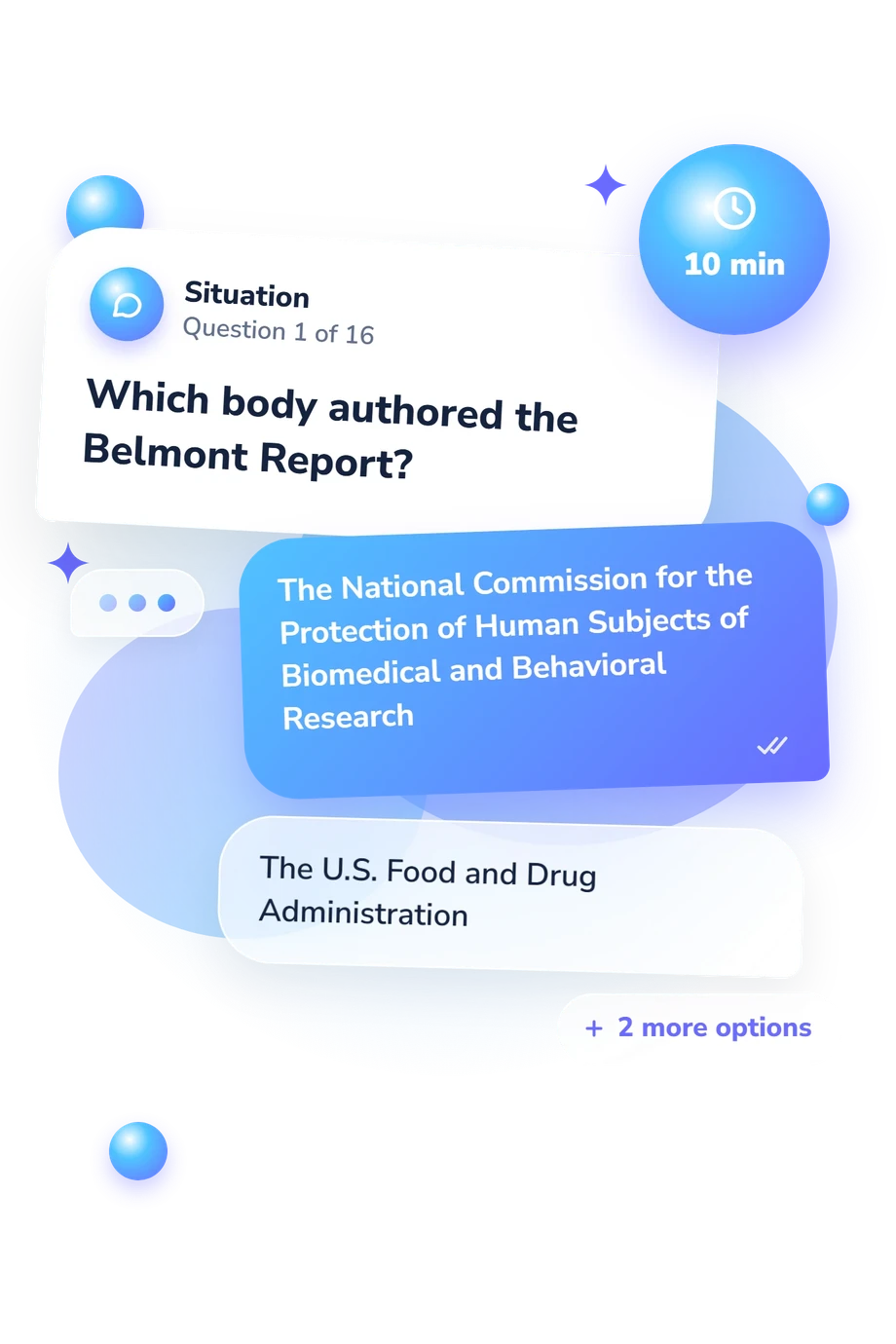
Example Questions From the Test
- The burdens and likely benefits are distributed unfairly, raising a justice concern
- The study violates beneficence solely because research cannot involve burdens
- The study lacks informed consent because disadvantaged adults cannot consent
- The study is ethical as long as recruitment is inexpensive and efficient
- Disclosure, compensation, and debriefing
- Recruitment, randomization, and publication
- Information, comprehension, and voluntariness
- Capacity, confidentiality, and scientific validity
- Consent, confidentiality, and peer review
- Privacy, scientific validity, and transparency
- Autonomy, nonmaleficence, and fidelity
- Respect for persons, beneficence, and justice
Belmont Report Quiz - Description and methodology of the test
Readers who want to check their grasp of research ethics can use the belmont report and its principles quiz to decide whether their knowledge is ready for application. It suits students, researchers, trainees, and anyone reviewing the ethical treatment of human participants. The Belmont Report Quiz offers a structured way to identify where review would be most useful. Results can guide further review when a principle or scenario exposes uncertainty.
What This Assessment Explores
These items measure recognition of the Belmont framework in situations involving autonomy, fairness, and research design. Some ask for a principle or fact directly; others present scenarios about consent, undue influence, vulnerable groups, or risk reduction. As a Belmont principles quiz, it tests whether the reader can apply an ethical idea rather than merely repeat its name.
The main dimensions are:
- Respect for persons shows understanding of autonomy, comprehension, voluntariness, and protection when decision-making is limited.
- Beneficence shows attention to minimizing avoidable harm while considering potential benefits.
- Justice shows understanding of fair distribution of research burdens and benefits, including participant selection.
The displayed Belmont Report Knowledge scale runs from 0-16: Foundation needed (0-6), Developing knowledge (7-12), and Strong knowledge (13-16). Together, the bands indicate how confidently the respondent recognizes principles and applies them to research situations.
Methodology and Scientific Basis
Each item uses a multiple-choice format with four answer options, combining direct knowledge checks with applied research scenarios. The best response depends on identifying the ethical issue at stake: whether consent is understandable and voluntary, whether a population is chosen fairly, or whether remaining risks are justified by the value of the study. The displayed result reports knowledge of the Belmont framework, and no separate weighting rule is specified.
The assessment is conceptually consistent with the three-principle framework in the Belmont Report, which remains the primary source for its content. Nagai, Nakazawa, and Akabayashi (2022) explain the report’s historical formation, while Schupmann and Moreno (2020) place its principles in broader ethical context. This research ethics knowledge test does not specify standardization or norming, and its educational result is not compliance certification or legal advice.
Performance may vary with prior coursework, reading comprehension, attention to wording, and guessing. Readers can use the result to target review of the principles, informed consent, risk-benefit assessment, or fair subject selection.
- National Commission for the Protection of Human Subjects of Biomedical and Behavioral Research. The Belmont Report: Ethical Principles and Guidelines for the Protection of Human Subjects of Research. U.S. Department of Health, Education, and Welfare; 1978. DHEW Publication No. (OS) 78-0012.
- Nagai H, Nakazawa E, Akabayashi A. The creation of the Belmont Report and its effect on ethical principles: a historical study. Monash Bioethics Review. 2022;40(2):157-170. 10.1007/s40592-022-00165-5.
- Schupmann W, Moreno JD. Belmont in Context. Perspectives in Biology and Medicine. 2020;63(2):220-239. 10.1353/pbm.2020.0028.
Updated: