
Alkane Quiz
How the Scales are Structured
Who Usually Takes This Test?
See How You Compare
Below is a preview of how scores are typically distributed across each scale.
Example Questions From the Test
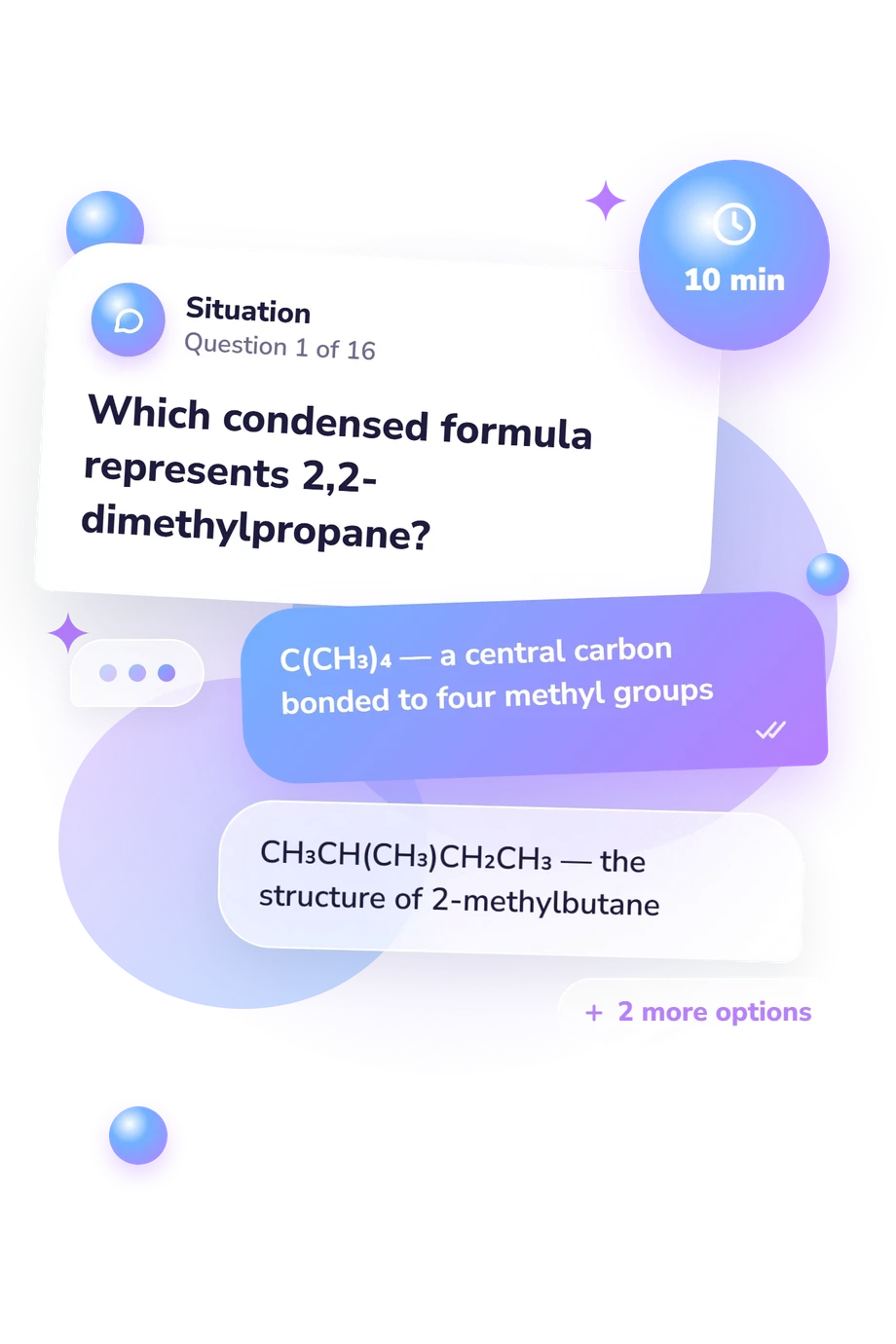
- C(CH₃)₄ — a central carbon bonded to four methyl groups
- CH₃CH(CH₃)CH₂CH₃ — the structure of 2-methylbutane
- CH₃CH₂CH₂CH₂CH₃ — the straight-chain structure of pentane
- CH₃CH(CH₃)CH₃ — the structure of 2-methylpropane
- Butane
- methylbutane
- methylpropane
- methylpropane
- methyl-3-ethylhexane
- ethyl-5-methylhexane
- methyl-2-ethylhexane
- ethyl-2-methylhexane
Alkane Quiz - Description and methodology of the test
Students and chemistry learners who want to gauge their preparation can use this alkane quiz as a focused knowledge check. It also gives learners practice with introductory alkane chemistry before an assignment, lesson, or examination. The result indicates their current level and helps direct revision toward concepts that need more attention.
What This Assessment Explores
Across the items, the assessment checks whether a learner can read condensed formulas, select parent chains, apply locants and naming order, recognize structural isomers, classify carbon atoms, and connect structure with physical or chemical behavior. Some items form a quiz on the nomenclature of alkanes, while others cover formulas, properties, and reactions.
Results appear on one scale: Alkane Knowledge (0-16). The bands are Foundations to Review (0-6), Developing Knowledge (7-12), and Strong Knowledge (13-16). They indicate whether core concepts need review, are developing, or are reliable across the assessed topics.
The main result themes are:
- Formula reading shows whether you can translate among molecular and condensed representations.
- Nomenclature shows how you choose parent chains, locants, and substituent order.
- Isomerism shows whether you distinguish connectivity and carbon environments.
- Reactions and properties show how well you balance equations and explain branching effects.
Methodology and Scientific Basis
Each item uses a single-best-answer multiple-choice format built around a formula, name, structure, reaction, or property. The alternatives include rule-based distractors, so selecting an answer requires applying the relevant chemistry principle. As an alkane nomenclature test, it emphasizes parent-chain selection, lowest locants, systematic naming, and condensed structures.
The question set also asks learners to identify molecular formulas, name isomers, balance combustion and cracking equations, and relate branching to boiling behavior.
The displayed result uses descriptive catalogue bands; no weighting or partial-credit rule is specified.
McMurry (2023) supplies the core chemistry framework; Favre and Powell support IUPAC naming principles; and Flowers, Theopold, Langley, and Robinson support formulas and reactions. The questionnaire is conceptually consistent with these sources, not an adaptation of any of those published works.
Interpretation can be affected by prior teaching, notation fluency, guessing, and current study context. Use the result as a learning snapshot: it highlights material to revisit or confirms stronger command of the tested content, without establishing broader chemistry mastery.
- John McMurry. Organic Chemistry. OpenStax, Houston, Texas, 2023.
- Henri A. Favre and Warren H. Powell, editors. Nomenclature of Organic Chemistry: IUPAC Recommendations and Preferred Names 2013. Royal Society of Chemistry, 2013. 10.1039/9781849733069.
- Paul Flowers, Klaus Theopold, Richard Langley, and William R. Robinson. Chemistry 2e. OpenStax, Houston, Texas, 2019.
Updated: