
Are You a Queen Bee Quiz
How the Scales are Structured
Who Usually Takes This Test?
See How You Compare
Below is a preview of how scores are typically distributed across each scale.
Example Questions From the Test
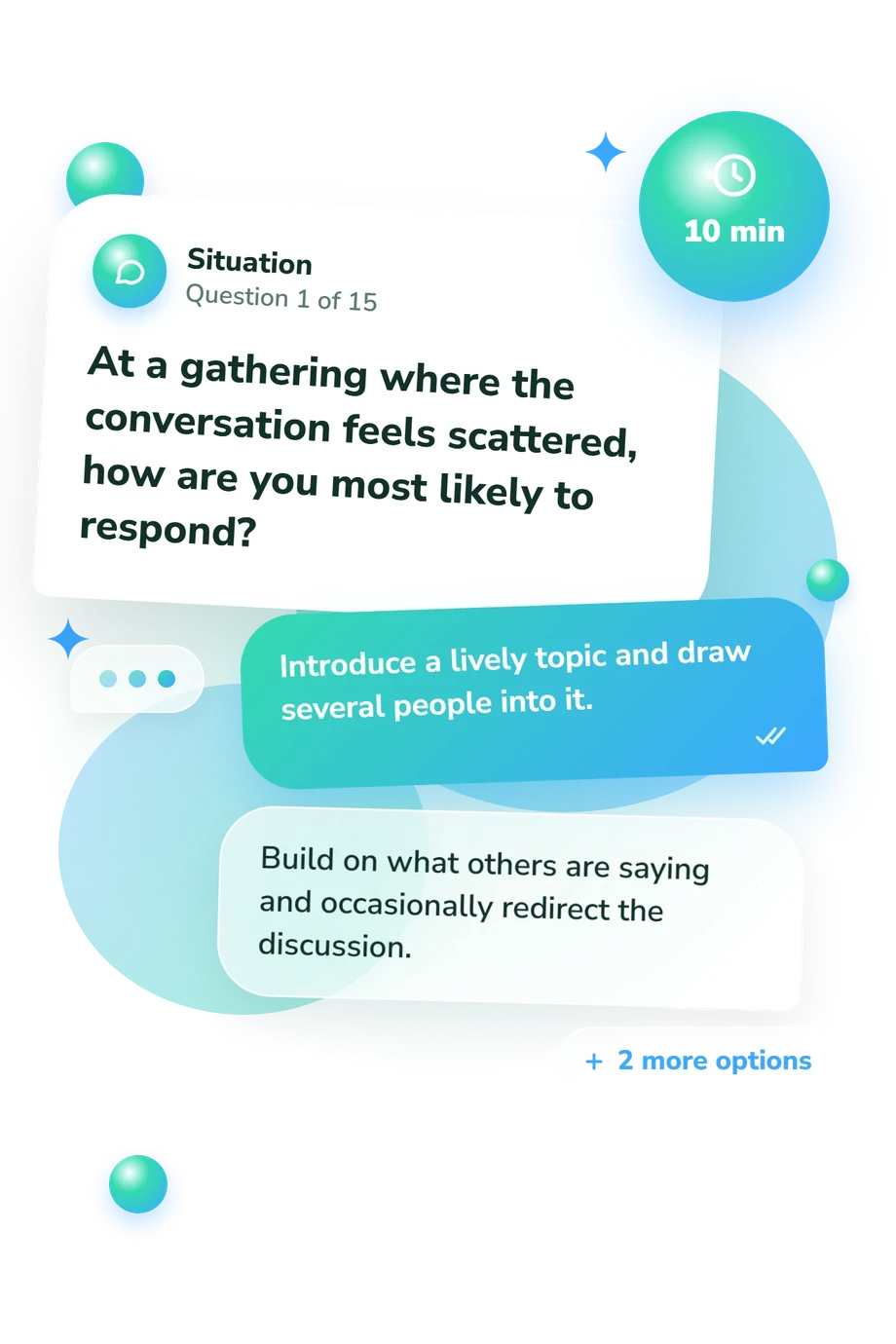
- Introduce a lively topic and draw several people into it.
- Build on what others are saying and occasionally redirect the discussion.
- Focus on a smaller side conversation that interests me.
- Listen and let other people establish the mood.
- Wait to see whether someone else revives the plan.
- Mention one activity I would enjoy without organizing it.
- Offer a couple of options and ask people to choose.
- Propose a clear plan, settle the details, and get commitments.
- I notice the change but assume different friendships can grow alongside ours.
- I make extra plans with my friend so our connection stays prominent.
- I wonder what has shifted and look for signs that my place is changing.
- I actively try to reestablish myself as the person they rely on most.
Are You a Queen Bee Quiz - Description and methodology of the test
People who want to understand their role in a friendship circle may take the Are You a Queen Bee Quiz when deciding whether to revisit a group habit or simply reflect on a recurring interaction. A queen bee quiz can organize that reflection around queen-bee dynamics without assigning a fixed social label. It suits anyone considering how to respond more deliberately in everyday group situations.
What This Assessment Explores
The questionnaire separates three social-functioning dimensions. Situations cover plans, decisions, newcomers, disagreement, and shifts in attention or access. Results describe participation, not character.
Dimensions are:
- Inclusive Leadership (0-15) measures your use of social awareness and influence to widen participation and connection: Selective Circle (0-5), Responsive Connector (6-10), or Community Builder (11-15).
- Social Influence (0-15) measures how readily you shape plans, conversations, and group direction: Background Presence (0-5), Situational Influencer (6-10), or Tone Setter (11-15).
- Status and Control (0-15) measures the strength of your preference for centrality, recognition, and influence over access: Flexible Position (0-5), Status Aware (6-10), or Centrality Protective (11-15).
The social-influence questions let readers compare the three tendencies in their profile without implying that the assessment calculates relationships between scales. The scales describe tendencies in selected situations, not intent, popularity, or moral worth.
Methodology and Scientific Basis
Each item presents a familiar group situation with four response choices. The options represent ways of stepping forward, supporting participation, staying peripheral, protecting a position, or adapting to others. This is comparative self-report, not a right-or-wrong performance.
Results are reported through the three displayed dimensions and named bands. The questionnaire does not document a fixed point value for each answer, so results are best read as the profile shown, not reverse-engineered into a scoring formula. Questions about queen-bee personality dynamics can prompt pattern recognition, although scores may shift with current relationships, recent exclusion, confidence, or the imagined setting.
The closest comparison is Adler and Adler (1995) on clique inclusion and exclusion. Derks, Van Laar, and Ellemers (2016) offer narrower context on the queen bee phenomenon among women leaders and junior women in organizations, not the properties of this questionnaire. These are conceptual comparisons, not evidence that this online questionnaire is an adaptation, standardized instrument, or validated clinical measure. Honest self-report and self-awareness shape the result, which works best as a prompt for examining group habits and alternatives.
- Adler, Patricia A., and Peter Adler. “Dynamics of Inclusion and Exclusion in Preadolescent Cliques.” Social Psychology Quarterly, 58(3), 1995, 145-162. 10.2307/2787039
- Derks, Belle, Colette Van Laar, and Naomi Ellemers. “The Queen Bee Phenomenon: Why Women Leaders Distance Themselves from Junior Women.” The Leadership Quarterly, 27(3), 2016, 456-469. 10.1016/j.leaqua.2015.12.007
- Cillessen, Antonius H. N., and Lara Mayeux. “From Censure to Reinforcement: Developmental Changes in the Association Between Aggression and Social Status.” Child Development, 75(1), 2004, 147-163. 10.1111/j.1467-8624.2004.00660.x
Updated: