
1 Timothy Quiz
How the Scales are Structured
Who Usually Takes This Test?
See How You Compare
Below is a preview of how scores are typically distributed across each scale.
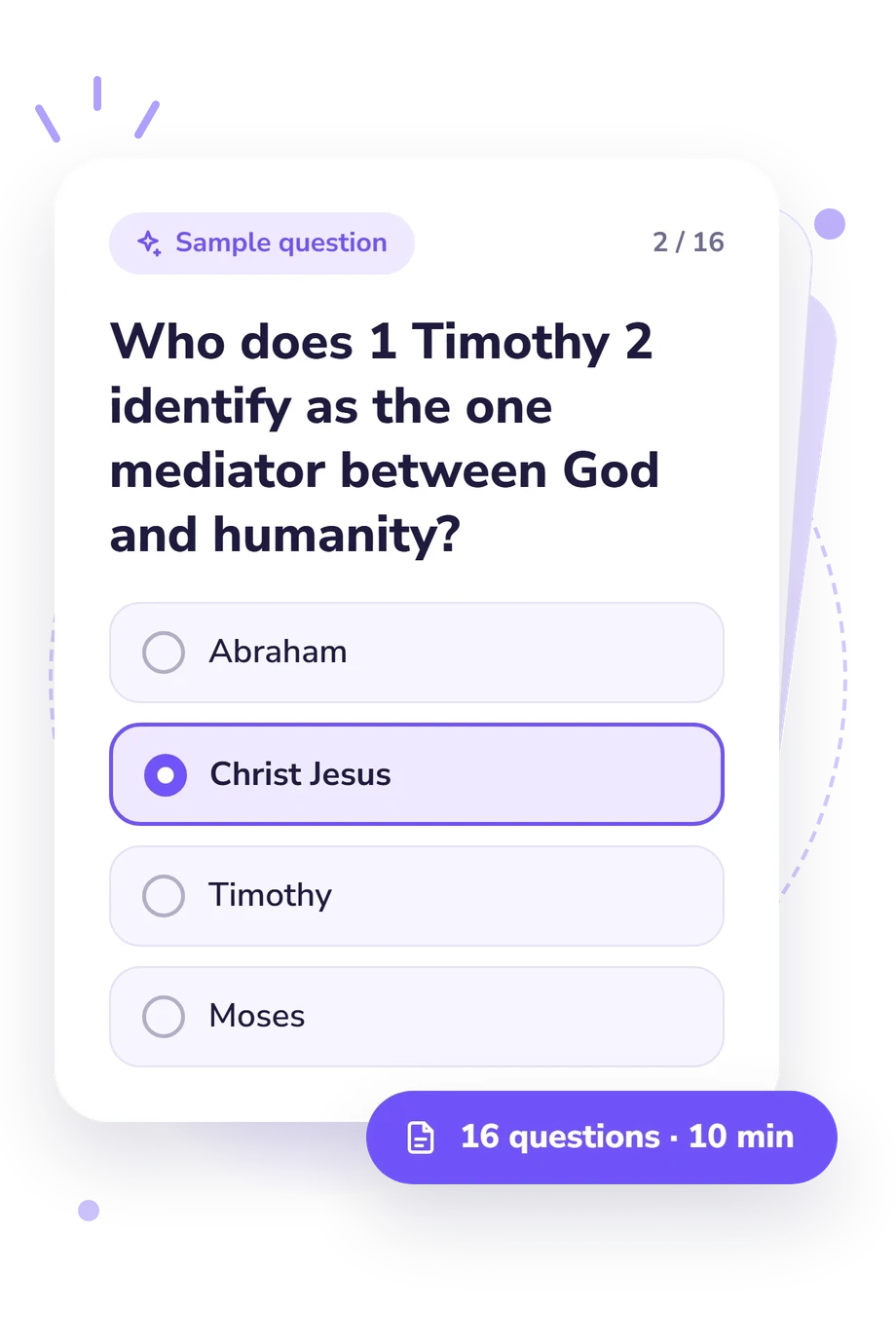
Example Questions From the Test
- As hesitant, private, and unwilling to travel
- As a tax collector who exploited his neighbors
- As blasphemous, persecuting, and violent
- As a false prophet who performed signs for money
- Abraham
- Christ Jesus
- Timothy
- Moses
- Using it to support speculative discussions about genealogies
- Using it lawfully to identify conduct contrary to sound teaching
- Treating obedience to it as a way to earn the role of apostle
- Limiting it to disputes about ceremonial calendars
1 Timothy Quiz - Description and methodology of the test
Readers who want to examine their recall of Paul’s first letter to Timothy can use this assessment, despite its 2020 presidential candidates quiz label, to review its people, teachings, instructions, and themes. It helps learners identify which parts of the letter they remember and which passages may deserve another reading. As a 1 Timothy scripture quiz, it suits personal study, group discussion, or review before or after reading the letter.
What This Assessment Explores
The questions test recall and interpretation rather than opinion. They move from Paul’s conduct and Christ as mediator to prayer, false teaching, leadership, widows, correction, and wealth, asking readers to connect details with the letter’s instructions.
The themes fall into four connected areas:
- Paul’s mission and Timothy’s assignment link teaching with faithful responsibility.
- Worship and public life join prayer, godliness, and conduct.
- Leadership and household conduct define expectations for overseers and deacons.
- Community care covers families, widows, age, correction, and money.
Readers may use it as a 1 Timothy knowledge quiz for study, group review, or memory refreshment. Its result appears on the 1 Timothy Knowledge scale, 0-16: Foundations to revisit (0-6), Developing knowledge (7-12), and Strong knowledge (13-16). The scale reflects knowledge of the letter’s setting, teachings, and practical guidance, not a theological judgment.
Methodology and Evidence Base
Each item presents a short question with four answer choices, so the task is selected-response recall with some application to situations described in the letter. The respondent chooses the best-supported answer, and the displayed result summarizes performance across the questionnaire; no separate weighting rule for individual answers is specified.
Wall and Steele (2012) and Towner (2006) support the questions’ biblical content and the letter’s setting, arguments, and practical instruction, while the 2021 updated NRSV supplies an English textual basis for comparison. These sources support content and context only; the questionnaire is a fixed-choice educational assessment with no published norming or validation, and it is not an adaptation of their commentaries.
The fixed-choice format makes this Bible knowledge quiz useful for checking focused understanding rather than personal opinion. Interpret the outcome as an educational summary of remembered content. Performance may shift with prior exposure, translation familiarity, attention, and memory on the day, so the score works best as a focused learning check for deciding what to reread.
- Wall, Robert W., and Richard B. Steele. 1 and 2 Timothy and Titus. Two Horizons New Testament Commentary. Grand Rapids, MI: William B. Eerdmans Publishing Company, 2012. ISBN 9780802825629.
- New Revised Standard Version Updated Edition. National Council of the Churches of Christ in the United States of America, 2021.
- Towner, Philip H. The Letters to Timothy and Titus. New International Commentary on the New Testament. Grand Rapids, MI: William B. Eerdmans Publishing Company, 2006. ISBN 9780802825131.
- Malherbe, Abraham J. 2007. “The Letters to Timothy and Titus - By Philip H. Towner.” Religious Studies Review 33 (3): 240. 10.1111/j.1748-0922.2007.00203_45.x
Updated: