
AP Style Quiz
How the Scales are Structured
Who Usually Takes This Test?
See How You Compare
Below is a preview of how scores are typically distributed across each scale.
Example Questions From the Test
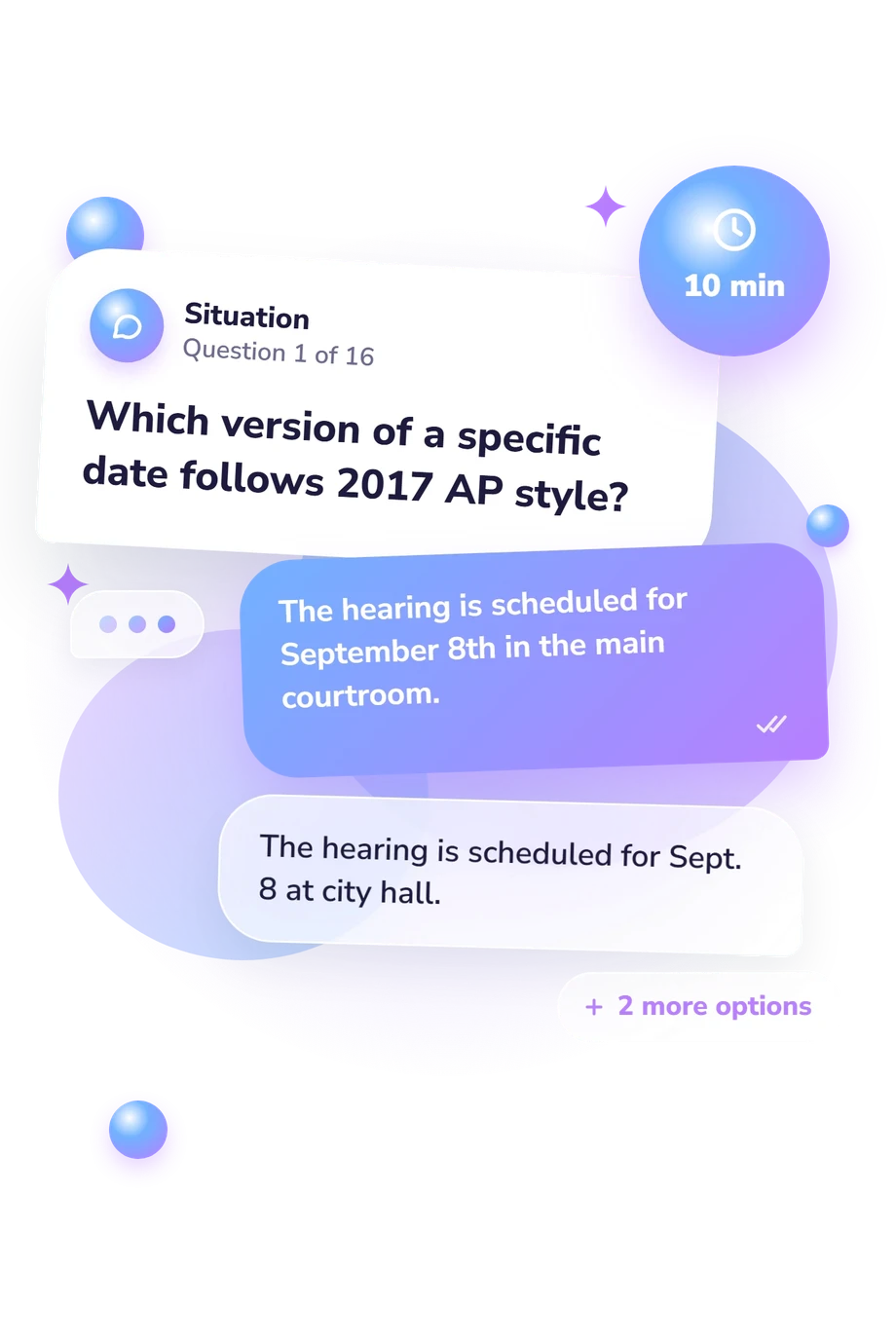
- The hearing is scheduled for September 8th in the main courtroom.
- The hearing is scheduled for Sept. 8 at city hall.
- The hearing is scheduled for September 8 before the council.
- The hearing is scheduled for Sept 8 in the afternoon.
- The station specializes in 1980's music each morning.
- The festival celebrates 1980s music.
- The documentary explores 1980s' music and fashion.
- The playlist contains '1980's music for the party.
- The firm opened an office in Denver, CO, last spring.
- The retailer opened a branch in Denver, Colo., near downtown.
- The company opened an office in Denver, Colorado.
- The agency moved its staff to Denver, Col., after the merger.
AP Style Quiz - Description and methodology of the test
Editors, reporters, students, and anyone working with news copy can use AP Style Quiz 2017 to examine how consistently they apply selected Associated Press conventions. This AP style quiz for 2017 conventions focuses on practical choices rather than broad writing ability, so the result can point to rules worth revisiting. It suits self-checking before coursework, newsroom tasks, or a focused style review.
What This Assessment Explores
The questionnaire samples rule-based decisions in edited news copy rather than general writing talent. Its result reports AP Style Knowledge on a 0-16 scale with Foundation (0-6), Developing (7-12), and Strong (13-16) bands. These labels describe performance on the tested 2017 conventions, not certification.
Because it is a 2017 AP style test, the result is a snapshot of convention-specific performance. It helps learners and working writers identify rules that merit review.
The tested areas include:
- Dates and numbers show whether the respondent handles months, years, percentages, ages, and fractions consistently.
- Punctuation tests quotations, colons, commas, hyphenation, and capitalization in complete sentences.
- Titles and addresses cover book titles, formal positions, degrees, street abbreviations, and state names.
- Usage checks 2017 styling for terms such as email and internet.
Methodology and Evidence Base
Each item presents a brief editorial situation with several answer choices. The respondent selects the wording that best follows the convention being tested, including details such as abbreviated months, quotation punctuation, capitalization after a colon, and title treatment. The score summarizes selected responses across the questionnaire, while the displayed bands give the total a practical interpretation.
AP Stylebook (Froke et al., 2017) is the principal reference for the conventions sampled here. The online questionnaire is scored against selected 2017 conventions, with no reported standardization or validation against a professional population. The questionnaire is not reported as a standardized or validated adaptation of the AP Stylebook.
Because the quiz is edition-specific, this AP style practice quiz reflects selected 2017 rules, and current recommendations may differ. The result should be read as performance on these selected conventions, not as a measure of overall editing skill; familiarity with editorial terminology and attention to small wording differences can also affect the outcome.
- Froke, Paula, Anna Jo Bratton, Oskar Garcia, David Minthorn, Karl Ritter, and Jerry Schwartz, eds. The Associated Press Stylebook and Briefing on Media Law 2017. 52nd ed. New York: Basic Books, 2017.
- The Associated Press. Data journalism chapter debuts in 2017 AP Stylebook. The Associated Press, May 31, 2017.
- Bessette, Lily G., Sacha C. Hauc, Heidi Danckers, Agata Atayde, and Richard Saitz. The Associated Press Stylebook Changes and the Use of Addiction-Related Stigmatizing Terms in News Media. Substance Abuse 43, no. 1 (2022): 127-130. 10.1080/08897077.2020.1748167
Updated: