
Am I Going Bald Quiz
How the Scales are Structured
Who Usually Takes This Test?
See How You Compare
Below is a preview of how scores are typically distributed across each scale.
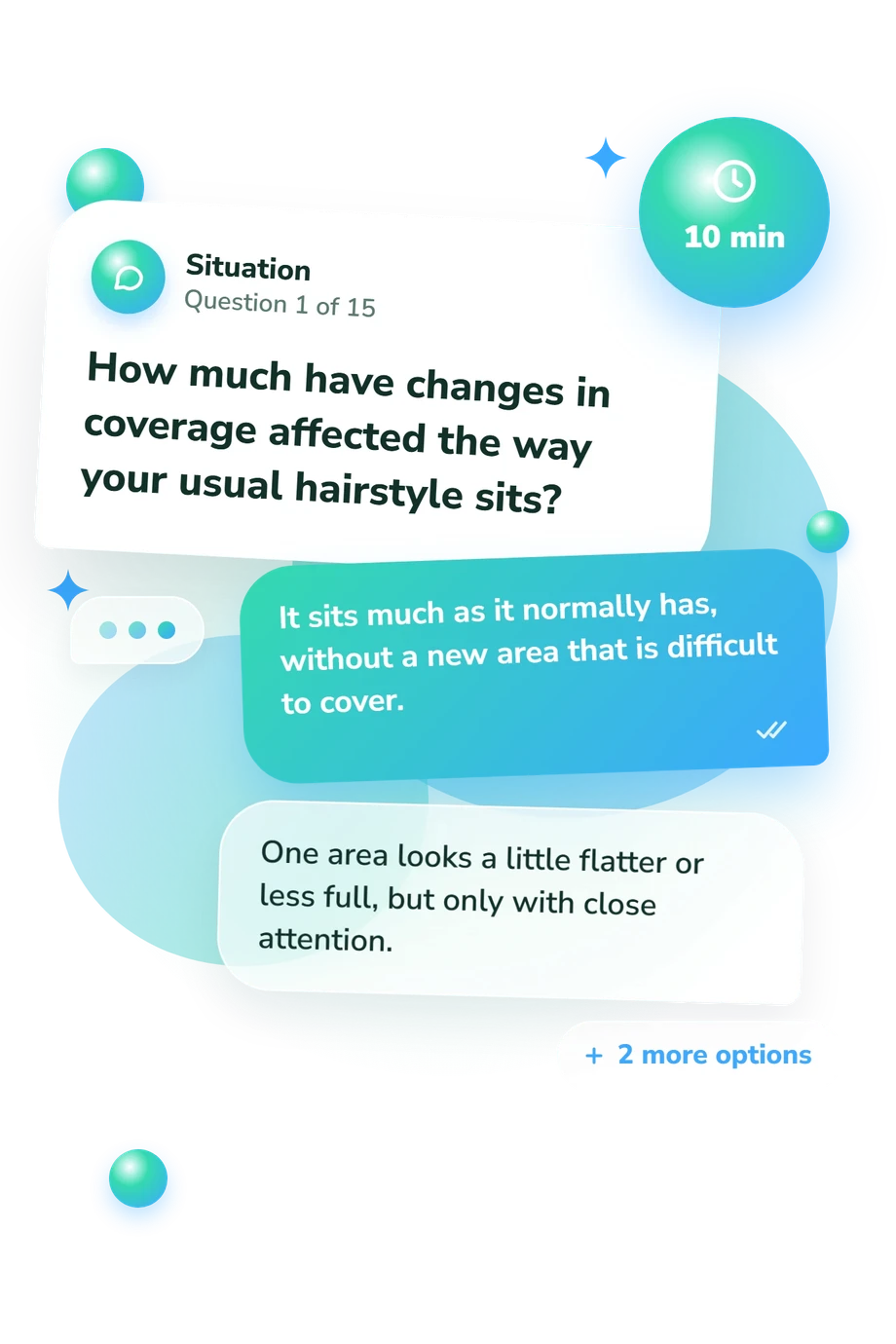
Example Questions From the Test
- It sits much as it normally has, without a new area that is difficult to cover.
- One area looks a little flatter or less full, but only with close attention.
- I regularly adjust the part, direction, or volume to cover a visibly thinner area.
- A formerly covered area now remains exposed despite arranging my hair as usual.
- No new change outside the scalp.
- A subtle change in one area that has remained stable.
- Clear thinning in another hair-bearing area.
- Sudden or patchy loss affecting multiple areas, including eyebrows or eyelashes.
- I did not notice increased shedding after such an event.
- A mild increase occurred and then began settling toward my baseline.
- The increase has continued for weeks without a clear return toward baseline.
- Shedding is intense, rapidly worsening, or accompanied by a newly exposed area of scalp.
Am I Going Bald Quiz - Description and methodology of the test
People who notice more shedding, a changing hairline, scalp symptoms, or a new patch can use the Am I Going Bald Quiz to organize what they are observing. It turns a broad worry into specific observations that can be compared with a familiar personal baseline. As a hair loss quiz, it helps the reader distinguish stable variation from changes that deserve closer attention.
What This Assessment Explores
Items ask about changes against a personal baseline: altered coverage, shedding after illness or stress, breakage, scalp symptoms, family pattern, hairstyle tension, hair outside the scalp, and progression.
Three result domains organize the concern behind a should i go bald quiz:
- Scalp and Health Context (0-15) shows whether responses include scalp, health, medication, nutrition, or urgent-looking features. Bands: No indicator endorsed (0), Indicator noted (1-2), Follow-up priority (3-15).
- Shedding and Hair-Shaft Changes (0-15) shows increased loose hair, clumping, snapping, fraying, or persistent shedding. Bands: No indicator endorsed (0), Indicator noted (1-2), Follow-up priority (3-15).
- Visible Pattern Changes (0-15) shows altered coverage, scalp visibility, receding edges, or discrete patches. Bands: No indicator endorsed (0), Indicator noted (1-2), Follow-up priority (3-15).
Together, the domains identify which observation deserves attention, even if another score is low.
Methodology and Scientific Basis
Each item offers four descriptions, from a familiar baseline through mild or persistent change to pronounced, rapid, patchy, painful, or concerning features. The respondent compares current observations with routines and photographs, not a universal norm.
Answers are grouped into the three domains and summarized as 0-15 scores. These bands are unvalidated reflective summaries, not severity ratings, diagnostic cutoffs, or proof that hair loss is absent. A single red-flag response can override the total, especially with rapid patch formation or an injured scalp. The question behind an am i losing my hair quiz is answered by considering symptoms and progression, not just the result label.
The content is conceptually consistent with Mubki et al. (2014), the Hair Shedding Visual Scale described by Martínez-Velasco et al. (2017), and the diagnostic approach of Jackson and Price (2013). It is not an adaptation or validation of those publications, but an online self-reflection tool organized around related observations.
Self-report is shaped by lighting, styling, recall, stress, health changes, and worry. Patchy loss or significant scalp symptoms warrant clinical discussion regardless of the score.
- Mubki, Thamer, Lidia Rudnicka, Malgorzata Olszewska, and Jerry Shapiro. “Evaluation and diagnosis of the hair loss patient: part I. History and clinical examination.” Journal of the American Academy of Dermatology, vol. 71, no. 3, 2014, pp. 415.e1-415.e15. 10.1016/j.jaad.2014.04.070
- Martínez-Velasco, María Abril, Norma Elizabeth Vázquez-Herrera, Austin John Maddy, Daniel Asz-Sigall, and Antonella Tosti. “The Hair Shedding Visual Scale: A Quick Tool to Assess Hair Loss in Women.” Dermatology and Therapy, vol. 7, no. 1, 2017, pp. 155-165. 10.1007/s13555-017-0171-8
- Jackson, Adrianna J., and Vera H. Price. “How to diagnose hair loss.” Dermatologic Clinics, vol. 31, no. 1, 2013, pp. 21-28. 10.1016/j.det.2012.08.007
Updated: