
Am I Anti-Semitic Quiz
How the Scales are Structured
Who Usually Takes This Test?
See How You Compare
Below is a preview of how scores are typically distributed across each scale.
Example Questions From the Test
- Their partner being Jewish would not affect how I view the relationship.
- I might feel unfamiliar with some traditions, but I would remain open and get to know the person.
- I would worry about cultural or family complications and encourage my friend to reconsider.
- I would prefer that the relationship not become serious because the partner is Jewish.
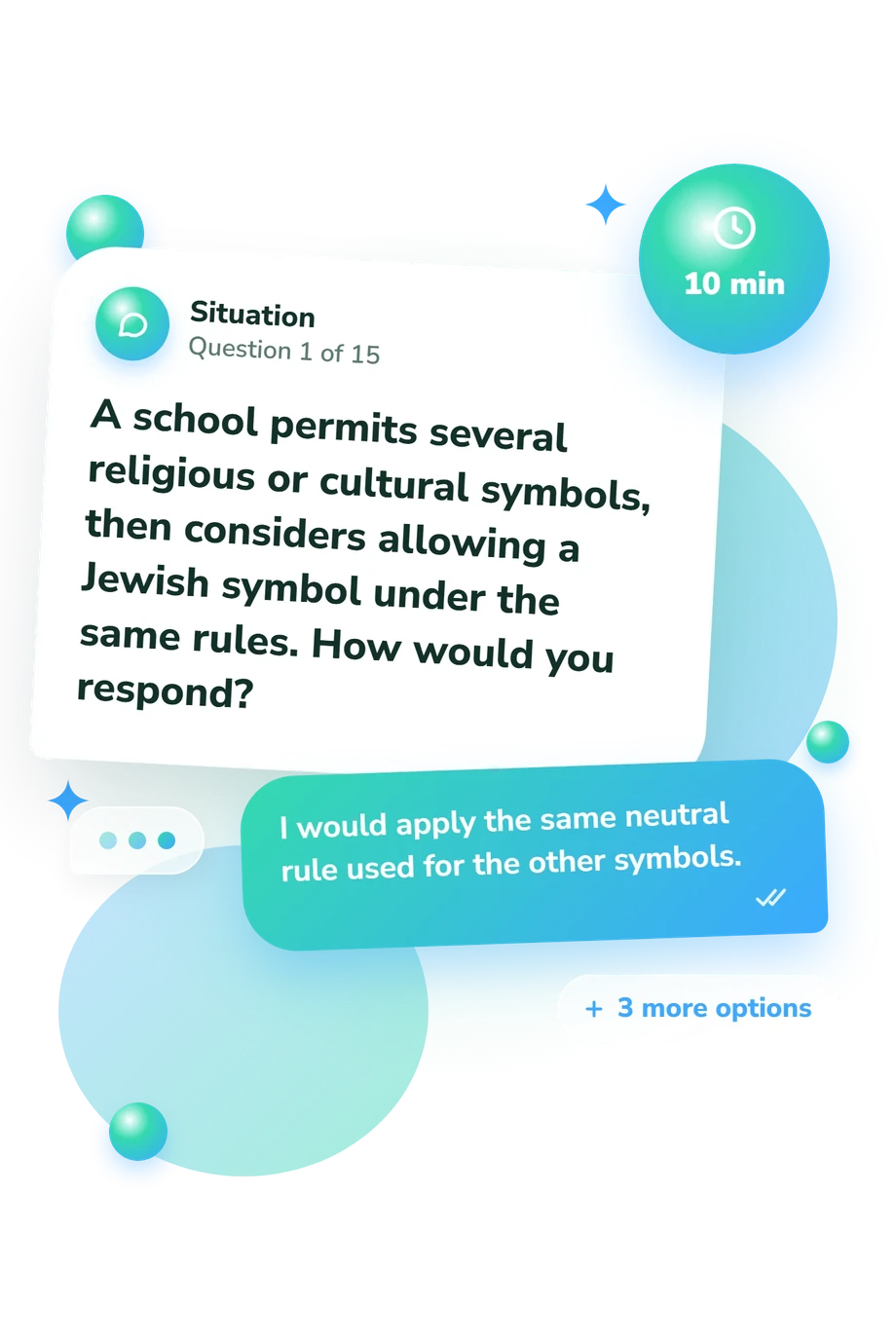
- I would apply the same neutral rule used for the other symbols.
- I might initially worry about political controversy, but I would still support consistent treatment.
- I would oppose it to prevent controversy while leaving the existing symbols in place.
- I would treat the Jewish symbol as uniquely political or as evidence of attempted group influence.
- That expectation unfairly assigns them responsibility based on identity.
- I understand why people assume a connection, but questions should not presume responsibility or a particular view.
- I think Jewish people have some obligation to clarify their position when the subject is prominent.
- I think refusing to condemn those actions is a legitimate reason to distrust the person.
Am I Anti-Semitic Quiz - Description and methodology of the test
People who want to examine how they respond when Jewish identity, political responsibility, stereotypes, or exclusion enter everyday situations can use the am i anti semitic quiz as a structured self-reflection exercise. Readers can use it as an antisemitism self-assessment to consider reactions to relationships, public symbols, workplace decisions, jokes, and reports of harassment. It is intended for anyone willing to examine whether standards remain consistent when Jewish people or Israel are involved.
What This Assessment Explores
Items examine whether respondents separate Jewish people from governments, apply comparable standards, resist stereotypes, and respond when antisemitism affects someone else. They also address social distance and bystander conduct. In this quiz about antisemitic attitudes, criticism of Israeli policy is not treated as evidence by itself; the focus is identity-based assumptions and unequal standards.
The result groups reflection into three dimensions:
- Collective Blame and Unequal Standards (0-15) shows whether Jewish people or institutions receive collective responsibility or inconsistent standards: Generally individualized (0-5), Inconsistent boundaries (6-10), Strong collective attribution (11-15).
- Interpersonal Inclusion and Bystander Conduct (0-15) shows how exclusion and support appear in social situations: Inclusive (0-5), Hesitant (6-10), Exclusionary (11-15).
- Stereotypes and Conspiracy Thinking (0-15) shows reliance on generalized traits or conspiracy narratives: Limited endorsement (0-5), Mixed endorsement (6-10), Strong endorsement (11-15).
Methodology and Scientific Basis
Each item presents a social or political situation with four response options. The choices describe varying reactions to these situations, ranging from more individualized or inclusive responses to stronger collective assumptions or exclusion; their order and weights are not documented. Respondents select the answer closest to their usual judgment, making this self-report rather than behavioral observation.
In its role as an antisemitism questionnaire, the tool produces separate dimension scores rather than one overall label. Ranges show possible totals, but per-answer weights are not stated; readers should not infer a scoring rule from ranges. The bands are descriptive, unvalidated reflections, not norms or definitive cutoffs.
Its content is conceptually consistent with the Generalised Antisemitism (GeAs) Scale by Allington, Hirsh, and Katz, which distinguishes ideas about Jews from antisemitic framing connected with Israel. This online questionnaire is not presented as an adaptation of GeAs, so findings from the published instrument do not establish validity here.
Interpret the profile as a prompt to examine patterns and context, remembering that self-report is vulnerable to social desirability and limited self-awareness; results are not diagnoses or fixed character verdicts.
- Allington, Daniel; Hirsh, David; and Katz, Louise. "The Generalised Antisemitism (GeAs) Scale: A Questionnaire Instrument for Measuring Antisemitism as Expressed in Relation Both to Jews and to Israel." Journal of Contemporary Antisemitism 5, no. 1 (2022): 37-48. 10.26613/jca/5.1.99
- Allington, Daniel; Hirsh, David; and Katz, Louise. "The Generalized Antisemitism (GeAs) Scale: Validity and Factor Structure." Journal of Contemporary Antisemitism 5, no. 2 (2022): 1-28. 10.26613/jca.5.2.113
Updated: