
60th Birthday Quiz
How the Scales are Structured
Who Usually Takes This Test?
See How You Compare
Below is a preview of how scores are typically distributed across each scale.
Example Questions From the Test
- 12:00 a.m. Wednesday
- 12:00 p.m. Wednesday
- 12:00 p.m. Thursday
- 12:00 a.m. Thursday
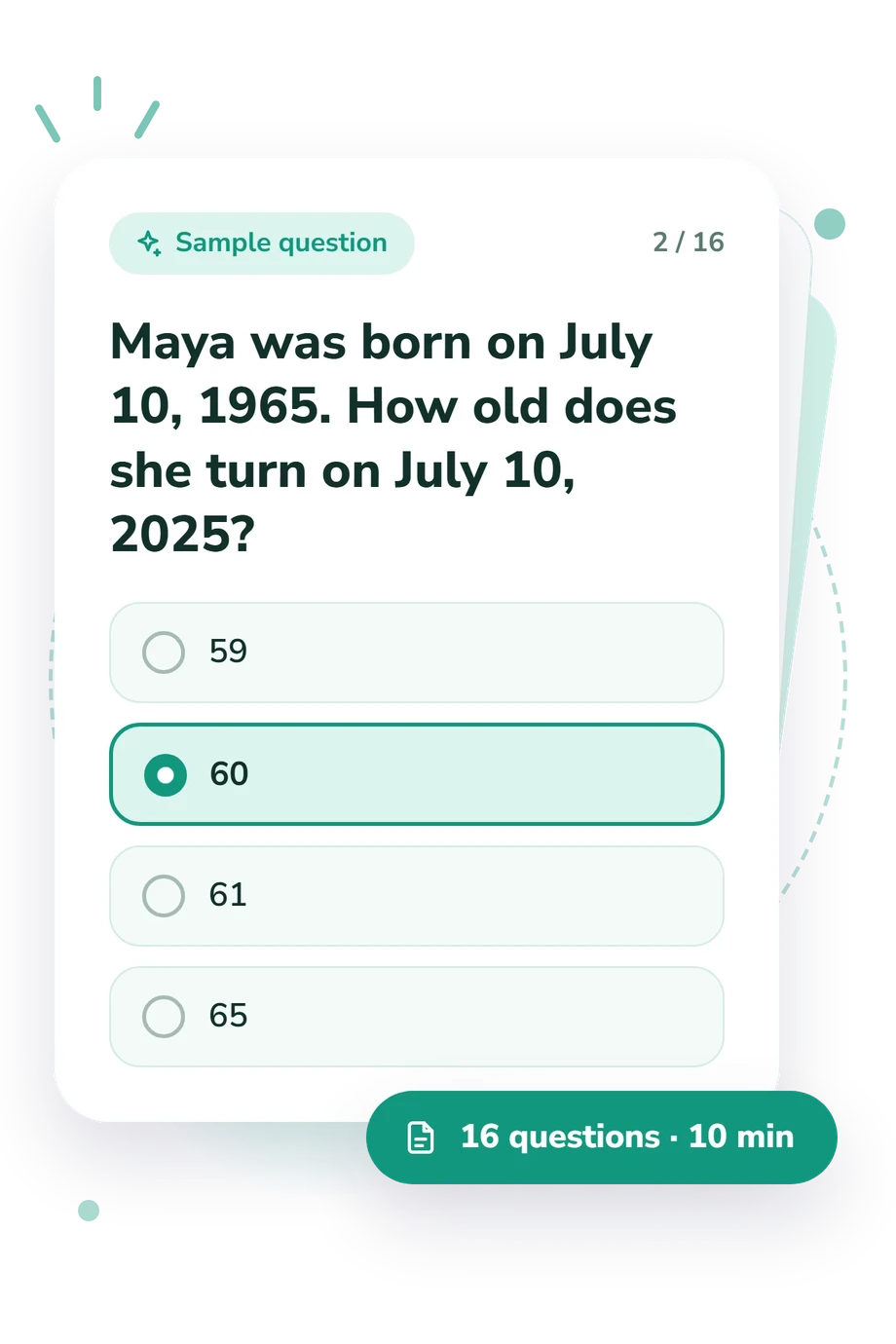
- 59
- 60
- 61
- 65
- Two candles shaped like 30
- A 5 candle followed by a 5 candle
- A 0 candle followed by a 6 candle
- A 6 candle followed by a 0 candle
60th Birthday Quiz - Description and methodology of the test
Designed for readers planning, attending, or simply reflecting on a milestone celebration, this assessment offers a focused way to check assumptions before a gathering. The 60th birthday quiz suits anyone who wants a practical check of familiarity with the number 60. Hosts, guests, family members, and curious learners can use these 60th-birthday quiz questions to apply that knowledge in context.
What This Assessment Explores
The quiz tests knowledge surrounding a 60-year milestone rather than personality or emotional adjustment. The questions cover arithmetic, calendar reasoning, cultural vocabulary, and celebration planning, including 60th birthday trivia. The result shows overall performance; reviewing individual answers, rather than the displayed score, may reveal topics worth exploring.
The displayed result is one knowledge scale scored from 0-16. It describes quiz performance, not a personality trait or emotional state. The levels are:
- 60th Birthday Knowledge (0-16) reflects the number of correct answers.
- Getting Started (0-6) shows recognition of some essentials while leaving room to explore milestone terms, traditions, and calculations.
- Developing Knowledge (7-12) indicates a solid foundation with some details or applications still to master.
- Birthday Trivia Expert (13-16) reflects strong knowledge across the number 60, cultural customs, dates, and practical celebration planning.
Methodology and Scientific Basis
Each item presents one question with four answer choices, and the respondent selects the best answer. The mix of recall and brief reasoning covers age calculation, time conversion, division, terminology, cultural knowledge, and practical judgment. Taken together, the 60th birthday questions apply information to invitations, seating, and accessibility rather than merely recalling a fact.
Scoring is straightforward: the total reflects the number of correct answers and produces a single descriptive result within the three result bands. Guessing, prior exposure, language, and familiarity with particular customs can affect it.
Mary Doi's study of a 60th-birthday ritual and William E. Deal's account of kanreki and the sexagenary cycle provide cultural and calendrical context for the quiz's subject matter, not psychometric validation or population norms for this score. The bands are descriptive categories for this knowledge quiz, and the questionnaire is not presented as an adaptation of those works.
The result describes performance on these items at completion, rather than broader ability or wellbeing.
- Doi, Mary L. (1991). A transformation of ritual: The nisei 60th birthday. Journal of Cross-Cultural Gerontology, 6(2), 153-163. 10.1007/BF00056753
- Matsubayashi, Tetsuya, Myoung-jae Lee, and Michiko Ueda. (2019). Higher Risk of Suicide on Milestone Birthdays: Evidence from Japan. Scientific Reports, 9, 16642. 10.1038/s41598-019-53203-4
- Zhang, He. (2020). The Chinese 60-Day/Year and Mesoamerican 260-Day Calendars: A Comparative Study of Cyclical Calendrical Systems and Cosmology. Sino-Platonic Papers, no. 305, 35 pages.
Updated: