
9th Grade Geography Quiz
How the Scales are Structured
Who Usually Takes This Test?
See How You Compare
Below is a preview of how scores are typically distributed across each scale.
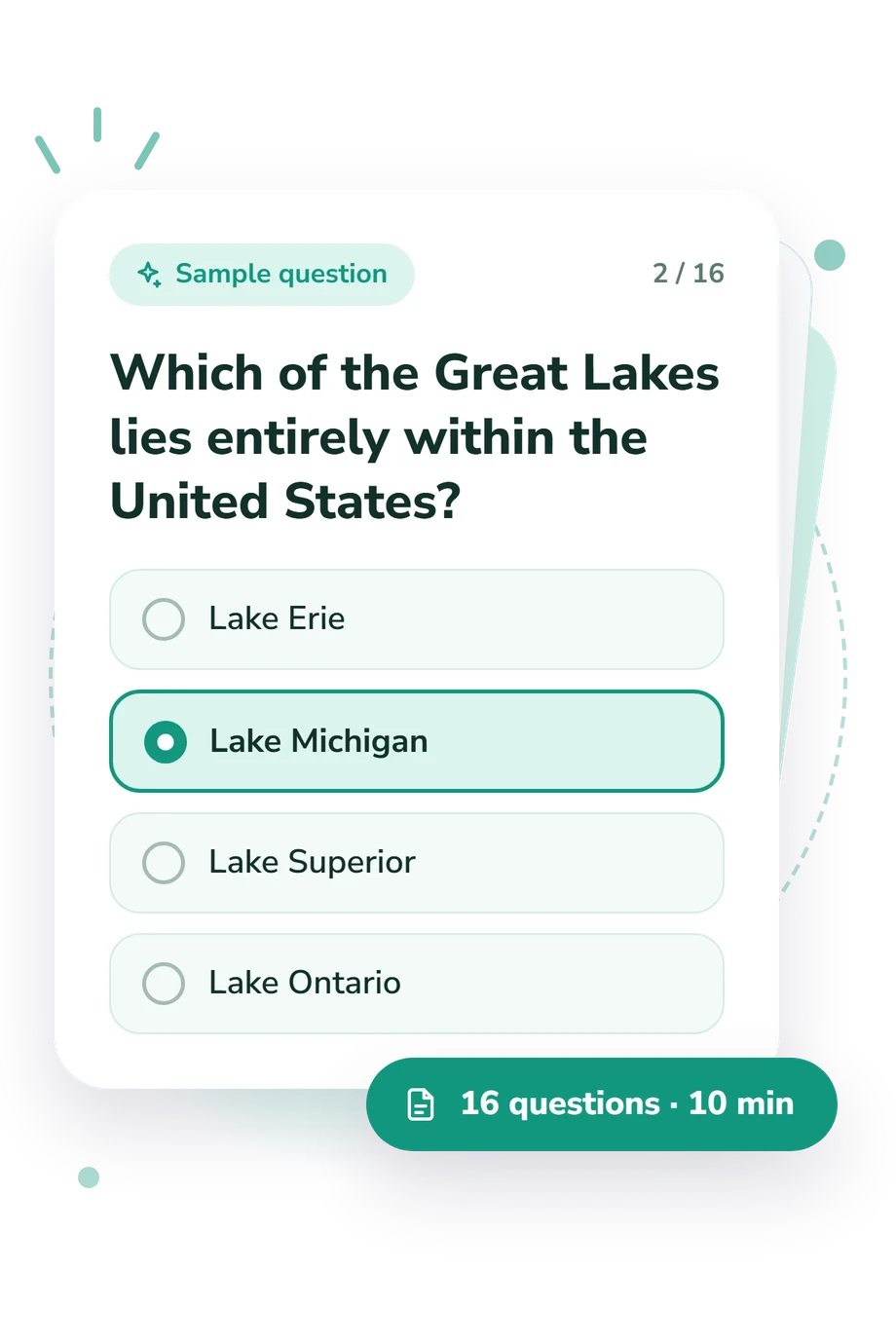
Example Questions From the Test
- Lake Erie
- Lake Michigan
- Lake Superior
- Lake Ontario
- Belize
- Cuba
- Guatemala
- Mexico
- 12:00 noon
- 11:00 a.m.
- 10:00 a.m.
- 1:00 p.m.
9th Grade Geography Quiz - Description and methodology of the test
Students reviewing geography concepts can use a grade 9 geography quiz when they want a check before moving to more advanced coursework. Teachers and adults refreshing school knowledge may value a practice activity. The 9th grade geography quiz gives an overall result to help a learner decide whether to continue, practise, or compare performance with course expectations. It supports that choice without claiming to represent complete geographic knowledge.
What This Assessment Explores
Geography means locating, comparing, and reasoning about places and physical systems. It suits learners revising school material and adults refreshing concepts. Learners using a ninth-grade geography quiz can view the result as performance on sampled situations, not a complete measure of geographic ability.
The assessment groups its content into these dimensions:
- Location and direction show how well you translate descriptions into compass movement, relative position, and routes.
- Regional and political geography indicates how accurately you recognize states, countries, borders, and major places.
- Physical geography measures understanding of rivers, landforms, plate boundaries, climate processes, latitude, and precipitation.
The displayed scale, 9th Grade Geography Knowledge (0-16), uses three bands: Foundations to Build (0-6) marks review; Developing Knowledge (7-12) reflects a useful base; Strong Knowledge (13-16) indicates stronger command of the sampled content. Read the result as a focused snapshot for further study.
Methodology and Evidence Base
Each item presents a situation or knowledge question with four answer choices. The respondent chooses the option that best fits the location, relationship, process, or calculation. This format makes the questionnaire a self-assessment.
Scoring produces a total result across sampled items. Because the questionnaire does not document how answers are weighted beyond the range, interpret the score through the bands rather than infer a formula. The overall band from this 9th grade geography test describes performance on sampled content; topic review should come from the questions or coursework.
Content selection is conceptually consistent with National Geography Standards (Heffron & Downs, 2012), particularly its focus on spatial relationships, physical systems, and geographic reasoning. The National Assessment Governing Board's 2010 framework adds a school-assessment perspective, while Wertheim et al. (2013) stress alignment between tasks and learning goals. The questionnaire is consistent with these frameworks but not a direct adaptation, and its administration is not standardized.
Results offer descriptive bands, not population norms, and no reliability or validity estimates are established. Guessing, instruction, attention, and context may affect performance, so pair it with coursework.
- Heffron, Susan Gallagher, and Roger M. Downs, eds. Geography for Life: National Geography Standards, Second Edition. Washington, DC: National Council for Geographic Education, 2012. ISBN 978-1-884136-41-2.
- National Assessment Governing Board. Geography Framework for the 2010 National Assessment of Educational Progress. Washington, DC: U.S. Department of Education, 2010.
- Wertheim, Jill A., Daniel C. Edelson, and The Road Map Project Assessment Committee. 'A Road Map for Improving Geography Assessment.' The Geography Teacher 10, no. 1 (2013): 15-21. 10.1080/19338341.2012.758044
Updated: