
Am I Badass Quiz
How the Scales are Structured
Who Usually Takes This Test?
See How You Compare
Below is a preview of how scores are typically distributed across each scale.
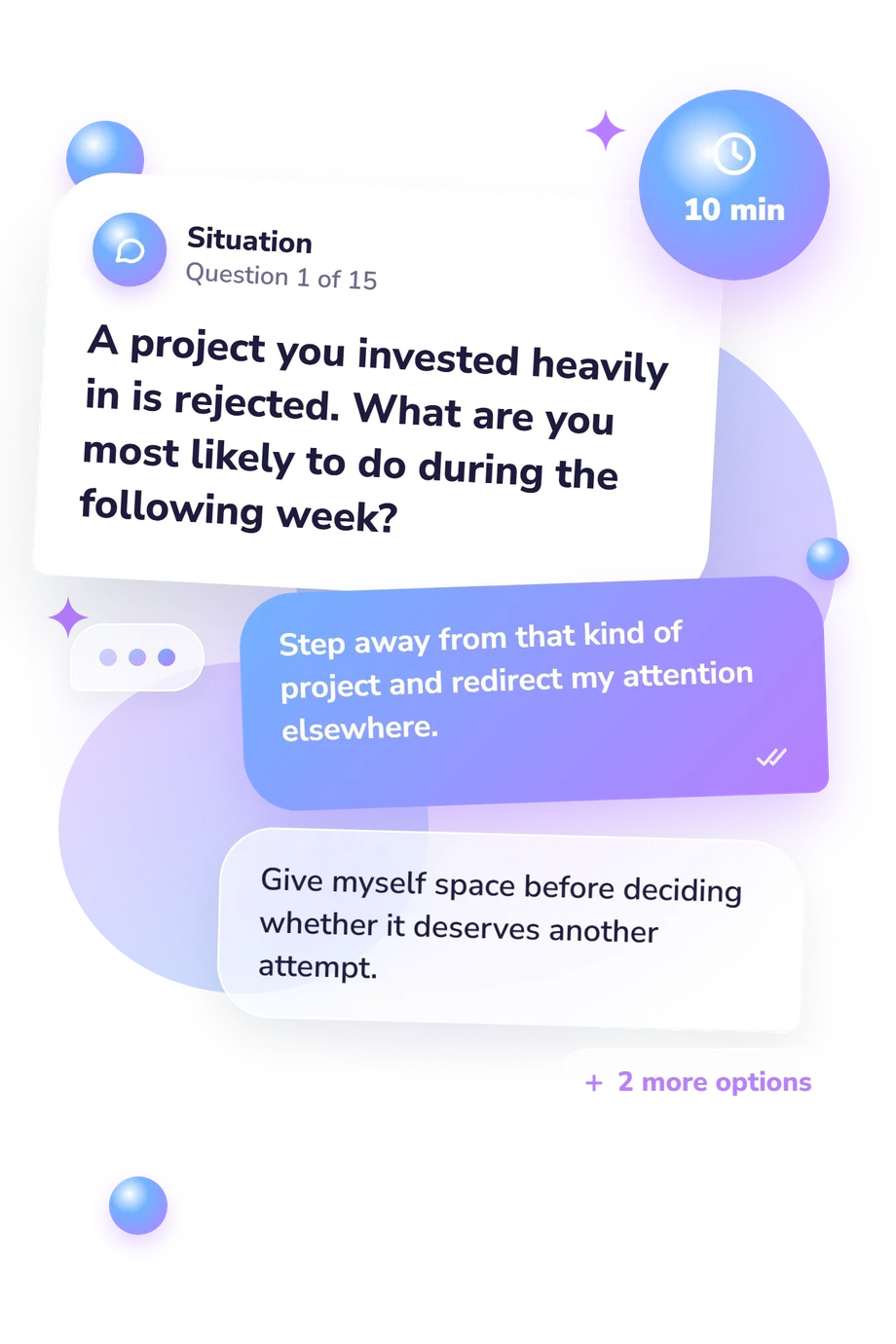
Example Questions From the Test
- Decline for now and develop it until I feel fully prepared.
- Ask whether I can present it at a later date.
- Accept, then focus on making the core argument solid.
- Accept if I can bring notes or a collaborator for support.
- I acknowledge it briefly and continue with much the same energy.
- I recover, though I become more careful for the remainder.
- I keep going but find it difficult to regain my rhythm.
- I shorten my part if possible and prefer to regroup afterward.
- I keep refining the plan until the route feels dependable.
- I choose a small trial so I can test my interest first.
- I tend to leave it as an idea when daily life feels settled.
- I set a near-term start date and learn by doing.
Am I Badass Quiz - Description and methodology of the test
Readers seeking a clearer picture of how they act under uncertainty, recover from setbacks, and handle social pressure can use this assessment for structured self-reflection. The Am I Badass Quiz links everyday choices with three practical dimensions rather than treating “badass” as a fixed identity. That profile can reveal patterns that routine decisions or difficult conversations may conceal. This badass personality test connects goals and relationships to observable patterns in action, recovery, and independence.
What This Assessment Explores
Scenarios place initiative, recovery, and self-definition in ordinary moments: imperfect opportunities, mistakes, disrupted plans, criticism, unfamiliar experiences, and group disagreement. The assessment is for readers exploring everyday patterns, not for assigning a fixed identity.
The displayed dimensions are:
- Bold Action (0-15) shows how you initiate and move through uncertainty; Deliberate Starter (0-5), Selective Risk-Taker (6-10), and Bold Initiator (11-15) are the bands.
- Comeback Grit (0-15) shows how you re-engage after setbacks; Protective Reset (0-5), Adaptive Rebuilder (6-10), and Persistent Comeback (11-15) are the bands.
- Independent Presence (0-15) shows how you hold preferences and limits when approval pulls elsewhere; Harmony-Oriented (0-5), Grounded Adapter (6-10), and Self-Directed Presence (11-15) are the bands.
Together, the profile describes style rather than worth. A bold action assessment is best interpreted in context, since caution, persistence, and independence can each be useful.
Methodology and Scientific Basis
Each item presents a personal or social scenario with four response options. Choices range from preserving stability or stepping back to acting, adjusting, speaking up, or continuing. Responses combine into three displayed scores; each can be converted to a percentage by dividing by 15 and multiplying by 100. This badass quiz makes the direct question-how badass am I?-more useful by tying it to observable choices rather than a label.
The closest conceptual reference is the Woodard-Pury Courage Scale-23, which addresses action under uncertainty. Recovery relates to the Brief Resilience Scale, while self-congruence connects with the Authenticity Scale. Duckworth et al. add a lens on sustained effort. These sources clarify the constructs, but this online questionnaire is not an adaptation of those instruments and has no published norms; it provides descriptive scores rather than normed comparisons with a reference population.
Because it relies on self-report, current mood, self-awareness, and sensitivity to approval can shape answers. The percentages and bands do not establish clinical cutoffs, so interpretation is strongest when compared with actual behavior across more than one situation.
- Woodard, C. R., & Pury, C. L. S. (2007). The construct of courage: Categorization and measurement. Consulting Psychology Journal: Practice and Research, 59(2), 135-147. 10.1037/1065-9293.59.2.135
- Smith, B. W., Dalen, J., Wiggins, K., Tooley, E., Christopher, P., & Bernard, J. (2008). The brief resilience scale: Assessing the ability to bounce back. International Journal of Behavioral Medicine, 15(3), 194-200. 10.1080/10705500802222972
- Wood, A. M., Linley, P. A., Maltby, J., Baliousis, M., & Joseph, S. (2008). The authentic personality: A theoretical and empirical conceptualization and the development of the Authenticity Scale. Journal of Counseling Psychology, 55(3), 385-399. 10.1037/0022-0167.55.3.385
- Duckworth, A. L., Peterson, C., Matthews, M. D., & Kelly, D. R. (2007). Grit: Perseverance and passion for long-term goals. Journal of Personality and Social Psychology, 92(6), 1087-1101. 10.1037/0022-3514.92.6.1087
Updated: