
Am I Gifted and Talented Quiz
How the Scales are Structured
Who Usually Takes This Test?
See How You Compare
Below is a preview of how scores are typically distributed across each scale.
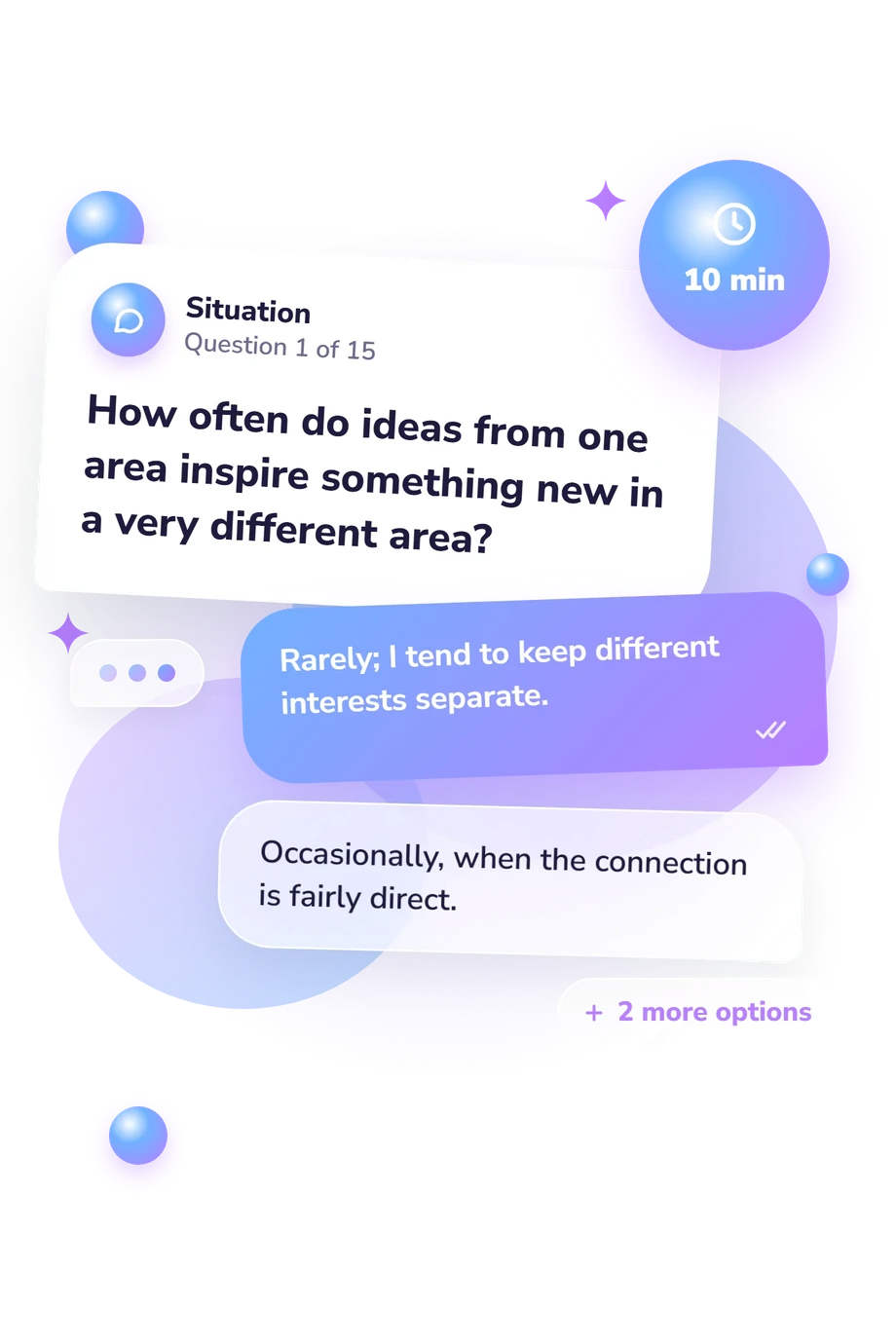
Example Questions From the Test
- Rarely; I tend to keep different interests separate.
- Occasionally, when the connection is fairly direct.
- Often; I enjoy combining methods or themes from different areas.
- Very often; unexpected cross-connections are a major source of my ideas.
- I infer the likely structure, test my interpretation, and revise the model if needed.
- I identify the missing pieces and make reasonable assumptions about some of them.
- I follow the parts that are clear and wait for guidance on the rest.
- I prefer not to begin until the instructions are complete.
- The direct sequence of events or stated facts.
- A few implications beyond what is explicitly stated.
- Patterns in motives, structure, or cause and effect.
- Several interacting layers, including assumptions, themes, and alternative interpretations.
Am I Gifted and Talented Quiz - Description and methodology of the test
For anyone wondering whether their thinking style fits common ideas about giftedness, the Am I Gifted and Talented Quiz offers a structured way to examine everyday patterns across reasoning, creativity, and learning. This giftedness self-assessment suits readers who want to reflect on how they reason, create, and learn. Its profile can help you compare those patterns across the three areas.
What This Assessment Explores
The questionnaire explores ambiguity, connections, alternatives, and learning beyond immediate demands. It suits readers reflecting on reasoning, creativity, and learning habits. This giftedness questionnaire separates the themes so you can compare aligned or contrasting patterns. The dimensions are:
- Cognitive Complexity and Pattern Reasoning (0-15) shows how readily you look for structure, layers, and connections when information is incomplete or difficult. The result is Concrete focus (0-5), Flexible complexity (6-10), or Strong complexity affinity (11-15).
- Creative and Divergent Expression (0-15) reflects how you adapt, combine, and generate ideas in open-ended situations. The result is Established-path expression (0-5), Adaptive creator (6-10), or Divergent expression (11-15).
- Learning Drive and Depth (0-15) shows how curiosity develops into sustained, self-directed investigation. The result is Selective curiosity (0-5), Active learner (6-10), or Deep learning drive (11-15).
Methodology and Evidence Base
Each item in this giftedness quiz offers four response choices describing different habitual approaches. They cover incomplete instructions, unfamiliar problems, cross-domain connections, open-ended creation, and sustained learning. This format asks you to recognize your usual pattern rather than complete a timed performance task.
The questionnaire reports three thematic profile scores rather than a single total. Read them together: similar results may indicate broadly aligned patterns, while differences can show that the three tendencies are not equally prominent in your self-description.
The approach is conceptually consistent with SRBCSS (Renzulli and Hartman, 1971), which attends to behaviors associated with advanced performance, and with Renzulli’s (1978) view of giftedness as more than a narrow ability score. Its emphasis on curiosity and complexity also overlaps with need for cognition described by Cacioppo, Petty, and Kao (1984), but this questionnaire is not that published instrument or a direct adaptation.
Self-report can shift with current stress, confidence, self-awareness, language, disability, educational access, responsibilities, and opportunities to practise; the three scores do not measure intelligence or establish giftedness.
- Renzulli, Joseph S., and Hartman, Robert K. (1971). Scale for Rating Behavioral Characteristics of Superior Students. Exceptional Children, 38(3), 243-248. 10.1177/001440297103800309
- Renzulli, Joseph S., Smith, Linda H., White, Alan J., Callahan, Carolyn M., Hartman, Robert K., and Westberg, Karen L. (2002). Scales for Rating the Behavioral Characteristics of Superior Students: Technical and Administration Manual, Revised Edition. Mansfield Center, CT: Creative Learning Press, Inc. ISBN: 0-936386-90-8
- Renzulli, Joseph S. (1978). What Makes Giftedness? Reexamining a Definition. Phi Delta Kappan, 60(3), 180-184, 261.
- Cacioppo, John T., Petty, Richard E., and Kao, Chuan Feng. (1984). The Efficient Assessment of Need for Cognition. Journal of Personality Assessment, 48(3), 306-307. 10.1207/s15327752jpa4803_13
Updated: