
Adverb Clauses Quiz
How the Scales are Structured
Who Usually Takes This Test?
See How You Compare
Below is a preview of how scores are typically distributed across each scale.
Example Questions From the Test
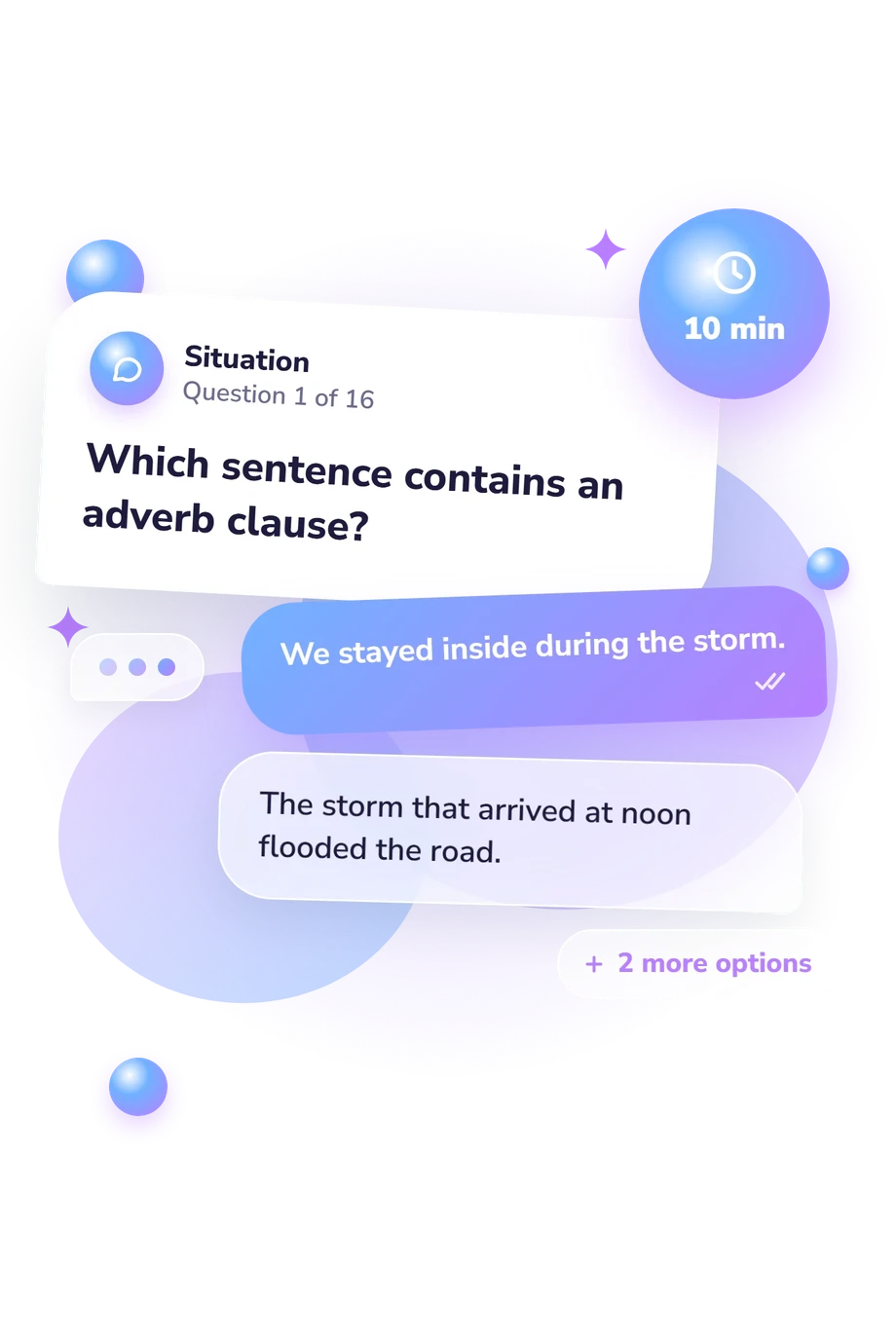
- We stayed inside during the storm.
- The storm that arrived at noon flooded the road.
- We knew that the road was closed.
- We stayed inside because the storm intensified.
- even though
- so that
- whenever
- as if
- that we walked very slowly
- so icy
- The path
- very slowly
Adverb Clauses Quiz - Description and methodology of the test
For learners who want a clearer command of complex sentences, this assessment connects grammatical form with meaning in context. The adverb clauses quiz is useful when you are reviewing subordinators, clause boundaries, or punctuation and want a focused picture of current understanding. It suits independent study and classroom revision because its adverb clause exercises cover these relationships and the overall result can guide focused review.
What This Assessment Measures
An adverb clause is a dependent clause that modifies a main clause and expresses cause, purpose, time, condition, concession, place, or result. The questions test recognition of these relationships, connector meaning, clause boundaries, and grammatical sentence completion. A quiz on adverbial clauses keeps attention on how clauses function in context.
Your single overall result reflects performance across the skills covered:
- Adverb Clauses Knowledge (0-16) summarizes how consistently you identify, interpret, and use adverb clauses: Foundation Building (0-6) signals review, Developing Knowledge (7-12) shows common forms with less familiar relationships to strengthen, and Strong Knowledge (13-16) reflects consistent recognition, interpretation, and use across contexts.
- Questions about relationships ask you to distinguish cause, purpose, condition, contrast, time, place, and result.
- Questions about sentence application ask you to complete, rephrase, punctuate, and revise clauses accurately.
Methodology and Evidence Base
Each item presents a sentence, sentence frame, or multiple-choice interpretation with four options. Questions test connector choice, clause identification, meaning, punctuation, implied subjects, and equivalent sentences. The questionnaire produces one displayed knowledge result covering the sampled skills; it does not present a separate score for each topic.
As an adverb clause test, this is a focused achievement measure. Greenbaum and Nelson (1996) describe corpus-based English usage, Haegeman (2010) examines how these clauses are formed, and Huddleston and Pullum provide a broader descriptive grammar framework for subordination and adverbial meaning. The questionnaire is conceptually consistent with these works but is not a direct adaptation or standardized administration of any one of them.
Read the bands as descriptions of knowledge of the tested content, not population norms. Results can vary with prior instruction, grammatical vocabulary, attention, and the examples selected. Use the outcome to target review of subordinators, clause boundaries, punctuation, and the tested relationships.
- Greenbaum, Sidney, and Gerald Nelson. "Positions of adverbial clauses in British English." World Englishes, 15(1), 1996, 69-81. 10.1111/j.1467-971X.1996.tb00093.x
- Haegeman, Liliane. "The internal syntax of adverbial clauses." Lingua, 120(3), 2010, 628-648. 10.1016/j.lingua.2008.07.007
- Huddleston, Rodney D., and Geoffrey K. Pullum. The Cambridge Grammar of the English Language. Cambridge University Press, 2002. ISBN 9780521431460
Updated: