
Binary Compound Quiz
How the Scales are Structured
Who Usually Takes This Test?
See How You Compare
Below is a preview of how scores are typically distributed across each scale.
Example Questions From the Test
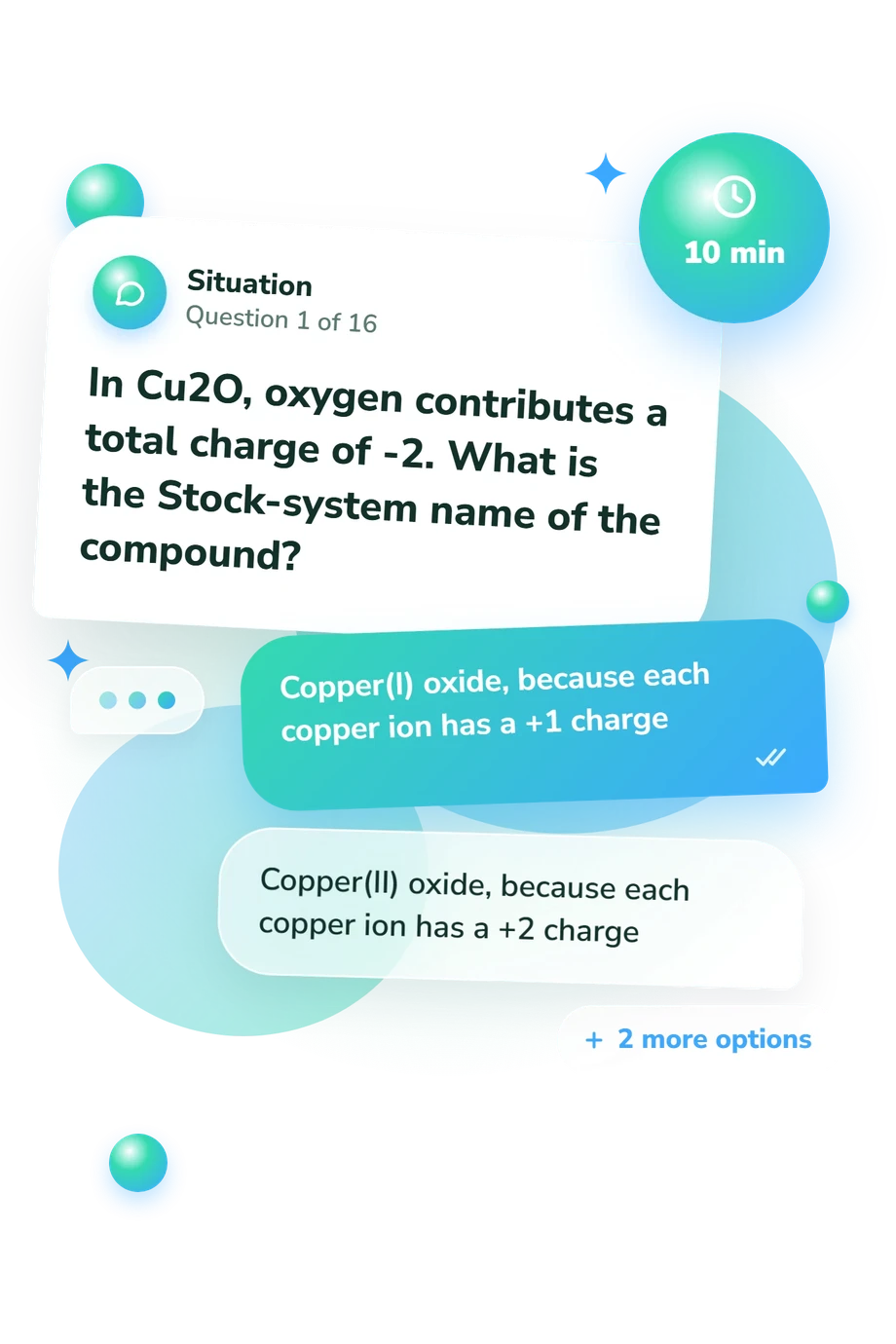
- Copper(I) oxide, because each copper ion has a +1 charge
- Copper(II) oxide, because each copper ion has a +2 charge
- Dicopper oxide, using molecular prefixes for an ionic compound
- Copper(I) dioxide, incorrectly indicating two oxygen atoms
- H2O only, excluding carbon monoxide
- NaOH and CaCO3, despite each containing three elements
- All four compounds, regardless of the number of elements
- H2O and CO, because each contains exactly two elements
- A compound made from two identical ions
- A mixture of two substances in any proportion
- A molecule containing exactly two atoms
- A pure substance containing exactly two different elements
Binary Compound Quiz - Description and methodology of the test
Students reviewing naming rules, ion charges, and formulas need a focused way to see which parts of binary-compound chemistry are secure. Biology Quiz Questions and Answers for Class 10 is a chemistry-focused check, despite the broader wording of its title. It suits learners who want to connect definitions with formula writing and use the result to guide targeted revision. A grade 10 chemistry quiz can show what deserves attention next.
What This Assessment Explores
Binary compounds contain exactly two different elements, and the questions test whether learners can recognize that definition in formulas rather than merely count atoms. They suit students consolidating inorganic nomenclature, charge reasoning, and formula writing. As a binary compounds quiz, the assessment links recall with applications involving names, formulas, oxidation states, and properties.
The result is reported as Binary Compound Knowledge (0-16), reflecting one knowledge dimension. Its displayed bands are Foundation to Build (0-6), Developing Knowledge (7-12), and Strong Knowledge (13-16). These questions cover four areas:
- Identifying binary substances means separating two-element compounds from formulas containing three or more elements.
- Balancing ionic formulas means matching positive and negative charges to produce a neutral compound.
- Applying naming rules means using Stock notation, oxidation states, and molecular prefixes accurately.
- Using properties means linking melting behavior and electrical conductivity with ionic or molecular classification.
Methodology and Scientific Basis
Each prompt presents a formula, naming task, charge problem, classification question, or property-based scenario with four answer choices. Correct selection depends on reading subscripts, prefixes, charges, oxidation states, and property clues rather than guessing.
A learner using binary compound practice questions can locate gaps in definitions, nomenclature, formula construction, and classification. Responses combine into one educational result; the bands indicate whether understanding is foundational, developing, or strong.
The scientific reference point is IUPAC Red Book (Connelly et al., 2005), which supports the treatment of inorganic names, oxidation states, and Stock notation. Chemistry 2e and the IUPAC Gold Book provide compatible explanations of binary compounds, ionic charge, molecular prefixes, and terminology. This questionnaire is conceptually consistent with those works, not an adaptation of them.
No norm group or psychometric standardization is stated for this online quiz, so the result is a focused learning indicator rather than a norm-referenced measure. Recent teaching, symbol familiarity, careful reading, and guessing can influence performance; reviewing the underlying rules alongside the result gives a more useful picture.
- Connelly, Neil G., Ture Damhus, Richard M. Hartshorn, and Alan T. Hutton, editors. Nomenclature of Inorganic Chemistry: IUPAC Recommendations 2005. Royal Society of Chemistry, Cambridge, 2005. ISBN 0-85404-438-8.
- Flowers, Paul, Klaus Theopold, Richard Langley, and William R. Robinson. Chemistry 2e. OpenStax, Houston, 2019. Chapter 2.7, Chemical Nomenclature.
- IUPAC. Compendium of Chemical Terminology, 2nd ed. (the Gold Book). Compiled by Alan D. McNaught and Andrew Wilkinson. Blackwell Scientific Publications, Oxford, 1997. 10.1351/goldbook.
Updated: