
Am I Afraid of Love Quiz
How the Scales are Structured
Who Usually Takes This Test?
See How You Compare
Below is a preview of how scores are typically distributed across each scale.
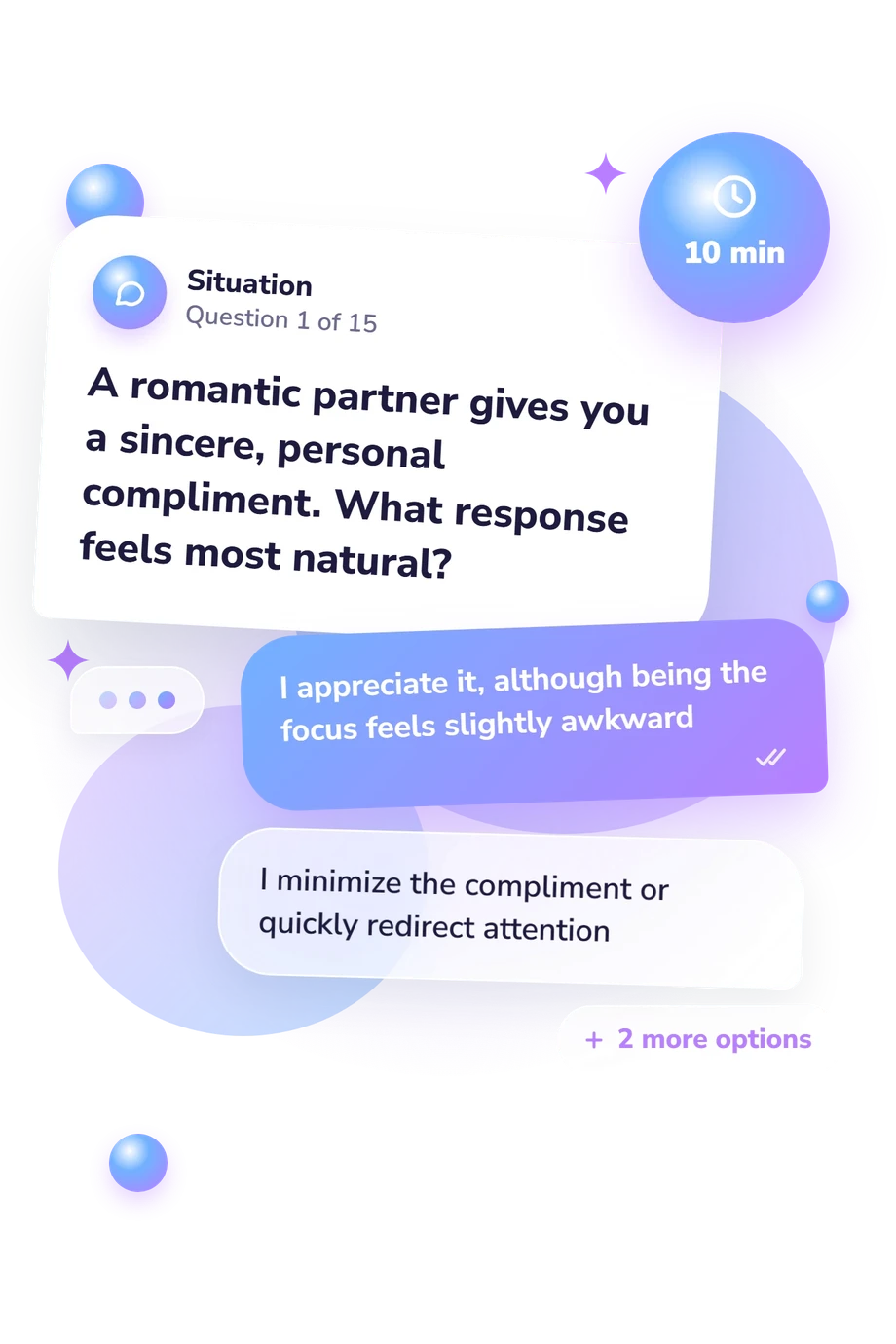
Example Questions From the Test
- I appreciate it, although being the focus feels slightly awkward
- I minimize the compliment or quickly redirect attention
- I let myself take it in and respond genuinely
- I wonder what prompted it and struggle to fully accept it
- Meaningful and manageable, even though it carries weight
- So exposing that I would rather avoid saying it
- Exciting, with some nerves about choosing the right moment
- Like something I should delay until I can feel completely certain
- Assume they are occupied and continue with my day
- Expect that they are losing interest and become distant myself
- Wonder about it, but wait for more information
- Review recent conversations for signs that something changed
Am I Afraid of Love Quiz - Description and methodology of the test
People who feel scared of love may still want a close relationship, and this assessment helps examine that tension without reducing it to a fixed trait. It is intended for anyone reflecting on dating or commitment, especially when affection, trust, or independence becomes difficult to balance. The Am I Afraid of Love Quiz connects those experiences with patterns that can be considered in context.
What This Assessment Explores
Across its scenarios, the am I scared of love quiz treats romantic fear as several patterns, not one fixed trait. Situations involving compliments, saying “I love you,” increased contact, future plans, disagreement, and hurt reveal how a respondent handles closeness, expression, independence, and uncertainty. The result shows whether distance is more closely associated with protecting independence, guarding emotional exposure, or anticipating hurt.
The three dimensions are:
- Closeness and Autonomy (0-15) shows whether intimacy coexists with identity: Closeness feels compatible (0-5), Space-conscious connection (6-10), or Closeness feels constraining (11-15).
- Emotional Vulnerability (0-15) indicates how readily affection and hurt can be expressed and received: Comfortable expression (0-5), Selective openness (6-10), or Strong emotional guard (11-15).
- Trust and Anticipated Hurt (0-15) reflects whether consistency supports trust or ambiguity suggests danger: Trust can develop (0-5), Watchful trust (6-10), or Hurt expected (11-15).
Methodology and Scientific Basis
Each item presents a relationship situation with four response options, ranging from open, trusting, or comfortable reactions to responses marked by distance, concealment, monitoring, or anticipated hurt. The choices ask for the reaction that feels most natural, so the format captures tendencies across contrasting situations rather than requiring one global judgment.
The displayed scores are unvalidated reflective summaries across the three dimensions, each accompanied by three interpretive bands rather than clinical cutoffs. Their conceptual reference is the Fear-of-Intimacy Scale (Descutner & Thelen, 1991), a published measure concerned with discomfort around emotional closeness. The replication by Doi and Thelen (1993) offers related evidence, while Bartholomew and Horowitz’s four-category attachment model helps situate themes of trust, distance, and expectations within an emotional connection. This questionnaire is conceptually consistent with those works, not an adaptation of them.
The format gives the questionnaire a structured way to support self-reflection, but its scores have not been established as standardized measures of severity. Because answers depend on self-report, current mood, recent experiences, and self-awareness may shape the pattern; the bands are best read as prompts for context-rich reflection rather than standalone conclusions.
- Descutner, Carol J., and Mark H. Thelen. "Development and Validation of a Fear-of-Intimacy Scale." Psychological Assessment, 3(2), 218-225, 1991. 10.1037/1040-3590.3.2.218
- Doi, Susan C., and Mark H. Thelen. "The Fear-of-Intimacy Scale: Replication and Extension." Psychological Assessment, 5(3), 377-383, 1993. 10.1037/1040-3590.5.3.377
- Bartholomew, Kim, and Leonard M. Horowitz. "Attachment Styles Among Young Adults: A Test of a Four-Category Model." Journal of Personality and Social Psychology, 61(2), 226-244, 1991. 10.1037/0022-3514.61.2.226
Updated: